Review
. 2017 Sep 14;4(3):67.
doi: 10.3390/medicines4030067.

Esophageal Cancer: Genomic and Molecular Characterization, Stem Cell Compartment and Clonal Evolution

Affiliations
Review

Esophageal Cancer: Genomic and Molecular Characterization, Stem Cell Compartment and Clonal Evolution

Ugo Testa et al. Medicines (Basel). .

Abstract

Esophageal cancer (EC) is the eighth most common cancer and is the sixth leading cause of death worldwide. The incidence of histologic subtypes of EC, esophageal adenocarcinoma (EAC) and esophageal squamous carcinoma (ESCC), display considerable geographic variation. EAC arises from metaplastic Barrett's esophagus (BE) in the context of chronic inflammation secondary to exposure to acid and bile. The main risk factors for developing ESCC are cigarette smoking and alcohol consumption. The main somatic genetic abnormalities showed a different genetic landscape in EAC compared to ESCC. EAC is a heterogeneous cancer dominated by copy number alterations, a high mutational burden, co-amplification of receptor tyrosine kinase, frequent TP53 mutations. The cellular origins of BE and EAC are still not understood: animal models supported a cellular origin either from stem cells located in the basal layer of esophageal epithelium or from progenitors present in the cardia region. Many studies support the existence of cancer stem cells (CSCs) able to initiate and maintain EAC or ESCC. The exact identification of these CSCs, as well as their role in the pathogenesis of EAC and ESCC remain still to be demonstrated. The reviewed studies suggest that current molecular and cellular characterization of EAC and ESCC should serve as background for development of new treatment strategies.

Keywords: Barrett’s disease; cancer stem cells; esophageal cancer; gene expression profiling; gene sequencing; tumor xenotrasplantation assay.


Conflict of interest statement

The authors declare no conflict of interest.

Figures
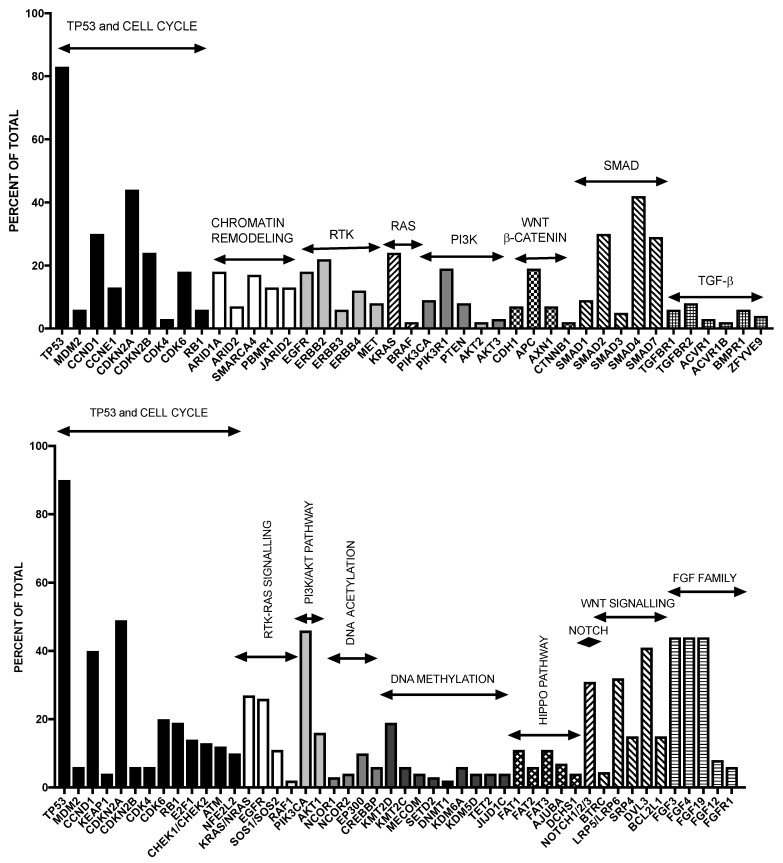
Figure 1
Figure 1
Frequency of the main genetic alterations observed in esophageal adenocarcinoma (EAC) (top panel) and in esophageal squamous carcinoma (ESCC) (bottom panel). The figure reports the cumulated frequency of both mutations and copy number alterations for the various genes indicated. The top panel is based on results reported by Dulak et al. [7] and Secrier et al. [9]. The bottom panel is based on data reported by Liu et al. [10], Song et al. [11], Gao et al. [12], Cheng et al. [13].
Figure 2
Figure 2
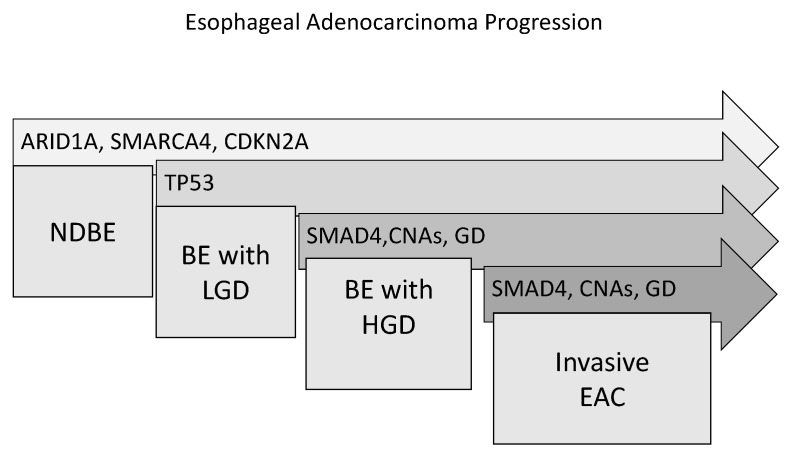
Model describing the progressive occurrence and accumulation of genetic alterations during the progression from non-dysplastic Barrett’s esophagus to invasive EAC, through the intermediate stages first of Barrett’s esophagus (BE) with low-grade dysplasia (LGD) and then BE with high-grade dysplasia (HGD). This model is based on results of studies reported by Weaver et al. [25] and Ross-Ines et al. [26].
Figure 3
Figure 3
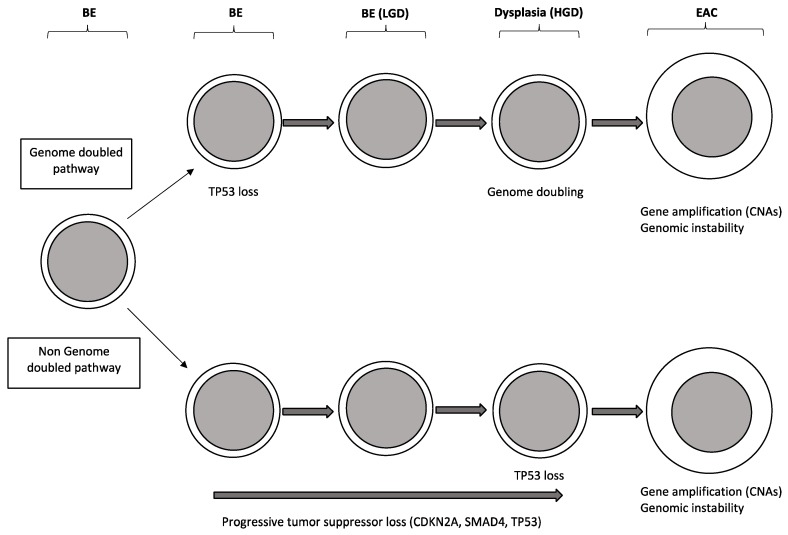
Schematic representation of two possible pathways of BE progression to EAC. The top model shows the tumor progression pathway involving genome doubling: this pathway implies the early occurrence of TP53; the genome doubling leads to genomic instability, oncogene amplification with frequent copy number alterations and aneuploidy. The bottom model shows the BE progression to EAC involving the gradual and progressive accumulation of tumor suppressor losses, followed by activation of oncogenes and development of genomic instability. Abbreviations: CAN: copy number alteration; BE: Barrett’s esophagus; LGD: low-grade dysplasia; HGD: high-grade dysplasia. This model is based on data reported by Stachler et al. [27].
Figure 4
Figure 4
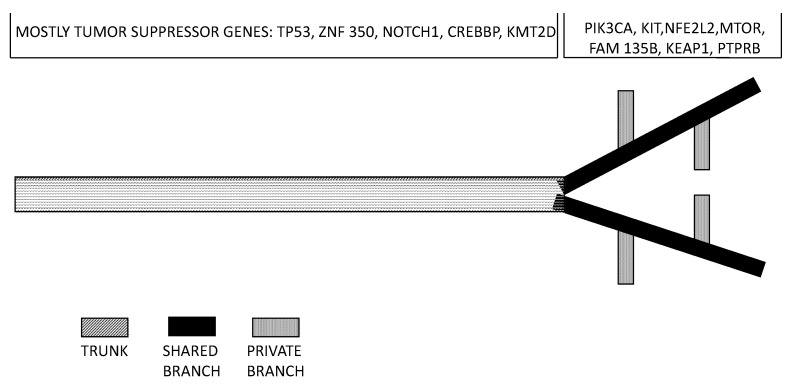
Intra-tumor heterogeneity of somatic mutations in ESCCs, as evaluated by multiregion whole-exome sequencing. The analysis of the mutational spectrum observed in different tumor regions allows the construction of a phylogenetic tree indicating the tumor evolution. In these phylogenetic trees, variable from one tumor to another, the trunk is defined as the initial clone, at the level of which are observed the initial genetic driver events responsible for tumor development; from this initial trunk, one or more branches are derived, maintaining some of the typical driver events observed in the trunk; finally, from the shared branches, one or more private branches may derive, characterized by the presence of mutations observed only in this tumor region. The result of this intra-tumor evolutionary process consists in an increase of tumor heterogeneity and by the development of a process generating multiple tumor regions with different biologic properties from a single initial tumor. On the top are reported the genes most frequently altered during the initial (trunk) and later (shared and private branches) phases of spatial-temporal development of ESCCs.

References

    1. Holmes R.S., Vaughan T.L. Epidemiology and pathogenesis of esophageal cancer. Semin. Radiat. Oncol. 2007;17:2–9. doi: 10.1016/j.semradonc.2006.09.003. - DOI - PubMed
    1. Lagergren J., Smyth E., Cunningham D., Lagergren P. Oesophageal cancer. Lancet. 2017 doi: 10.1016/S0140-6736(17)31462-9. in press. - DOI - PubMed
    1. Smyth E.C., Lagergren J., Fitzgerald R.C., Lordick F., Shah M.A., Lagergren P., Cunningham D. Oesophageal cancer. Nat. Rev. Dis. Primers. 2017;3:17048. doi: 10.1038/nrdp.2017.48. - DOI - PMC - PubMed
    1. Contino G., Vaughan T.L., Whiteman D., Fitzgerald R.C. The evolving genomic landscape of Barrett’s esophagus and esophageal adenocarcinoma. Gastroenterology. 2017;153:657–673. doi: 10.1053/j.gastro.2017.07.007. - DOI - PMC - PubMed
    1. Lordick E., Kang J.K., Chung H.C., Salman P., Oh S.C., Bodoky G., Kurteva G., Volovat C., Moiseyenko V.M., Gorbunova V., et al. Capecitabine and cisplatin with or without cetuximab for patients with previously untreated advanced gastric cancer (EXPAND): A randomized, open-label phase 3 trial. Lancet Oncol. 2013;14:490–499. doi: 10.1016/S1470-2045(13)70102-5. - DOI - PubMed

LinkOut - more resources