The clinical and microbiological characteristics of enteric fever in Cambodia, 2008-2015
- PMID: 28931025
- PMCID: PMC5624643
- DOI: 10.1371/journal.pntd.0005964
The clinical and microbiological characteristics of enteric fever in Cambodia, 2008-2015
Abstract
Background: Enteric fever remains a major public health problem in low resource settings and antibiotic resistance is increasing. In Asia, an increasing proportion of infections is caused by Salmonella enterica serovar Paratyphi A, which for a long time was assumed to cause a milder clinical syndrome compared to Salmonella enterica serovar Typhi.
Methodology: A retrospective chart review study was conducted of 254 unique cases of blood culture confirmed enteric fever who presented at a referral adult hospital in Phnom Penh, Cambodia between 2008 and 2015. Demographic, clinical and laboratory data were collected from clinical charts and antibiotic susceptibility testing was performed. Whole genome sequence analysis was performed on a subset of 121 isolates.
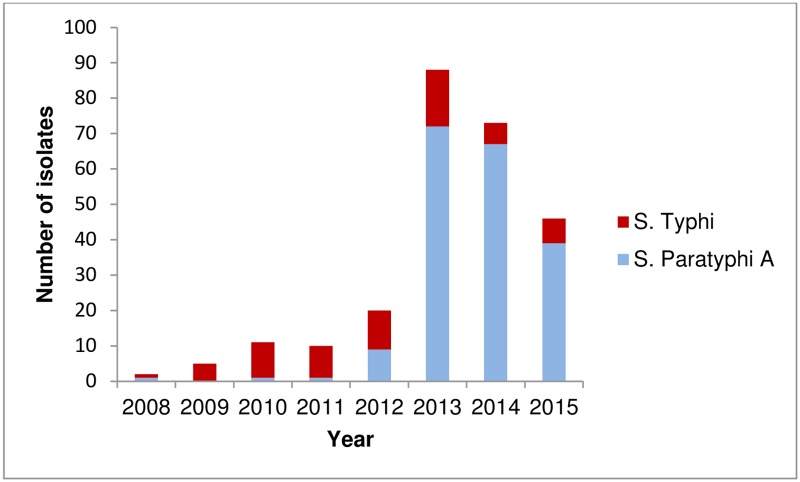
Results: One-hundred-and-ninety unique patients were diagnosed with Salmonella Paratyphi A and 64 with Salmonella Typhi. In the period 2008-2012, Salmonella Paratyphi A comprised 25.5% of 47 enteric fever cases compared to 86.0% of 207 cases during 2013-2015. Presenting symptoms were identical for both serovars but higher median leukocyte counts (6.8 x 10⁹/L vs. 6.3 x 10⁹/L; p = 0.035) and C-reactive protein (CRP) values (47.0 mg/L vs. 36 mg/L; p = 0.034) were observed for Salmonella Typhi infections. All but one of the Salmonella Typhi isolates belonged to haplotype H58 associated with multidrug resistance (MDR) (i.e. resistance to ampicillin, chloramphenicol and co-trimoxazole).;42.9% actually displayed MDR compared to none of the Salmonella Paratyphi A isolates. Decreased ciprofloxacin susceptibility (DCS) was observed in 96.9% (62/64) of Salmonella Typhi isolates versus 11.5% (21/183) of Salmonella Paratyphi A isolates (all but one from 2015). All isolates were susceptible to azithromycin and ceftriaxone.
Conclusions: In Phnom Penh, Cambodia, Salmonella Paratyphi A now causes the majority of enteric fever cases and decreased susceptibility against ciprofloxacin is increasing. Overall, Salmonella Typhi was significantly more associated with MDR and DCS compared to Salmonella Paratyphi A.
Conflict of interest statement
The authors have declared that no competing interests exist.
Figures
References
-
- Bhan MK, Bahl R, Bhatnagar S. Typhoid and paratyphoid fever. Lancet. 2005;366(9487):749–62. doi: 10.1016/S0140-6736(05)67181-4 - DOI - PubMed
-
- Meltzer E, Sadik C, Schwartz E. Enteric fever in Israeli travelers: a nationwide study. J Travel Med. 2005;12(5):275–81. - PubMed
-
- Maskey AP, Day JN, Phung QT, Thwaites GE, Campbell JI, Zimmerman M, et al. Salmonella enterica serovar Paratyphi A and S. enterica serovar Typhi cause indistinguishable clinical syndromes in Kathmandu, Nepal. Clin Infect Dis. 2006;42(9):1247–53. doi: 10.1086/503033 - DOI - PubMed
-
- Vollaard AM, Ali S, Widjaja S, Asten HA, Visser LG, Surjadi C, et al. Identification of typhoid fever and paratyphoid fever cases at presentation in outpatient clinics in Jakarta, Indonesia. Trans R Soc Trop Med Hyg. 2005;99(6):440–50. doi: 10.1016/j.trstmh.2004.09.012 - DOI - PubMed
-
- Parry CM, Hien TT, Dougan G, White NJ, Farrar JJ. Typhoid fever. N Engl J Med. 2002;347(22):1770–82. doi: 10.1056/NEJMra020201 - DOI - PubMed
MeSH terms
Substances
LinkOut - more resources
Full Text Sources
Other Literature Sources
Research Materials
Miscellaneous