


The efficacy of initial ventilation strategy for adult immunocompromised patients with severe acute hypoxemic respiratory failure: study protocol for a multicentre randomized controlled trial (VENIM)
- PMID: 28931394
- PMCID: PMC5607592
- DOI: 10.1186/s12890-017-0467-6
The efficacy of initial ventilation strategy for adult immunocompromised patients with severe acute hypoxemic respiratory failure: study protocol for a multicentre randomized controlled trial (VENIM)
Abstract
Background: Acute respiratory failure (ARF) is still one of the most severe complications in immunocompromised patients. Our previous systematic review showed noninvasive mechanical ventilation (NIV) reduced mortality, length of hospitalization and ICU stay in AIDS/hematological malignancy patients with relatively less severe ARF, compared to invasive mechanical ventilation (IMV). However, this systematic review was based on 13 observational studies and the quality of evidence was low to moderate. The efficacy of NIV in more severe ARF and in patients with other causes of immunodeficiency is still unclear. We aim to determine the efficacy of the initial ventilation strategy in managing ARF in immunocompromised patients stratified by different disease severity and causes of immunodeficiency, and explore predictors for failure of NIV.
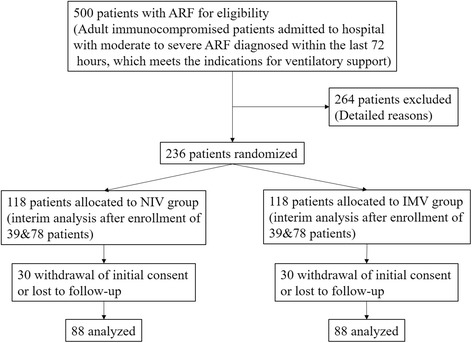
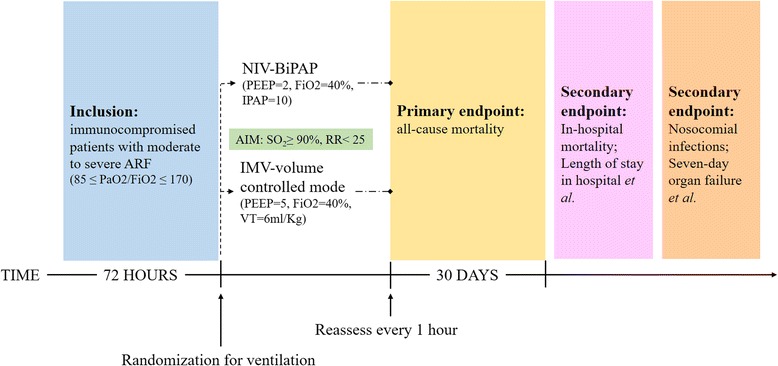
Methods and analysis: The VENIM is a multicentre randomized controlled trial (RCT) comparing the effects of NIV compared with IMV in adult immunocompromised patients with severe hypoxemic ARF. Patients who meet the indications for both forms of ventilatory support will be included. Primary outcome will be 30-day all-cause mortality. Secondary outcomes will include in-hospital mortality, length of stay in hospital, improvement of oxygenation, nosocomial infections, seven-day organ failure, adverse events of intervention, et al. Subgroups with different disease severity and causes of immunodeficiency will also be analyzed.
Discussion: VENIM is the first randomized controlled trial aiming at assessing the efficacy of initial ventilation strategy in treating moderate and severe acute respiratory failure in immunocompromised patients. The result of this RCT may help doctors with their ventilation decisions.
Trial registration: ClinicalTrials.gov NCT02983851 . Registered 2 September 2016.
Keywords: Acute respiratory failure; Immunocompromised patients; Invasive mechanical ventilation; Noninvasive mechanical ventilation; Ventilation strategy.
Conflict of interest statement
Ethics approval and consent to participate
The study protocol and informed consent documents have been approved by the Ethics Committees of Peking Union Medical College Hospital in Oct. 2016 (JS-1158) and the other 16 cooperating hospitals. The VENIM trial has been registered on
A data and safety monitoring committee (DSMC) will be established, consisting of two physicians and one biostatistician independent of the present trial. DSMC is responsible for monitoring the safety data, evaluating the results of interim analysis, and providing with recommendations about whether the trial should continue, prolonged, or terminated prematurely.
Consent for publication
Not applicable.
Competing interests
The authors declare that they have no competing interests.
Publisher’s Note
Springer Nature remains neutral with regard to jurisdictional claims in published maps and institutional affiliations.
Figures
References
-
- Thiery G, Azoulay E, Darmon M, Ciroldi M, De Miranda S, Levy V, Fieux F, Moreau D, Le Gall JR, Schlemmer B. Outcome of cancer patients considered for intensive care unit admission: a hospital-wide prospective study. J Clin Oncol Off J Am Soc Clin Oncol. 2005;23(19):4406–4413. doi: 10.1200/JCO.2005.01.487. - DOI - PubMed
-
- Benoit DD, Vandewoude KH, Decruyenaere JM, Hoste EA, Colardyn FA. Outcome and early prognostic indicators in patients with a hematologic malignancy admitted to the intensive care unit for a life-threatening complication. Crit Care Med. 2003;31(1):104–112. doi: 10.1097/00003246-200301000-00017. - DOI - PubMed
Publication types
MeSH terms
Associated data
LinkOut - more resources
Full Text Sources
Other Literature Sources
Medical
