. 2017 Sep 20;9(1):77.
doi: 10.1186/s13195-017-0306-2.

Tracking progressive pathological and functional decline in the rTg4510 mouse model of tauopathy

Affiliations

Tracking progressive pathological and functional decline in the rTg4510 mouse model of tauopathy

Thomas Blackmore et al. Alzheimers Res Ther. .

Abstract

Background: The choice and appropriate use of animal models in drug discovery for Alzheimer's disease (AD) is pivotal to successful clinical translation of novel therapeutics, yet true alignment of research is challenging. Current models do not fully recapitulate the human disease, and even exhibit various degrees of regional pathological burden and diverse functional alterations. Given this, relevant pathological and functional endpoints must be determined on a model-by-model basis. The present work explores the rTg4510 mouse model of tauopathy as a case study to define best practices for the selection and validation of cognitive and functional endpoints for the purposes of pre-clinical AD drug discovery.

Methods: Male rTg4510 mice were first tested at an advanced age, 12 months, in multiple behavioural assays (step 1). Severe tau pathology and neurodegeneration was associated with profound locomotor hyperactivity and spatial memory deficits. Four of these assays were then selected for longitudinal assessment, from 4 to 12 months, to investigate whether behavioural performance changes as a function of accumulation of tau pathology (step 2). Experimental suppression of tau pathology-via doxycycline administration-was also investigated for its effect on functional performance.

Results: Progressive behavioural changes were detected where locomotor activity and rewarded alternation were found to most closely correlate with tau burden and neurodegeneration. Doxycycline initiated at 4 months led to a 50% suppression of transgene expression, which was sufficient to prevent subsequent increases in tau pathology and arrest related functional decline.

Conclusions: This two-step approach demonstrates the importance of selecting assays most sensitive to the phenotype of the model. A robust relationship was observed between pathological progression, development of phenotype, and their experimental manipulation-three crucial factors for assessing the translational relevance of future pre-clinical findings.

Keywords: Alzheimer’s Disease; Behaviour; Cognition; Neurodegeneration; Pathology; Tau; rTg4510.


Conflict of interest statement

Ethics approval and consent to participate

All animal procedures were carried out at Eli Lilly and Company Limited, in accordance with the UK Animals (Scientific Procedures) Act 1986.

Consent for publication

Not applicable.

Competing interests

The authors declare being employees of Eli Lilly & Company Limited at the time this work was completed.

Publisher’s Note

Springer Nature remains neutral with regard to jurisdictional claims in published maps and institutional affiliations.

Figures
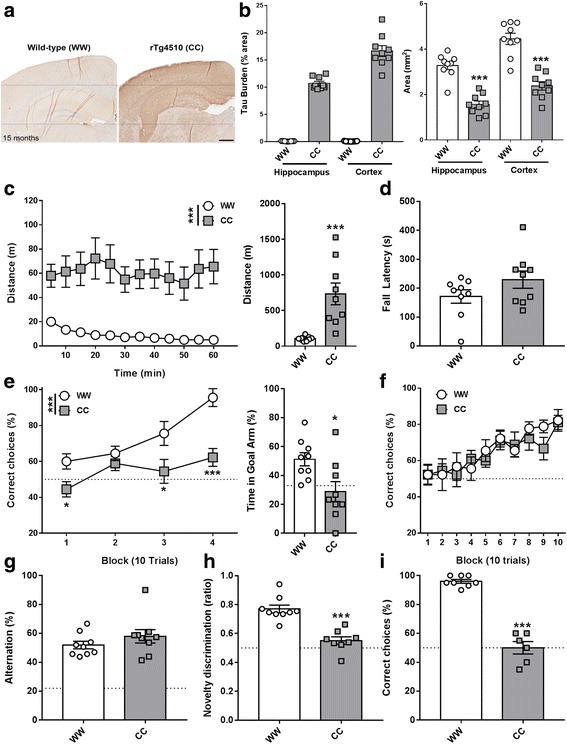
Fig. 1
Fig. 1
Immunohistochemical and behavioural profiling of 12- to 15-month-old rTg4510 mice. Pathology: Bi-transgenic rTg4510 (CC) mice displayed severe hippocampal and cortical tau burden and atrophy (a), as measured by PG-5-positive staining and area, respectively (b). Behaviour: CC mice displayed profound hyperactive behaviour in the open-field locomotor activity task (c), whereas motor co-ordination remains intact as measured in the Rotarod task (d). CC mice were impaired in the acquisition and 24-h probe testing in the swim escape Y-maze spatial reference memory task (e). Acquisition of a Y-maze non-spatial, visual cue discrimination learning task was no different than in wild-type/non-transgenic rTg4510 (WW) controls (f). No deficit was observed in the Y-maze continuous alternation task (g), while CC mice were impaired in both the spatial novelty preference (h) and discrete-trial rewarded alternation (i). Scale bar = 500 μm. All data are presented as mean ± SEM, dotted lines denote chance level. *p < 0.05, **p < 0.01, ***p < 0.001, versus WW controls
Fig. 2
Fig. 2
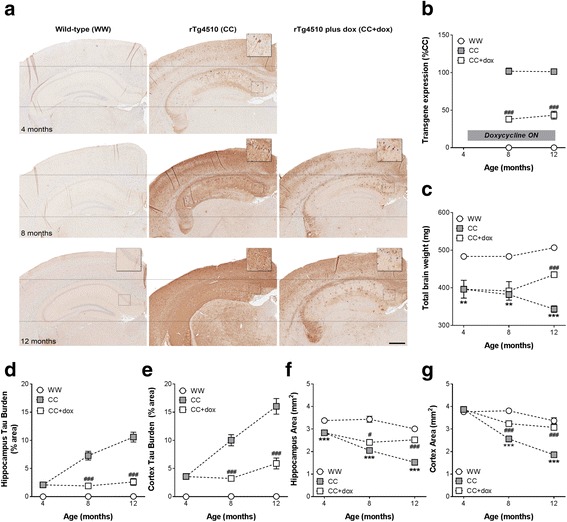
Tau pathology in male rTg4510 mice following doxycycline treatment. Representative immunohistochemical images of 4-, 8-, and 12-month-old male rTg4510 brains (a). RT-qPCR revealed a 40 to 50% reduction of tau expression in bi-transgenic rTg4510 (CC) mice receiving doxycycline (dox) treatment (b). Brain weight was decreased in CC mice at all time points, and was attenuated in 12-month-old CC + dox mice (c). Increasing levels of tau pathology were observed in both the hippocampus (d) and cortex (e) of CC mice from 8 months of age. These were normalised following doxycycline treatment. CC mice displayed high levels of atrophy in the hippocampus at all time points (f) and in the cortex at 8 and 12 months (g); atrophy was prevented by doxycycline treatment. Note that hashed lines do not represent longitudinal, repeated assessment of these animals. Scale bar = 500 μm. All data are presented as mean ± SEM. *p < 0.05, **p < 0.01, ***p < 0.001, versus wild-type/non-transgenic rTg4510 (WW) controls; # p < 0.05, ## p < 0.01, ###p < 0.001, versus rTg4510 CC mice
Fig. 3
Fig. 3
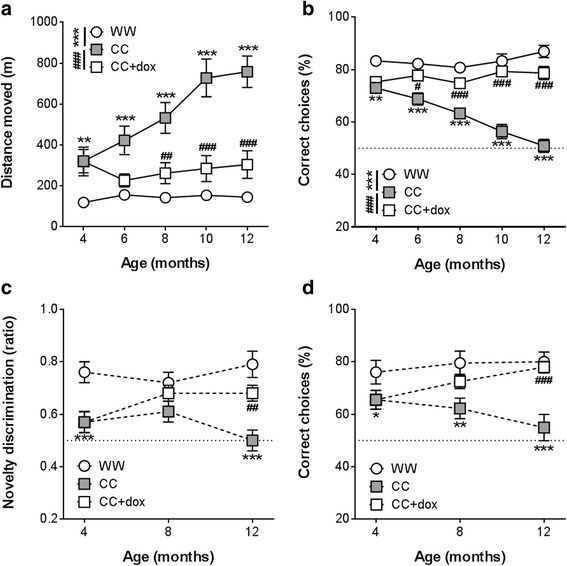
Behavioural alterations in male rTg4510 mice following doxycycline treatment. Locomotor activity revealed bi-transgenic rTg4510 (CC) mice to be hyperactive at 4 months and become increasingly more active as they age, whilst CC + doxycycline (dox) mice remained stable at levels similar to those observed prior to starting doxycycline treatment (a). T-maze rewarded alternation task accuracy was significantly poorer in CC mice at 4 months of age, and declined progressively until reaching chance levels at 12 months. Doxycycline treatment significantly improved performance; CC + dox mice made significantly more correct choices than CC mice from 6 months onwards (b). CC mice were impaired in novelty discrimination, as assessed in a spatial novelty preference Y-maze task. CC + dox mice showed improved novelty discrimination compared to CC at 12 months (c). Spatial learning was assessed using acquisition of an aversively-motivated Y-maze; CC mice made significantly fewer correct choices over 40 trials than WW mice, and further decreases were seen with age. Doxycycline treatment improved performance, with CC + dox mice making more correct choices than CC at 8 and 12 months (d). Note that hashed lines do not represent longitudinal, repeated assessment of these animals. All data presented as mean ± SEM, dotted horizontal lines denote chance level. *p < 0.05, **p < 0.01, ***p < 0.001, versus wild-type/non-transgenic rTg4510 (WW) controls; # p < 0.05, ## p < 0.01, ### p < 0.001, versus rTg4510 CC mice
Fig. 4
Fig. 4
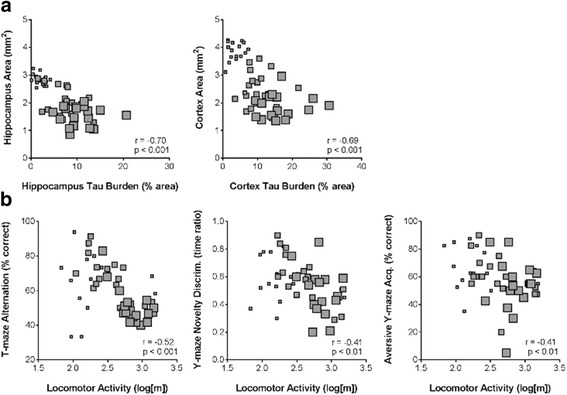
Relationships between measures of pathology or behaviour in male rTg4510 CC mice. Strong negative correlation was observed between measures of tau burden and atrophy in both the hippocampus and cortex (a). Open-field locomotor activity was correlated with all three other behavioural assays: T-maze rewarded alternation, Y-maze spatial novelty preference, and the acquisition of the aversive Y-maze spatial reference memory task (b). Small squares = 4 months; medium squares = 8 months; large squares = 12 months
Fig. 5
Fig. 5
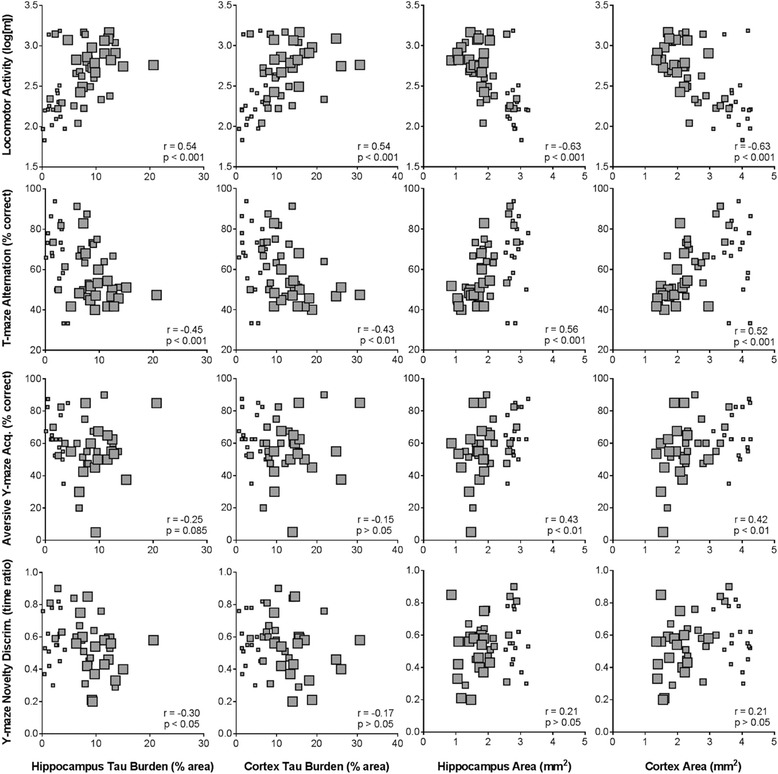
Relationships between measures of pathology and behaviour in male rTg4510 CC mice. Locomotor activity and T-maze performance were strongly related to all pathological endpoints. Aversive Y-maze spatial learning also correlated with atrophy in both the hippocampus and cortex, which was not the case for Y-maze novelty preference. Small squares = 4 months; medium squares = 8 months; large squares = 12 months

References

    1. Alzheimer’s Association 2016 Alzheimer’s disease facts and figures. Alzheimers Dement. 2016;12(4):459–509. doi: 10.1016/j.jalz.2016.03.001. - DOI - PubMed
    1. Anand R, Gill KD, Mahdi AA. Therapeutics of Alzheimer’s disease: past, present and future. Neuropharmacology. 2014;76(Pt A):27–50. doi: 10.1016/j.neuropharm.2013.07.004. - DOI - PubMed
    1. Karran E, De Strooper B. The amyloid cascade hypothesis: are we poised for success or failure? J Neurochem Suppl. 2016;2:237–52. doi: 10.1111/jnc.13632. - DOI - PubMed
    1. Morgan P, Van Der Graaf PH, Arrowsmith J, Feltner DE, Drummond KS, Wegner CD, Street SD. Can the flow of medicines be improved? Fundamental pharmacokinetic and pharmacological principles toward improving Phase II survival. Drug Discov Today. 2012;17(9–10):419–24. doi: 10.1016/j.drudis.2011.12.020. - DOI - PubMed
    1. Soejitno A, Tjan A, Purwata TE. Alzheimer’s disease: lessons learned from amyloidocentric clinical trials. CNS Drugs. 2015;29(6):487–502. doi: 10.1007/s40263-015-0257-8. - DOI - PubMed

MeSH terms