. 2017 Sep 20;7(1):11968.
doi: 10.1038/s41598-017-12210-z.

Serum 1,5-anhydroglucitol when used with fasting plasma glucose improves the efficiency of diabetes screening in a Chinese population

Affiliations

Serum 1,5-anhydroglucitol when used with fasting plasma glucose improves the efficiency of diabetes screening in a Chinese population

Lingwen Ying et al. Sci Rep. .

Abstract

Serum 1,5-anhydroglucitol (1,5-AG) levels can not only accurately reflect the mean blood glucose over the previous 1-2 weeks in diabetic patients but also offers the advantage of representing postprandial glucose. To evaluate the clinical significance of 1,5-AG in diabetes detection, especially when used in combination with fasting plasma glucose (FPG), a total of 3098 participants at high risk for diabetes (1467 men, 1631 women) were enrolled. A total of 1471 (47.5%) participants were diagnosed with diabetes, and the mean 1,5-AG level in the diabetic group was significantly lower than that in non-diabetic group [12.5 (7.8-17.5) μg/mL vs. 20.5 (15.3-26.4) μg/mL, P < 0.001]. The optimal cut-off point was 15.9 μg/mL, for which the sensitivity, specificity, and area under the curve (AUC) were 69.2%, 72.3%, and 0.781, respectively. For the combination of FPG and 1,5-AG, the sensitivity, specificity, and AUC improved to 82.5%, 83.5%, and 0.912, respectively. This method helped 75.8% of the participants avoid an oral glucose tolerance test (OGTT), reducing the need to carry out the OGTT by 43.9% compared to the use of the FPG criterion only. In conclusion, the addition of FPG to serum 1,5-AG improves the efficiency of diabetes screening in the Chinese population.


Conflict of interest statement

The authors declare that they have no competing interests.

Figures
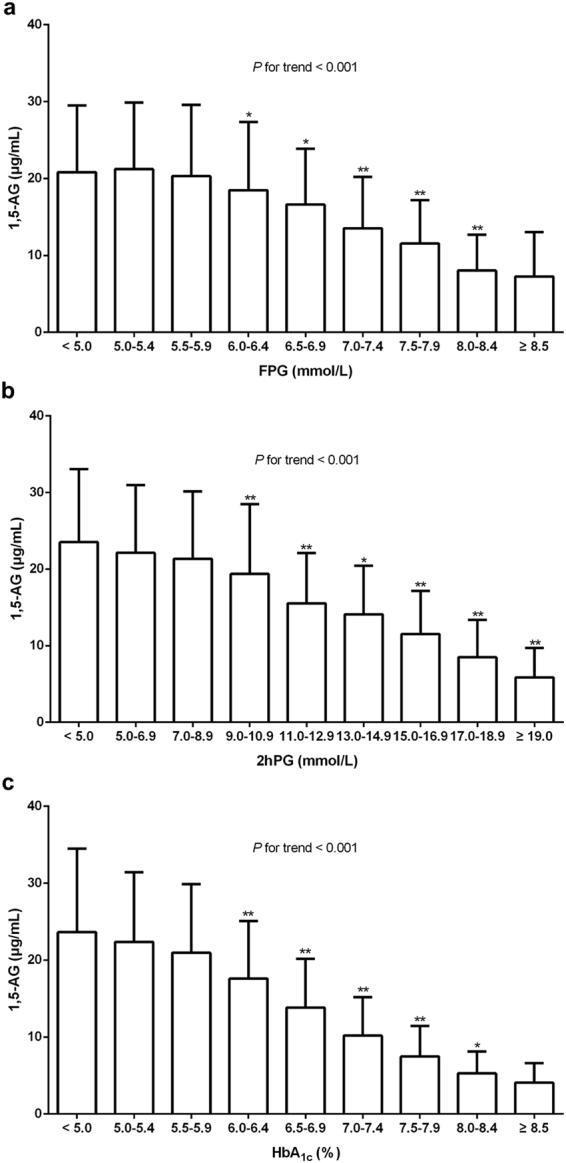
Figure 1
Figure 1
Characteristics of 1,5-anhydroglucitol (1,5-AG) levels in the total group (a) compared with different FPG levels; (b) compared with different 2hPG levels; (c) compared with different HbA1c levels). * P < 0.05 versus the former group, ** P < 0.01 versus the former group. Abbreviation: 2hPG, 2-hour postload plasma glucose; FPG: fasting plasma glucose; HbA 1c, glycated hemoglobin A1c.
Figure 2
Figure 2
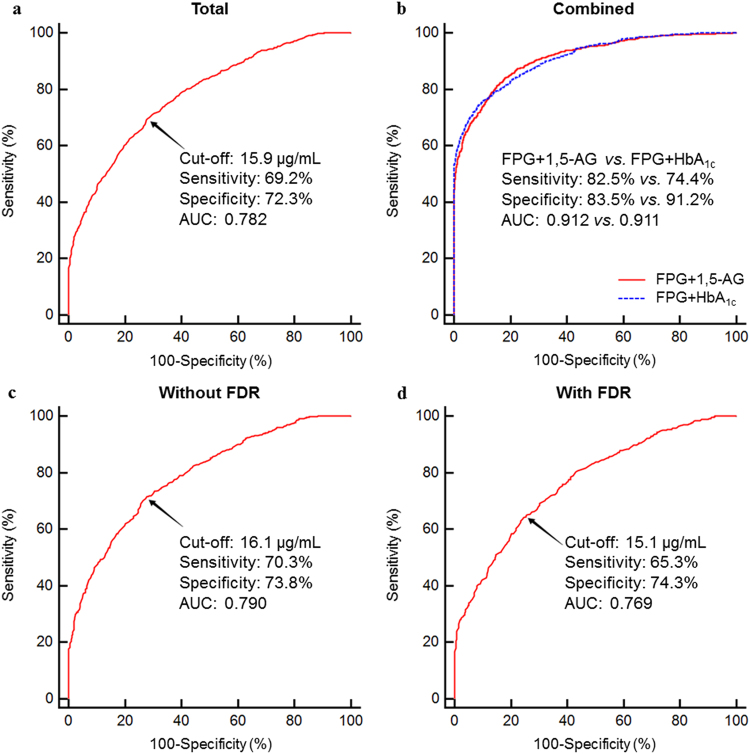
ROC curves for 1,5-anhydroglucitol (1,5-AG) ((a) in the total group; (b) in the total group with combined model; (c) in the non-FDR subgroup; (d) in the FDR subgroup) in the diagnosis of diabetes. For the combination of FPG with serum 1,5-AG, the sensitivity, specificity, and AUC were 82.5%, 83.5%, and 0.912, respectively. As for the combination of FPG and HbA1c, the sensitivity, specificity, and AUC were 74.4%, 91.2%, and 0.911, respectively. There was no significant difference in the AUCs (P > 0.05). However, the specificity and sensitivity differed significantly from each other (all P < 0.001). Abbreviation: AUC: area under the curve; FDR: first degree relative with diabetes; FPG: fasting plasma glucose; HbA 1c: glycated hemoglobin A1c; ROC: receiver operating characteristic.
Figure 3
Figure 3
Screening strategies for detecting diabetes by an OGTT after use of (a) the FPG criteria, (b) the combination of FPG and HbA1c, or (c) the combination of FPG and 1,5-AG. The proportions of the study population in specific diagnostic categories were: (a) FPG < 5.6 mmol/L to exclude and FPG ≥ 7.0 mmol/L to diagnose diabetes, with 43.1% participants needing an OGTT to confirm the diagnose. The sensitivity, specificity, PPV, and NPV for this strategy were 47.3%, 100%, 100%, and 67.7%, respectively. (b) As for the combined criteria of FPG and HbA1c criteria, FPG < 5.6 mmol/L and HbA1c < 5.7% to exclude diabetes, and FPG ≥ 7.0 mmol/L and/or HbA1c ≥ 6.5% to confirm diabetes, 46.8% participants needed an OGTT. The sensitivity, specificity, PPV, and NPV for this strategy were 70.2%, 100%, 100%, and 78.8%, respectively. (c) With the combined FPG and 1,5-AG criteria, which are FPG < 5.6 mmol/L and 1,5-AG > 15.9 μg/mL for exclusion of diabetes, and FPG ≥ 7.0 mmol/L and/or 1,5-AG ≤ 15.9 μg/mL for the diagnosis of diabetes, only 24.2% participants needed an OGTT. The sensitivity, specificity, PPV, and NPV for this strategy were 78.7%, 72.3%, 72.0%, and 78.9%, respectively. Abbreviations: DM: diabetes mellitus; FPG: fasting plasma glucose; HbA 1c : glycated hemoglobin A1c; NPV: negative predictive value; OGTT: oral glucose tolerance test; PPV: positive predictive value.

References

    1. Whiting DR, Guariguata L, Weil C, Shaw J. IDF diabetes atlas: global estimates of the prevalence of diabetes for 2011 and 2030. Diabetes Res Clin Pract. 2011;94:311–321. doi: 10.1016/j.diabres.2011.10.029. - DOI - PubMed
    1. Wang L, et al. Prevalence and ethnic pattern of diabetes and prediabetes in China in 2013. JAMA. 2017;317:2515–2523. doi: 10.1001/jama.2017.7596. - DOI - PMC - PubMed
    1. Ding D, et al. Hyperglycemia and mortality among patients with coronary artery disease. Diabetes Care. 2014;37:546–554. doi: 10.2337/dc13-1387. - DOI - PubMed
    1. Li L, Jick S, Breitenstein S, Michel A. Prevalence of diabetes and diabetic nephropathy in a large U.S. commercially insured pediatric population, 2002–2013. Diabetes Care. 2016;39:278–284. - PubMed
    1. Alberti KG, Zimmet PZ. Definition, diagnosis and classification of diabetes mellitus and its complications. Part 1: diagnosis and classification of diabetes mellitus provisional report of a WHO consultation. Diabet Med. 1998;15:539–553. doi: 10.1002/(SICI)1096-9136(199807)15:7<539::AID-DIA668>3.0.CO;2-S. - DOI - PubMed

Publication types