


Novel predictors for lymph node metastasis in submucosal invasive colorectal carcinoma
- PMID: 28932085
- PMCID: PMC5583578
- DOI: 10.3748/wjg.v23.i32.5936
Novel predictors for lymph node metastasis in submucosal invasive colorectal carcinoma
Abstract
Aim: To evaluate a novel grading system to predict lymph node metastasis (LNM) in patients with submucosal invasive colorectal carcinoma (SICRC).
Methods: We analyzed the associations between LNM and various clinicopathological features in 252 patients with SICRC who had undergone radical surgery at the Seoul Saint Mary's hospital between 2000 and 2015.
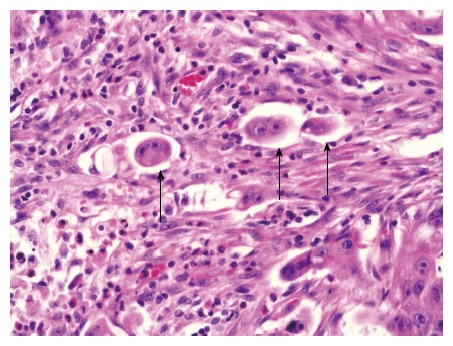
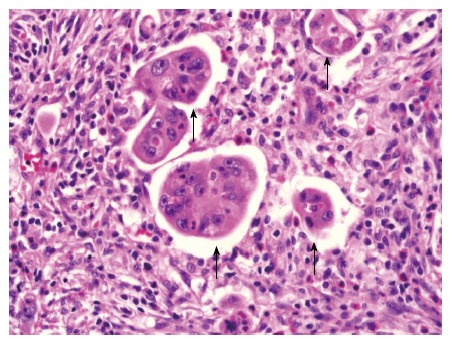
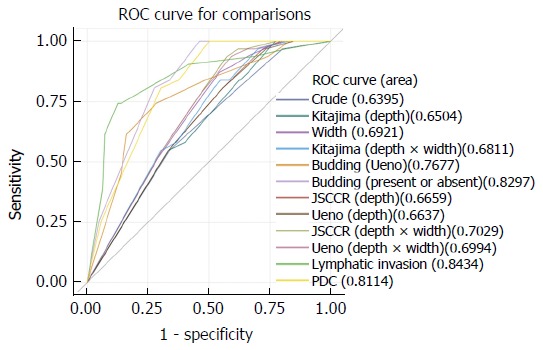
Results: LNM was observed in 31 patients (12.3%). The depth and width of the submucosal invasion, lymphatic invasion, tumor budding, and the presence of poorly differentiated clusters (PDCs) were significantly associated with the incidence of LNM. Using multivariate analysis, the receiver operating characteristic curvewas calculated and the area under curve (AUC) was used to compare the ability of the different parameters to identify the risk of LNM. The most powerful clinicopathological parameter for predicting LNM was lymphatic invasion (difference AUC = 0.204), followed by the presence or absence of tumor budding (difference AUC = 0.190), presence of PDCs (difference AUC = 0.172) and tumor budding graded by the Ueno method (difference AUC = 0.128).
Conclusion: Our results indicate that the tumor budding and the depth multiplied by the width measurements of submucosal invasion can provide important information for patients with SICRC.
Keywords: Colorectal cancer; Lymph node; Metastasis; Neoplasm invasion.
Conflict of interest statement
Conflict-of-interest statement: The authors do not have any conflicts of interest to disclose.
Figures
References
-
- Nivatvongs S. Surgical management of early colorectal cancer. World J Surg. 2000;24:1052–1055. - PubMed
-
- Kikuchi R, Takano M, Takagi K, Fujimoto N, Nozaki R, Fujiyoshi T, Uchida Y. Management of early invasive colorectal cancer. Risk of recurrence and clinical guidelines. Dis Colon Rectum. 1995;38:1286–1295. - PubMed
-
- Egashira Y, Yoshida T, Hirata I, Hamamoto N, Akutagawa H, Takeshita A, Noda N, Kurisu Y, Shibayama Y. Analysis of pathological risk factors for lymph node metastasis of submucosal invasive colon cancer. Mod Pathol. 2004;17:503–511. - PubMed
-
- Kitajima K, Fujimori T, Fujii S, Takeda J, Ohkura Y, Kawamata H, Kumamoto T, Ishiguro S, Kato Y, Shimoda T, et al. Correlations between lymph node metastasis and depth of submucosal invasion in submucosal invasive colorectal carcinoma: a Japanese collaborative study. J Gastroenterol. 2004;39:534–543. - PubMed
Publication types
MeSH terms
LinkOut - more resources
Full Text Sources
Other Literature Sources
Medical
