


Vascular Aging: Implications for Cardiovascular Disease and Therapy
- PMID: 28932625
- PMCID: PMC5602592
- DOI: 10.4172/2161-1025.1000183
Vascular Aging: Implications for Cardiovascular Disease and Therapy
Abstract
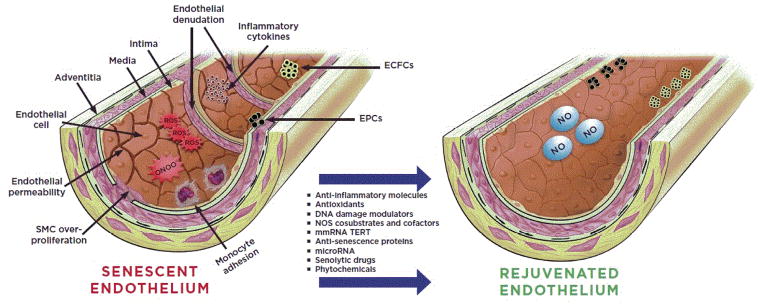
The incidence and prevalence of cardiovascular disease is highest among the elderly, in part, due to deleterious effects of advancing age on the heart and blood vessels. Aging, a known cardiovascular risk factor, is progressively associated with structural and functional changes to the vasculature including hemodynamic disturbance due to increased oxidative stress, premature cellular senescence and impairments in synthesis and/or secretion of endothelium-derived vasoactive molecules. These molecular and physiological changes lead to vessel wall stiffening and thickening, as well as other vascular complications that culminate to loss of vascular tone regulation and endothelial function. Intriguingly, the vessel wall, a biochemically active structure composed of collagen, connective tissue, smooth muscle and endothelial cells, is adversely affected by processes involved in premature or normal aging. Notably, the inner most layer of the vessel wall, the endothelium, becomes senescent and dysfunctional with advancing age. As a result, its ability to release vasoactive molecules such as acetylcholine (ACh), prostacyclin (PGI2), endothelium-derived hyperpolarizing factor (EDHF), and nitric oxide (NO) is reduced and the cellular response to these molecules is also impaired. By contrast, the vascular endothelium increases its generation and release of reactive oxygen (ROS) and nitrogen (RNS) species, vasoconstrictors such as endothelin (ET) and angiotensin (AT), and endogenous inhibitors of NO synthases (NOSs) to block NO. This skews the balance of the endothelium in favor of the release of highly tissue reactive and harmful molecules that promote DNA damage, telomere erosion, senescence, as well as stiffened and hardened vessel wall that is prone to the development of hypertension, diabetes, atherosclerosis and other cardiovascular risk factors. This Review discusses the impact of advancing age on cardiovascular health, and highlights the cellular and molecular mechanisms that underlie age-associated vascular changes. In addition, the role of pharmacological interventions in preventing or delaying age-related cardiovascular disease is discussed.
Keywords: Cardiovascular health; Endothelial senescence; Endothelium; Vascular aging; Vascular function; Vascular pharmacology; Vascular rejuvenation.
Figures
References
-
- National Institutes of Aging. Blood Vessels and Aging: The Rest of the Journey in Health and Aging 2005
-
- Capell BC, Collins FS, Nabel EG. Mechanisms of cardiovascular disease in accelerated aging syndromes. Circ Res. 2007;101:13–26. - PubMed
-
- Lakatta EG, Levy D. Arterial and cardiac aging: major shareholders in cardiovascular disease enterprises: Part I: aging arteries: a “set up” for vascular disease. Circulation. 2003;107:139–146. - PubMed
-
- Lakatta EG, Levy D. Arterial and cardiac aging: major shareholders in cardiovascular disease enterprises: Part II: the aging heart in health: links to heart disease. Circulation. 2003;107:346–354. - PubMed
-
- Ferrari AU, Radaelli A, Centola M. Invited review: aging and the cardiovascular system. J Appl Physiol. 2003;95:2591–2597. - PubMed
Grants and funding
LinkOut - more resources
Full Text Sources
Other Literature Sources
Research Materials