Autism Spectrum Disorder Among US Children (2002-2010): Socioeconomic, Racial, and Ethnic Disparities
- PMID: 28933930
- PMCID: PMC5637670
- DOI: 10.2105/AJPH.2017.304032
Autism Spectrum Disorder Among US Children (2002-2010): Socioeconomic, Racial, and Ethnic Disparities
Abstract
Objectives: To describe the association between indicators of socioeconomic status (SES) and the prevalence of autism spectrum disorder (ASD) in the United States during the period 2002 to 2010, when overall ASD prevalence among children more than doubled, and to determine whether SES disparities account for ongoing racial and ethnic disparities in ASD prevalence.
Methods: We computed ASD prevalence and 95% confidence intervals (CIs) from population-based surveillance, census, and survey data. We defined SES categories by using area-level education, income, and poverty indicators. We ascertained ASD in 13 396 of 1 308 641 8-year-old children under surveillance.
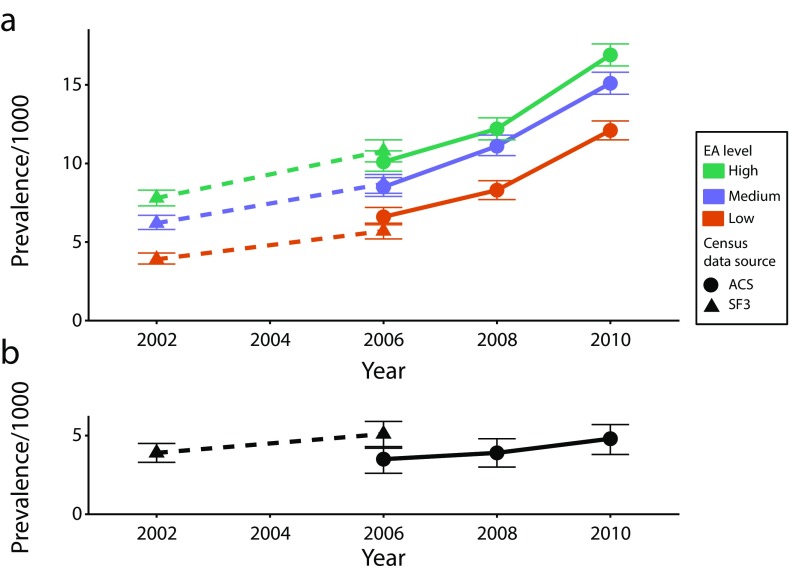
Results: The prevalence of ASD increased with increasing SES during each surveillance year among White, Black, and Hispanic children. The prevalence difference between high- and low-SES groups was relatively constant over time (3.9/1000 [95% CI = 3.3, 4.5] in 2002 and 4.1/1000 [95% CI = 3.6, 4.6] in the period 2006-2010). Significant racial/ethnic differences in ASD prevalence remained after stratification by SES.
Conclusions: A positive SES gradient in ASD prevalence according to US surveillance data prevailed between 2002 and 2010, and racial and ethnic disparities in prevalence persisted during this time among low-SES children.
Figures
Comment in
-
Trends in Autism Spectrum Disorders: The Interaction of Time, Group-Level Socioeconomic Status, and Individual-Level Race/Ethnicity.Am J Public Health. 2017 Nov;107(11):1698-1699. doi: 10.2105/AJPH.2017.304085. Am J Public Health. 2017. PMID: 29019763 Free PMC article. No abstract available.
-
Durkin and Imm Respond.Am J Public Health. 2018 Mar;108(3):e16-e17. doi: 10.2105/AJPH.2017.304272. Am J Public Health. 2018. PMID: 29412722 Free PMC article. No abstract available.
-
Autism and Socioeconomic Status-An Immune Link?Am J Public Health. 2018 Mar;108(3):e16. doi: 10.2105/AJPH.2017.304271. Am J Public Health. 2018. PMID: 29412723 Free PMC article. No abstract available.
References
-
- Autism and Developmental Disabilities Monitoring Network Surveillance Year 2010 Principal Investigators; Centers for Disease Control and Prevention. Prevalence of autism spectrum disorder among children aged 8 years—Autism and Developmental Disabilities Monitoring Network, 11 sites, United States, 2010. MMWR Surveill Summ. 2014;63(SS-2):1–21. - PubMed
-
- Kogan MD, Blumberg SJ, Schieve LA et al. Prevalence of parent-reported diagnosis of autism spectrum disorder among children in the US, 2007. Pediatrics. 2009;124(5):1395–1403. - PubMed
-
- Boyle CA, Boulet S, Schieve LA et al. Trends in the prevalence of developmental disabilities in US children, 1997–2008. Pediatrics. 2011;127(6):1034–1042. - PubMed
MeSH terms
Grants and funding
LinkOut - more resources
Full Text Sources
Other Literature Sources
Medical