


Association between Exposure to p,p'-DDT and Its Metabolite p,p'-DDE with Obesity: Integrated Systematic Review and Meta-Analysis
- PMID: 28934091
- PMCID: PMC5915185
- DOI: 10.1289/EHP527
Association between Exposure to p,p'-DDT and Its Metabolite p,p'-DDE with Obesity: Integrated Systematic Review and Meta-Analysis
Abstract
Background: The prevalence of obesity is increasing in all countries, becoming a substantial public health concern worldwide. Increasing evidence has associated obesity with persistent pollutants such as the pesticide DDT and its metabolite p,p'-DDE.
Objectives: Our objective was to systematically review the literature on the association between exposure to the pesticide DDT and its metabolites and obesity to develop hazard identification conclusions.
Methods: We applied a systematic review-based strategy to identify and integrate evidence from epidemiological, in vivo, and in vitro studies. The evidence from prospective epidemiological studies was quantitatively synthesized by meta-analysis. We rated the body of evidence and integrated the streams of evidence to systematically develop hazard identification conclusions.
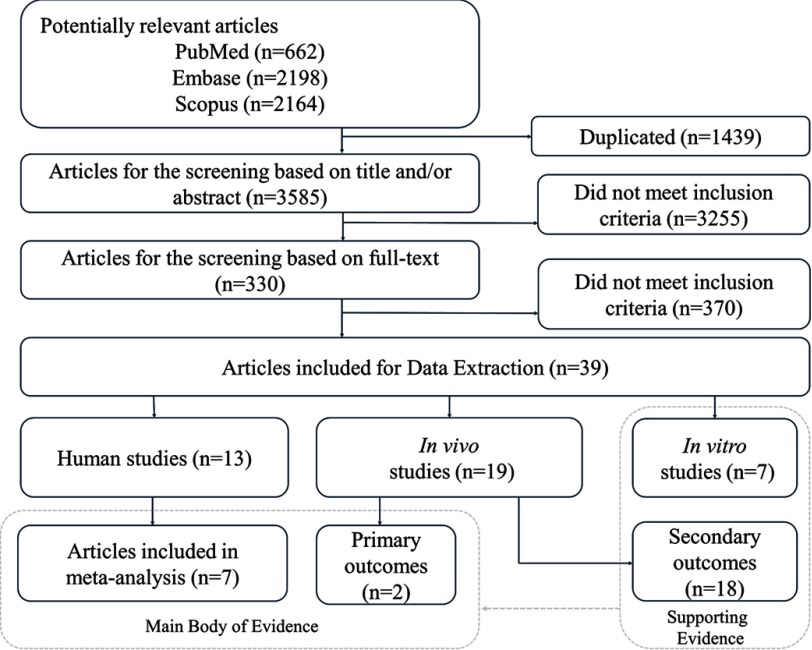
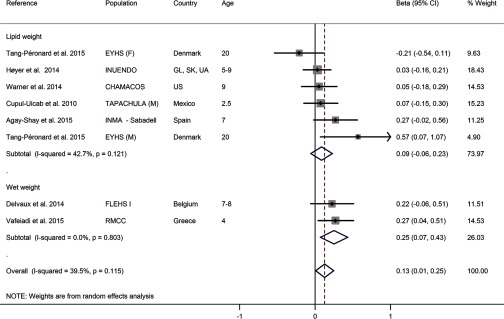
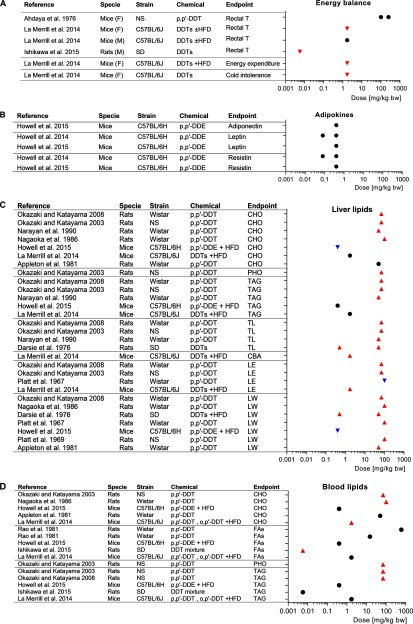
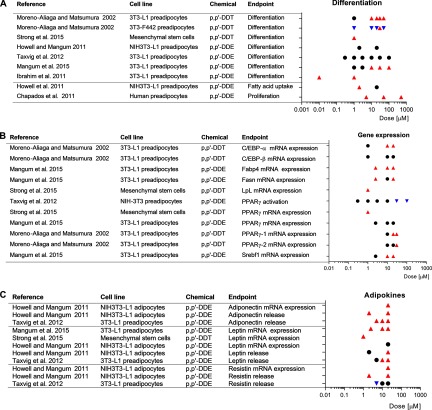
Results: We identified seven epidemiological studies reporting prospective associations between exposure to p,p'-DDE and adiposity assessed by body mass index (BMI) z-score. The results from the meta-analysis revealed positive associations between exposure to p,p'-DDE and BMI z-score (β=0.13 BMI z-score (95% CI: 0.01, 0.25) per log increase of p,p'-DDE). Two studies constituted the primary in vivo evidence. Both studies reported positive associations between exposure to p,p'-DDT and increased adiposity in rodents. We identified 19 in vivo studies and 7 in vitro studies that supported the biological plausibility of the obesogenic effects of p,p'-DDT and p,p'-DDE.
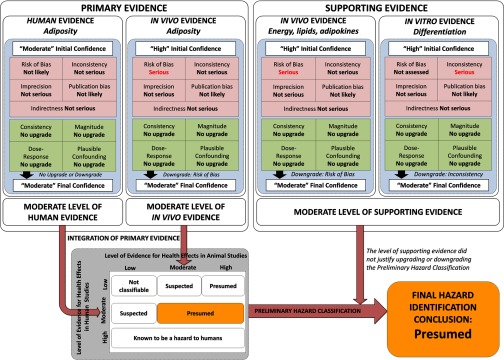
Conclusions: We classified p,p'-DDT and p,p'-DDE as "presumed" to be obesogenic for humans, based on a moderate level of primary human evidence, a moderate level of primary in vivo evidence, and a moderate level of supporting evidence from in vivo and in vitro studies. https://doi.org/10.1289/EHP527.
Figures
Comment in
-
DDT and Obesity in Humans: Exploring the Evidence in a New Way.Environ Health Perspect. 2018 Feb 22;126(2):024003. doi: 10.1289/EHP2545. Environ Health Perspect. 2018. PMID: 29483061 Free PMC article. No abstract available.
References
-
- Agay-Shay K, Martinez D, Valvi D, Garcia-Esteban R, Basagaña X, Robinson O, et al. 2015. Exposure to endocrine-disrupting chemicals during pregnancy and weight at 7 years of age: a multi-pollutant approach. Environ Health Perspect 123:1030–1037, PMID: 25956007, 10.1289/ehp.1409049. - DOI - PMC - PubMed
-
- Ahdaya SM, Shah PV, Guthrie FE. 1976. Thermoregulation in mice treated with parathion, carbaryl, or DDT. Toxicol Appl Pharmacol 35:575–580, PMID: 817420. - PubMed
-
- Appleton BS, Shriver CN, Arnrich L, Hathcock JN. 1981. Effects of 3-methylcholanthrene and DDT on cholesterol 7 alpha-hydroxylase in rats. Durg-Nutr Interact 1(1):15–21, PMID: 6926812. - PubMed
Publication types
MeSH terms
Substances
Grants and funding
LinkOut - more resources
Full Text Sources
Other Literature Sources
Medical
Miscellaneous