Forensic genetics and genomics: Much more than just a human affair
- PMID: 28934201
- PMCID: PMC5608170
- DOI: 10.1371/journal.pgen.1006960
Forensic genetics and genomics: Much more than just a human affair
Abstract
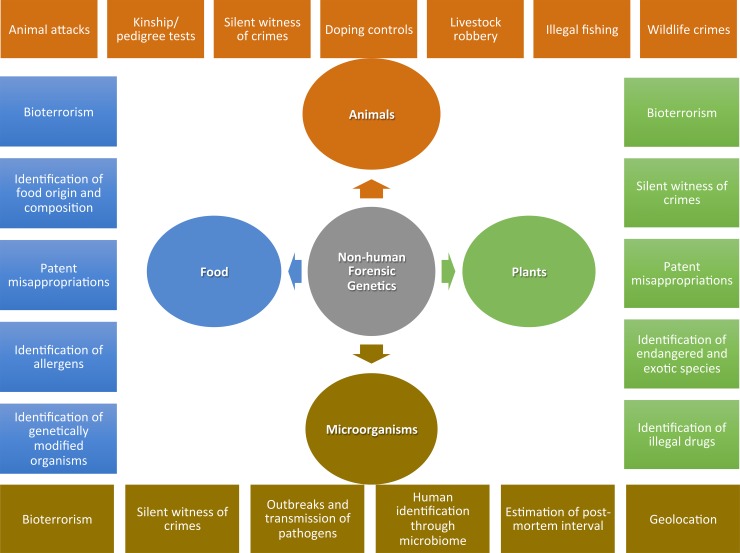
While traditional forensic genetics has been oriented towards using human DNA in criminal investigation and civil court cases, it currently presents a much wider application range, including not only legal situations sensu stricto but also and, increasingly often, to preemptively avoid judicial processes. Despite some difficulties, current forensic genetics is progressively incorporating the analysis of nonhuman genetic material to a greater extent. The analysis of this material-including other animal species, plants, or microorganisms-is now broadly used, providing ancillary evidence in criminalistics in cases such as animal attacks, trafficking of species, bioterrorism and biocrimes, and identification of fraudulent food composition, among many others. Here, we explore how nonhuman forensic genetics is being revolutionized by the increasing variety of genetic markers, the establishment of faster, less error-burdened and cheaper sequencing technologies, and the emergence and improvement of models, methods, and bioinformatics facilities.
Conflict of interest statement
The authors have declared that no competing interests exist.
Figures

References
-
- Saks MJ, Koehler JJ. The coming paradigm shift in forensic identification science. Science. 2005;309(5736):892–5. doi: 10.1126/science.1111565 . - DOI - PubMed
-
- Amorim A. Basic Principles In: Siegel JA, Saukko PJ, editors. Encyclopedia of Forensic Sciences. 1 2nd ed. Waltham: Academic Press; 2013. p. 211–3.
-
- Amorim A. Introduction to the Special Issue on Forensic Genetics: Non-Human DNA. The Open Forensic Science Journal. 2010;3:6–8.
-
- Almog J. Forensics as a proactive science. Sci Justice. 2014;54(5):325–6. doi: 10.1016/j.scijus.2014.05.008 . - DOI - PubMed
-
- Kayser M, de Knijff P. Improving human forensics through advances in genetics, genomics and molecular biology. Nat Rev Genet. 2011;12(3):179–92. doi: 10.1038/nrg2952 . - DOI - PubMed
Publication types
MeSH terms
Substances
LinkOut - more resources
Full Text Sources
Other Literature Sources