


Exploring the salivary microbiome of children stratified by the oral hygiene index
- PMID: 28934367
- PMCID: PMC5608389
- DOI: 10.1371/journal.pone.0185274
Exploring the salivary microbiome of children stratified by the oral hygiene index
Abstract
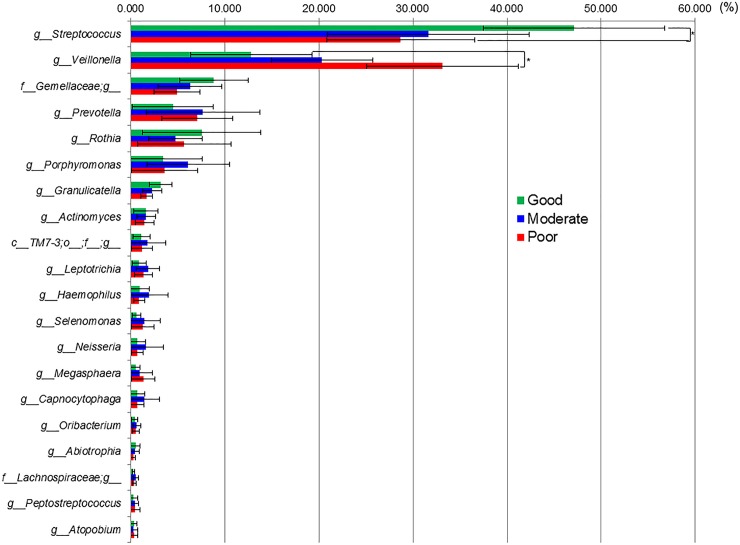
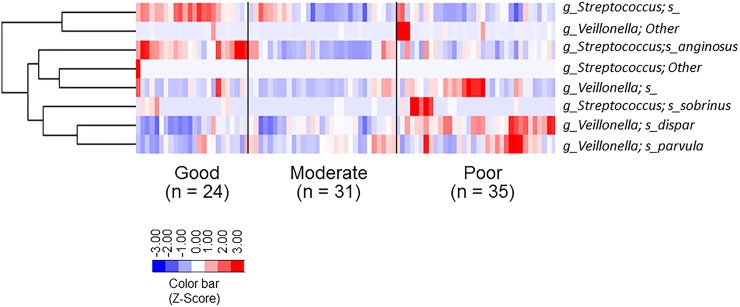
Poor oral hygiene often leads to chronic diseases such as periodontitis and dental caries resulting in substantial economic costs and diminished quality of life in not only adults but also in children. In this study, the salivary microbiome was characterized in a group of children stratified by the Simplified Oral Hygiene Index (OHI-S). Illumina MiSeq high-throughput sequencing based on the 16S rRNA was utilized to analyze 90 salivary samples (24 Good, 31 Moderate and 35 Poor oral hygiene) from a cohort of Thai children. A total of 38,521 OTUs (Operational Taxonomic Units) with a 97% similarity were characterized in all of the salivary samples. Twenty taxonomic groups (Seventeen genera, two families and one class; Streptococcus, Veillonella, Gemellaceae, Prevotella, Rothia, Porphyromonas, Granulicatella, Actinomyces, TM-7-3, Leptotrichia, Haemophilus, Selenomonas, Neisseria, Megasphaera, Capnocytophaga, Oribacterium, Abiotrophia, Lachnospiraceae, Peptostreptococcus, and Atopobium) were found in all subjects and constituted 94.5-96.5% of the microbiome. Of these twenty genera, the proportion of Streptococcus decreased while Veillonella increased with poor oral hygiene status (P < 0.05). Furthermore, an unassigned species of Veillonella, Veillonella dispar and Veillonella parvula tended to be elevated in the Poor oral hygiene group. This is the first study demonstrating an important association between increase of Veillonella and poor oral hygiene status in children. However, further studies are required to identify the majority of Veillonella at species level in salivary microbiome of the Poor oral hygiene group.
Conflict of interest statement
Figures
References
-
- Seirawan H, Faust S, Mulligan R. The impact of oral health on the academic performance of disadvantaged children. Am J Public Health 2012. 102(9): 1729–1734. doi: 10.2105/AJPH.2011.300478 - DOI - PMC - PubMed
-
- Prabhu S, John J. Oral health education for improving oral health status of school children—a systematic review. J Dent Med Sci 2015. 14(2): 101–106.
-
- Ismail AS, Behrndt CL, Hooper LV. Reciprocal interactions between commensal bacteria and gamma delta intraepithelial lymphocytes during mucosal injury. J Immunol 2009. 182(5): 3047–3054. doi: 10.4049/jimmunol.0802705 - DOI - PMC - PubMed
-
- Kau AL, Ahern PP, Griffin NW, Goodman AL, Gordon JI. Human nutrition, the gut microbiome and the immune system. Nature 2011. 474: 327–336. doi: 10.1038/nature10213 - DOI - PMC - PubMed
-
- Chang JY, Antonopoulos DA, Kalra A, Tonelli A, Khalife WT, Schmidt TM et al. Decreased diversity of the fecal microbiome in recurrent Clostridium difficile-associated diarrhea. J Infect Dis 2008. 197(3): 435–438. doi: 10.1086/525047 - DOI - PubMed
MeSH terms
Substances
LinkOut - more resources
Full Text Sources
Other Literature Sources
