


MiR-9, miR-21, and miR-155 as potential biomarkers for HPV positive and negative cervical cancer
- PMID: 28934937
- PMCID: PMC5609051
- DOI: 10.1186/s12885-017-3642-5
MiR-9, miR-21, and miR-155 as potential biomarkers for HPV positive and negative cervical cancer
Abstract
Background: Cervical cancer is the second leading cause of death among female patients with cancer in the world. High risk human papillomavirus has causal roles in cervical cancer initiation and progression by deregulating several cellular processes. However, HPV infection is not sufficient for cervical carcinoma development. Therefore, other genetic and epigenetic factors may be involved in this complex disease, and the identification of which may lead to better diagnosis and treatment. Our aim was to analyze the expression of microRNAs in cervical cancer cases positive or negative for HPV E6/E7 mRNA, and to assess their diagnostic usefulness and relevance.
Methods: The expression of three different microRNAs (miR-9, miR-21, and miR-155) in 52 formalin-fixed paraffin-embedded (FFPE) primary cervical cancer tissue samples and 50 FFPE normal cervical tissue samples were evaluated.
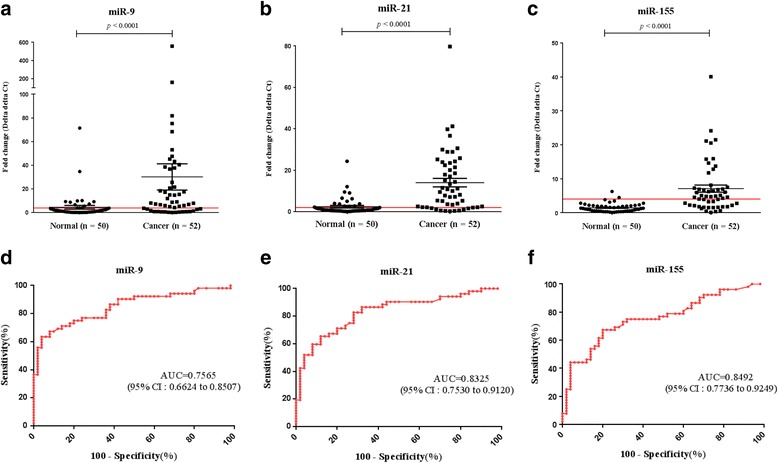
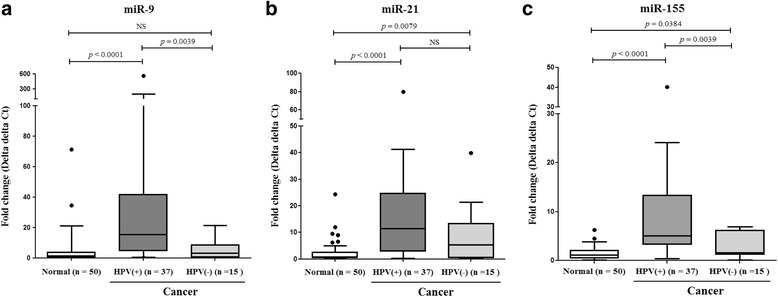
Results: MiR-9, miR-21, and miR-155 were significantly overexpressed in cervical cancer tissues compared to normal tissues (P < 0.001). MiR-21 and miR-155 expression combined with the HPV E6/E7 mRNA assay in HPV E6/E7 negative cervical cancer showed increased AUC of 0.7267 and 0.7000, respectively (P = 0.01, P = 0.04), demonstrating their potential as diagnostic tools. Moreover, miR-21 and miR-155 were predictors showing a 7 fold and 10.3 fold higher risk for HPV E6/E7 negative patients with cervical cancer (P = 0.024 and P = 0.017, respectively) while miR-155 was a predictor showing a 27.9 fold higher risk for HPV E6/E7 positive patients with cervical cancer (P < 0.0001).
Conclusions: There is a strong demand for additional, alternative molecular biomarkers for diagnosis and management of precancer patients. MiR-21 and miR-155 may be helpful in the prediction of both HPV positive and HPV negative cases of cervical cancer.
Keywords: Cervical cancer; HPV E6/E7; Molecular diagnosis; RT-qPCR; microRNA.
Conflict of interest statement
Ethics approval and consent to participate
Institutional Ethics Committee at Yonsei University Wonju College of Medicine approved the study protocol (approval no. YWMR-12-4-010) and all subjects provided written informed consent.
Consent for publication
Not applicable.
Competing interests
The authors declare that they have no competing interests.
Publisher’s Note
Springer Nature remains neutral with regard to jurisdictional claims in published maps and institutional affiliations.
Figures
References
-
- Koivusalo R, Mialon A, Pitkanen H, Westermarck J, Hietanen S. Activation of p53 in cervical cancer cells by human papillomavirus E6 RNA interference is transient, but can be sustained by inhibiting endogenous nuclear export-dependent p53 antagonists. Cancer Res. 2006;66:11817–11824. doi: 10.1158/0008-5472.CAN-06-2185. - DOI - PubMed
