. 2017 Sep 21;7(1):12103.
doi: 10.1038/s41598-017-12015-0.

Whole genome sequencing, molecular typing and in vivo virulence of OXA-48-producing Escherichia coli isolates including ST131 H30-Rx, H22 and H41 subclones

Affiliations

Whole genome sequencing, molecular typing and in vivo virulence of OXA-48-producing Escherichia coli isolates including ST131 H30-Rx, H22 and H41 subclones

María de Toro et al. Sci Rep. .

Abstract

Carbapenem-resistant Enterobacteriaceae, including the increasingly reported OXA-48 Escherichia coli producers, are an emerging public health threat worldwide. Due to their alarming detection in our healthcare setting and their possible presence in the community, seven OXA-48-producing, extraintestinal pathogenic E. coli were analysed by whole genome sequencing as well as conventional tools, and tested for in vivo virulence. As a result, five E. coli OXA-48-producing subclones were detected (O25:H4-ST131/PST43-fimH30-virotype E; O25:H4-ST131/PST9-fimH22-virotype D5, O16:H5-ST131/PST506-fimH41; O25:H5-ST83/PST207 and O9:H25-ST58/PST24). Four ST131 and one ST83 isolates satisfied the ExPEC status, and all except the O16:H5 ST131 isolate were UPEC. All isolates exhibited local inflammatory response with extensive subcutaneous necrosis but low lethality when tested in a mouse sepsis model. The bla OXA-48 gene was located in MOBP131/IncL plasmids (four isolates) or within the chromosome (three ST131 H30-Rx isolates), carried by Tn1999-like elements. All, except the ST83 isolate, were multidrug-resistant, with additional plasmids acting as vehicles for the spread of various resistance genes. This is the first study to analyse the whole genome sequences of bla OXA-48-positive ST131, ST58 and ST83 E. coli isolates in conjunction with experimental data, and to evaluate the in vivo virulence of bla OXA-48 isolates, which pose an important challenge to patient management.


Conflict of interest statement

The authors declare that they have no competing interests.

Figures
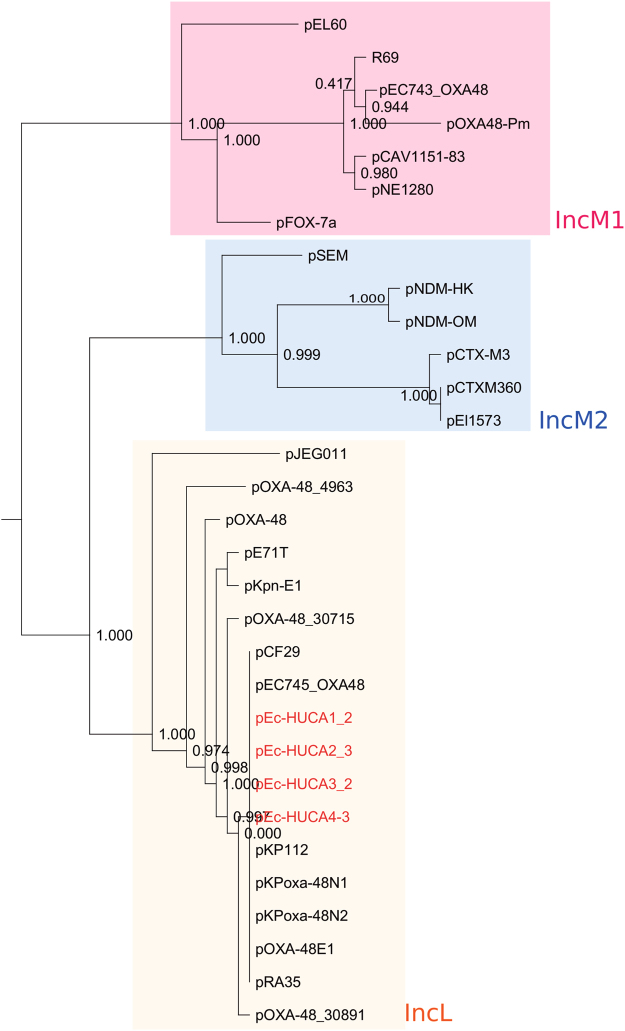
Figure 1
Figure 1
Phylogenetic tree of IncL plasmids from OXA-48-producing isolates of Escherichia coli. The tree is based on SNPs found in the core genome (19,995 bp +/− 45 bp; 26 CDS with ≥80% identity, ≥60% pairwise alignment coverage), common to 31 IncL (18), IncM1 (seven) and IncM2 (six) plasmids. Bootstrap support values of 1,000 replicates are shown at the nodes. Clusters corresponding to each group/subgroup are enclosed in yellow, pink and blue boxes. IncL plasmids are more closely related to IncM2 than to IncM1 plasmids.
Figure 2
Figure 2
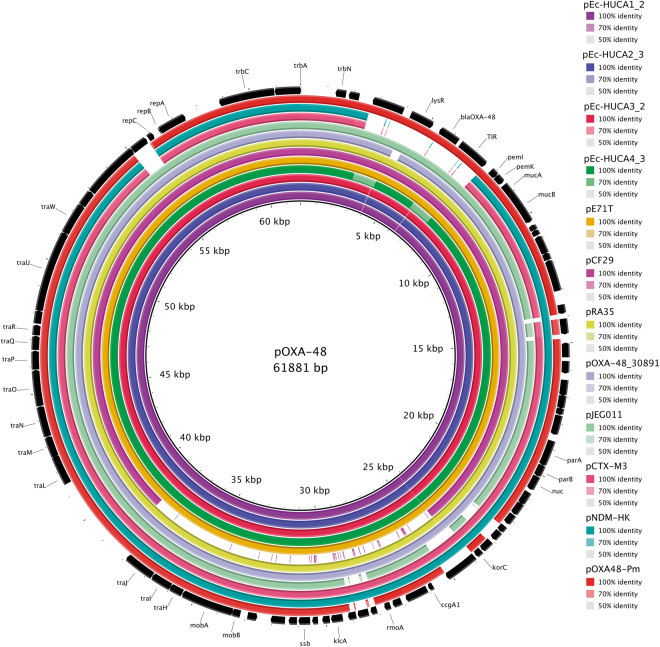
BRIG (Blast Ring Image generator) comparison of the IncL plasmids from OXA-48-producing Escherichia coli isolates and representative IncL, IncM1 and IncM2 plasmids. Each ring corresponds to a plasmid (indicated at the right of the figure together with the color code). Plasmid pOXA-48 (inner black ring) was used as a reference. Their genes are shown in the outer ring, represented by black arrows that also indicate the direction of transcription.
Figure 3
Figure 3
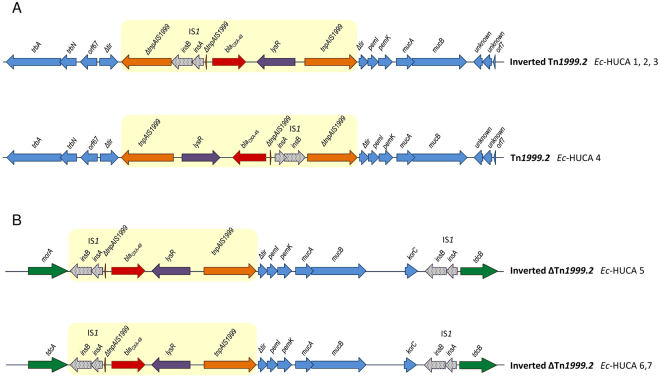
Genetic environment of the bla OXA-48 gene. (A) Structures of the Tn1999-like transposons and adjacent DNA from the IncL bla OXA-48 plasmids of Ec-HUCA 1, 2, 3 and 4. (B) Structure of the inverted and deleted Tn1999.2 transposon and the adjacent DNA including the insertion sites in the chromosomes of Ec-HUCA 5, 6 and 7. Open reading frames are represented by arrows indicating the direction of transcription and having different fillings: orange, IS1999; black dots, IS1; red, bla OXA-48; purple, lysR; blue, IncL plasmid genes; green, E. coli chromosomal genes. The Tn1999-like structures are highlighted by yellow boxes.
Figure 4
Figure 4
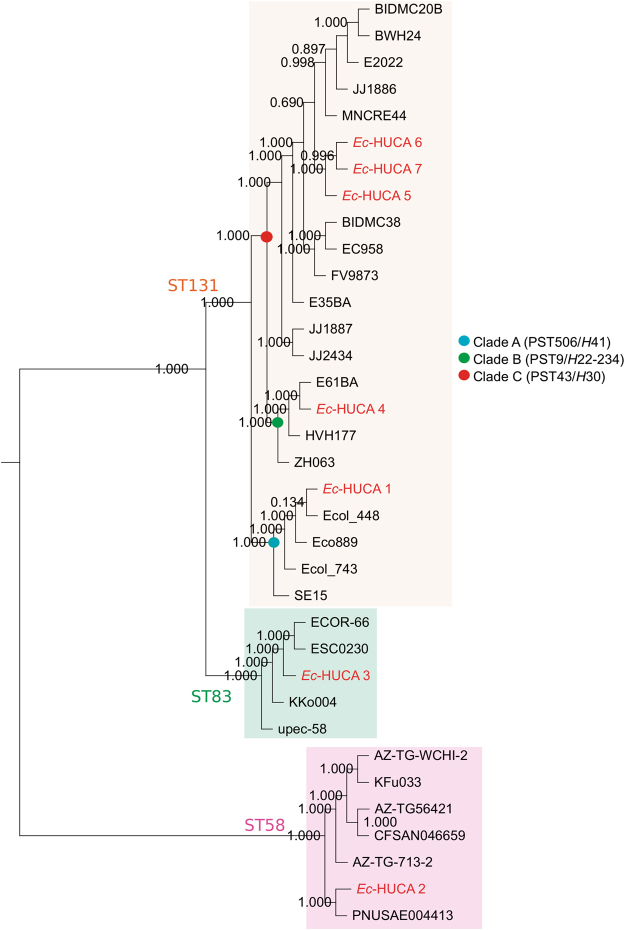
Phylogenetic tree of the OXA-48-producing Escherichia coli genomes. The tree is based on the core genome SNPs (3,154,218 bp ± 1716 bp; 3185 CDS with ≥80% identity, ≥60% pairwise alignment coverage). Bootstrap support values of 1,000 replicates are shown at the nodes. The ST131 clades are indicated with blue (Clade A, PST506/fimH41), green (Clade B, PST9/fimH22-234) and red (Clade C, PST43/fimH30) circles.

References

    1. Riley LW. Pandemic lineages of extraintestinal pathogenic Escherichia coli. Clin. Microbiol. Infect. 2014;20:380–390. doi: 10.1111/1469-0691.12646. - DOI - PubMed
    1. Petty NK, et al. Global dissemination of a multidrug resistant Escherichia coli clone. Proc. Natl. Acad. Sci. 2014;111:5694–5699. doi: 10.1073/pnas.1322678111. - DOI - PMC - PubMed
    1. Nicolas-Chanoine M-H, et al. Intercontinental emergence of Escherichia coli clone O25:H4-ST131 producing CTX-M-15. J. Antimicrob. Chemother. 2008;61:273–281. doi: 10.1093/jac/dkm464. - DOI - PubMed
    1. Patel, G. & Bonomo, R. A. ‘Stormy waters ahead’: Global emergence of carbapenemases. Frontiers in Microbiology4 (2013). - PMC - PubMed
    1. Poirel L, Potron A, Nordmann P. OXA-48-like carbapenemases: the phantom menace. J. Antimicrob. Chemother. 2012;67:1597–1606. doi: 10.1093/jac/dks121. - DOI - PubMed

Publication types

MeSH terms

Substances

LinkOut - more resources