Effect of Cordyceps sinensis on the Treatment of Experimental Autoimmune Encephalomyelitis: A Pilot Study on Mice Model
- PMID: 28937034
- PMCID: PMC5634078
- DOI: 10.4103/0366-6999.215335
Effect of Cordyceps sinensis on the Treatment of Experimental Autoimmune Encephalomyelitis: A Pilot Study on Mice Model
Abstract
Background: As a traditional Chinese medicine, Cordyceps sinensis (CS) possesses a variety of immunoregulatory properties. This study aimed to explore the therapeutic potential of CS in a mice model of multiple sclerosis (MS)-experimental autoimmune encephalomyelitis (EAE).
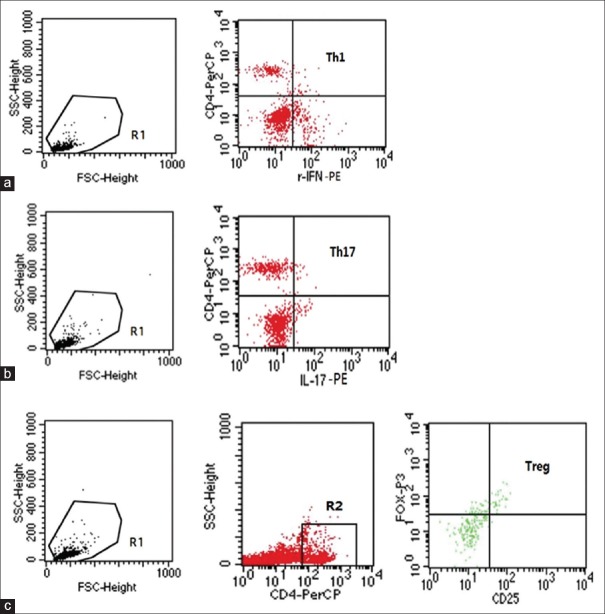
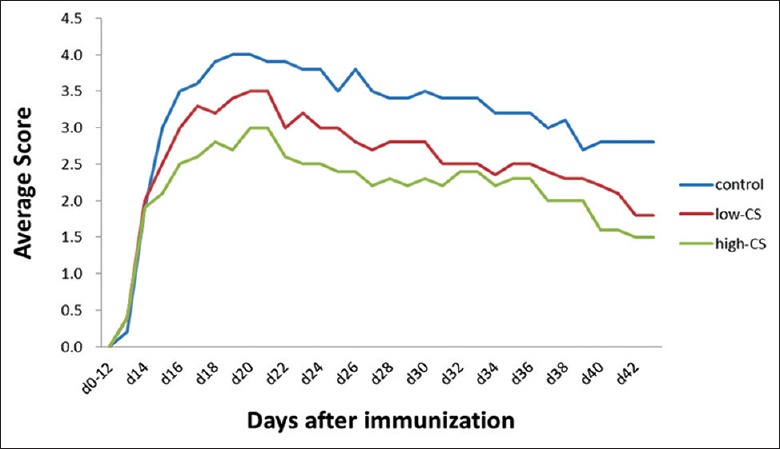
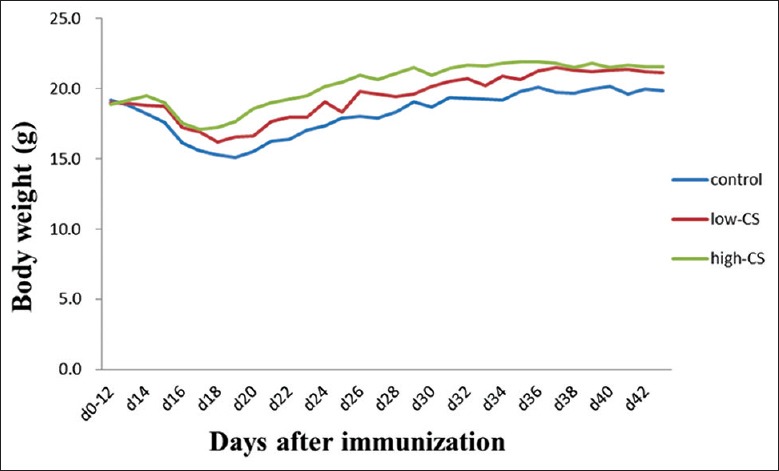
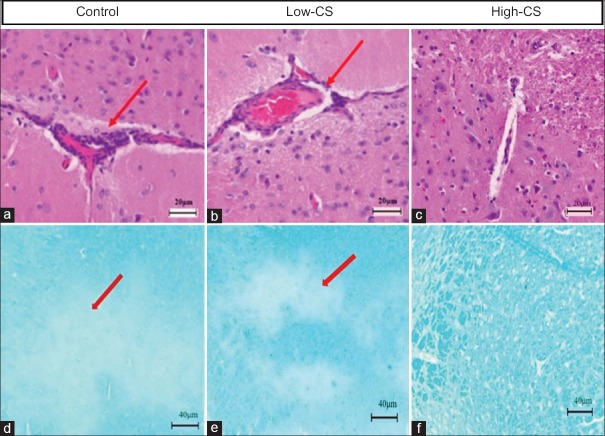
Methods: Female C57BL/6 mice were immunized with myelin oligodendrocyte glycoprotein35-55to induce EAE, followed by an instant intragastric feeding with a low dosage of CS (low-CS group, n = 5), high dosage of CS (high-CS group, n = 5), or the same volume of normal saline (control group, n = 5). All the mice were observed for clinical assessment. Over the 30 days of CS treatment, flow cytometry was used to detect the frequency of helper T-cell (Th) subsets, Th1 and Th17, and CD4+ CD25+ regulatory T cells in the spleen and lymph nodes. Meanwhile, pathological changes in brain were determined using both hematoxylin-eosin and luxol fast blue staining. Data were analyzed using the one-way analysis of variance (ANOVA).
Results: Over the 15 and 30 days of CS treatment, the clinical assessment for EAE demonstrated that both high-CS group (2.51 ± 0.31 and 2.26 ± 0.39 scores, respectively) and low-CS group (2.99 ± 0.40 and 2.69 ± 0.46, respectively) had lower disease severity scores than those of control group (3.57 ± 0.53 and 3.29 ± 0.53, all P < 0.01, respectively). Meanwhile, after 15 and 30 days, the high-CS group (19.18 ± 1.34 g and 20.41 ± 1.56 g, respectively) and low-CS group (18.07 ± 1.18 g and 19.48 ± 1.69 g, respectively) had a lower body weight, as compared with control group (16.85 ± 1.15 g and 18.22 ± 1.63 g, all P < 0.01, respectively). At 30 days post-CS treatment, there was a lower Th1 frequency in the lymph nodes (2.85 ± 1.54% and 2.77 ± 1.07% vs. 5.35 ± 1.34%, respectively; P < 0.05) and spleens (3.96 ± 1.09% and 3.09 ± 0.84% vs. 5.07 ± 1.50%, respectively; P < 0.05) and less inflammatory infiltration and demyelination in the brain of CS-treated mice than that of control group.
Conclusions: Our preliminary study demonstrated that CS efficiently alleviated EAE severity and EAE-related pathology damage and decreased the number of Th1s in the periphery, indicating its effectiveness in the treatment of murine EAE. Thus, our findings strongly support the therapeutic potential of this agent as a new traditional Chinese medicine approach in MS treatment.
Conflict of interest statement
There are no conflicts of interest.
Figures
References
-
- Xu J, Huang Y, Chen XX, Zheng SC, Chen P, Mo MH, et al. The mechanisms of pharmacological activities of Ophiocordyceps sinensis fungi. Phytother Res. 2016;30:1572–83. doi: 10.1002/ptr.5673. - PubMed
-
- Harrison DM. In the clinic. Multiple sclerosis. Ann Intern Med. 2014;160:ITC4. doi: 10.7326/0003-4819-160-7-201404010-01004. - PubMed
-
- Criado MB, Santos MJ, Machado J, Gonçalves AM, Greten HJ. Effects of acupuncture on gait of patients with multiple sclerosis. J Altern Complement Med. 2017 [Epub ahead of print] doi: 10.1089/acm.2016.0355. - PubMed
-
- Ji X, Liu H, An C, Wang Y, Zhao H, Zhang Q, et al. You-Gui pills promote nerve regeneration by regulating netrin1, DCC and rho family GTPases RhoA, Racl, Cdc42 in C57BL/6 mice with experimental autoimmune encephalomyelitis. J Ethnopharmacol. 2016;187:123–33. doi: 10.1016/j.jep.2016.04.025. - PubMed
-
- Lalive PH, Molnarfi N, Benkhoucha M, Weber MS, Santiago-Raber ML. Antibody response in MOG(35-55) induced EAE. J Neuroimmunol. 2011;240-241:28–33. doi: 10.1016/j.jneuroim.2011.09.005. - PubMed
MeSH terms
LinkOut - more resources
Full Text Sources
Research Materials