The Epidemiology of Stress Fractures in Collegiate Student-Athletes, 2004-2005 Through 2013-2014 Academic Years
- PMID: 28937802
- PMCID: PMC5687241
- DOI: 10.4085/1062-6050-52.8.01
The Epidemiology of Stress Fractures in Collegiate Student-Athletes, 2004-2005 Through 2013-2014 Academic Years
Abstract
Context: Stress fractures are injuries caused by cumulative, repetitive stress that leads to abnormal bone remodeling. Specific populations, including female athletes and endurance athletes, are at higher risk than the general athletic population. Whereas more than 460 000 individuals participate in collegiate athletics in the United States, no large study has been conducted to determine the incidence of stress fractures in collegiate athletes.
Objective: To assess the incidence of stress fractures in National Collegiate Athletic Association (NCAA) athletes and investigate rates and patterns overall and by sport.
Design: Descriptive epidemiology study.
Setting: National Collegiate Athletic Association institutions.
Patients or other participants: National Collegiate Athletic Association athletes.
Main outcome measure(s): Data were analyzed from the NCAA Injury Surveillance Program for the academic years 2004-2005 through 2013-2014. We calculated rates and rate ratios (RRs) with 95% confidence intervals (CIs).
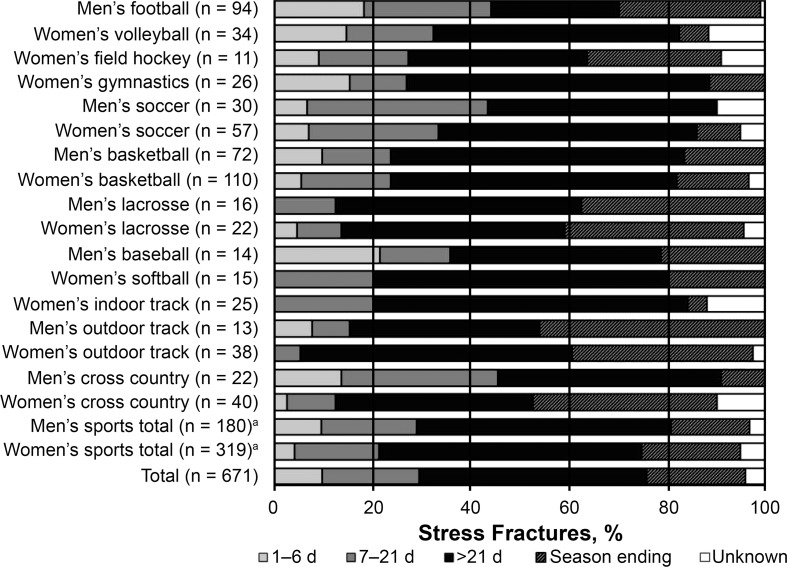
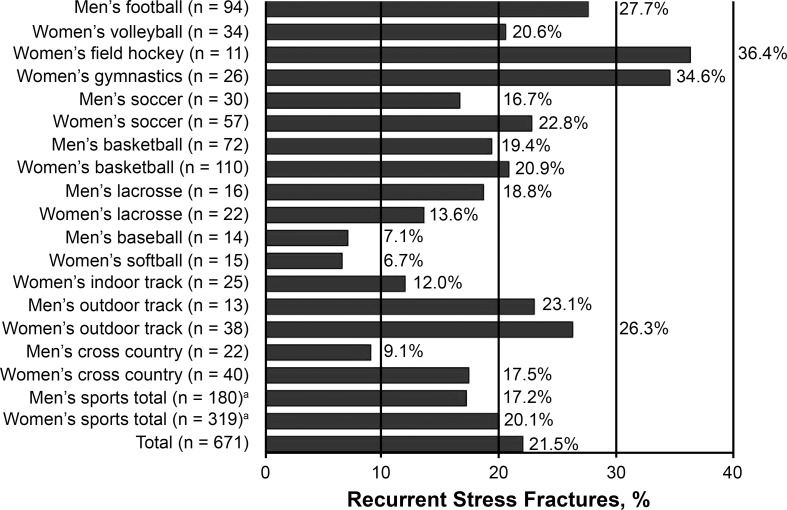
Results: A total of 671 stress fractures were reported over 11 778 145 athlete-exposures (AEs) for an overall injury rate of 5.70 per 100 000 AEs. The sports with the highest rates of stress fractures were women's cross-country ( 28.59/100 000 AEs), women's gymnastics ( 25.58/100 000 AEs), and women's outdoor track ( 22.26/100 000 AEs). Among sex-comparable sports (baseball/softball, basketball, cross-country, ice hockey, lacrosse, soccer, swimming and diving, tennis, indoor track, and outdoor track), stress fracture rates were higher in women (9.13/100 000 AEs) than in men (4.44/100 000 AEs; RR = 2.06; 95% CI = 1.71, 2.47). Overall, stress fracture rates for these NCAA athletes were higher in the preseason (7.30/100 000 AEs) than in the regular season (5.12/100 000 AEs; RR = 1.43; 95% CI = 1.22, 1.67). The metatarsals (n = 254, 37.9%), tibia (n = 147, 21.9%), and lower back/lumbar spine/pelvis (n = 81, 12.1%) were the most common locations of injury. Overall, 21.5% (n = 144) of stress fractures were recurrent injuries, and 20.7% (n = 139) were season-ending injuries.
Conclusions: Women experienced stress fractures at higher rates than men, more often in the preseason, and predominantly in the foot and lower leg. Researchers should continue to investigate biological and biomechanical risk factors for these injuries as well as prevention interventions.
Keywords: bone remodeling; injury incidence; overuse injuries.
Figures
References
-
- Bennell KL, Malcolm SA, Thomas SA, Wark JD, Brukner PD. The incidence and distribution of stress fractures in competitive track and field athletes: a twelve-month prospective study. Am J Sports Med. 1996; 24 2: 211– 217. - PubMed
-
- DiFiori JP, Benjamin HJ, Brenner J., et al. Overuse injuries and burnout in youth sports: a position statement from the American Medical Society for Sports Medicine. Clin J Sport Med. 2014; 24 1: 3– 20. - PubMed
-
- Bennell KL, Malcolm SA, Thomas SA., et al. Risk factors for stress fractures in female track-and-field athletes: a retrospective analysis. Clin J Sport Med. 1995; 5 4: 229– 235. - PubMed
-
- Beck TJ, Ruff CB, Shaffer RA, Betsinger K, Trone DW, Brodine SK. Stress fractures in military recruits: gender differences in muscle and bone susceptibility factors. Bone. 2000; 27 3: 437– 444. - PubMed
MeSH terms
LinkOut - more resources
Full Text Sources
Other Literature Sources
Medical