. 2017 Nov 1;158(11):3738-3753.
doi: 10.1210/en.2017-00098.

Targeted Disruption of YAP and TAZ Impairs the Maintenance of the Adrenal Cortex

Affiliations

Targeted Disruption of YAP and TAZ Impairs the Maintenance of the Adrenal Cortex

Adrien Levasseur et al. Endocrinology. .

Abstract

Yes-associated protein (YAP) and transcriptional coactivator with PDZ-binding motif (TAZ) are functionally redundant transcriptional regulators that are downstream effectors of the Hippo signaling pathway. They act as major regulators of stem cell maintenance, cell growth, and differentiation. To characterize their roles in the adrenal cortex, we generated a mouse model in which Yap and Taz were conditionally deleted in steroidogenic cells (Yapflox/flox;Tazflox/flox;Nr5a1cre/+). Male Yapflox/flox;Tazflox/flox;Nr5a1cre/+ mice were characterized by an age-dependent degeneration of the adrenal cortex associated with an increase in apoptosis and a progressive reduction in the expression levels of steroidogenic genes. Evaluation of the expression levels of stem and progenitor cell population markers in the adrenal glands of Yapflox/flox;Tazflox/flox;Nr5a1cre/+ mice also showed the downregulation of sonic hedgehog (Shh), a marker of the subcapsular progenitor cell population. Gross degenerative changes were not observed in the adrenal glands of Yapflox/flox;Tazflox/flox;Nr5a1cre/+ females, although steroidogenic capacity and Shh expression were reduced, suggesting that mechanisms of adrenocortical maintenance are sex specific. These results define a crucial role for YAP and TAZ in the maintenance of the postnatal adrenal cortex.


Figures

Figure 1.
Figure 1.
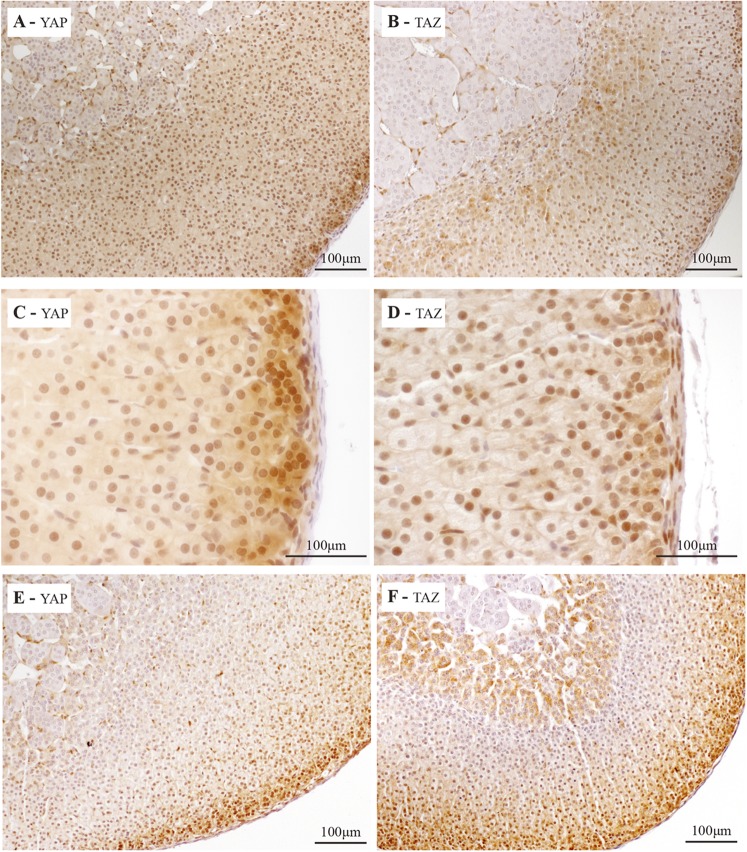
Localization of YAP and TAZ in the adrenal gland of mice. Immunohistochemical analysis of (A) YAP and (B) TAZ expression in adrenal glands from 10-week-old male mice. Immunohistochemical analysis of (C) YAP and (D) TAZ at higher magnification to illustrate expression in the capsule. Immunohistochemical analysis of (E) YAP and (F) TAZ expression in adrenal glands from a 10-week-old virgin female.
Figure 2.
Figure 2.
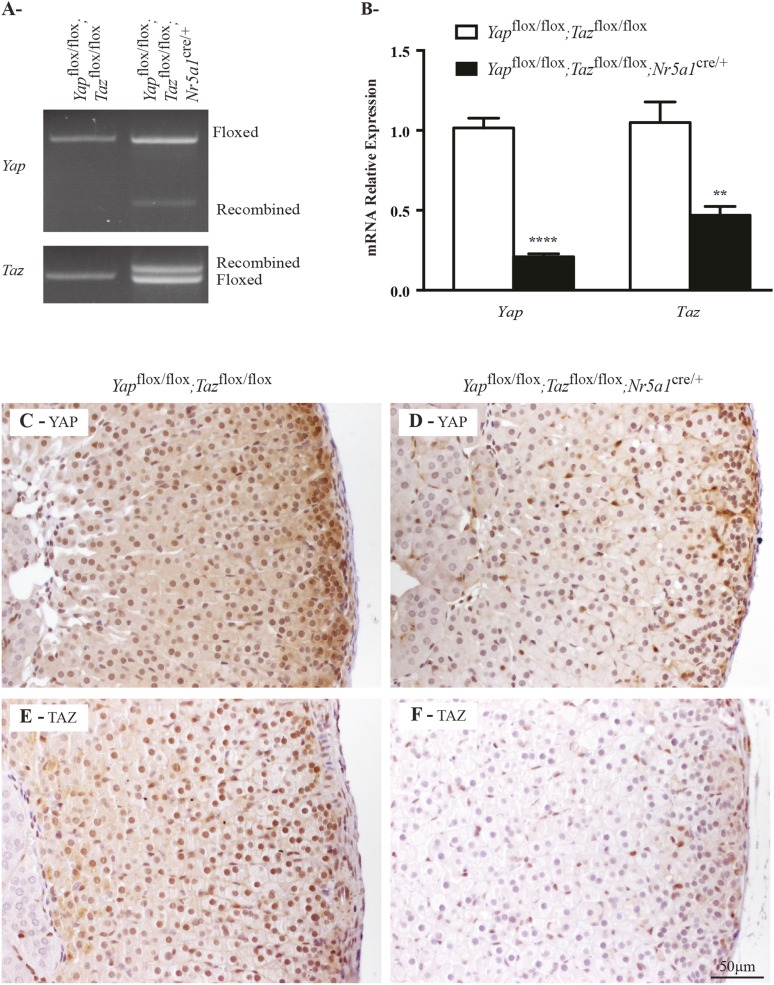
Yap and Taz knockdown efficiency in male Yapflox/flox;Tazflox/flox;Nr5a1cre/+ mice. (A) PCR genotype analyses for Yap and Taz performed on adrenal glands from 10-week-old males of the indicated genotypes. Bands corresponding to the floxed and Cre-recombined alleles are indicated. (B) qRT-PCR analysis of Yap and Taz mRNA levels in the adrenal glands of 10-week-old males of the indicated genotypes (n = 6 animals per genotype). All data were normalized to the housekeeping gene Rpl19 and are expressed as means (columns) ± standard error of the mean (error bars). Asterisks indicate significantly different from control (**P < 0.01; ****P < 0.0001). (C, D) Immunohistochemical analysis of YAP expression in adrenal glands from 10-week-old male (C) Yapflox/flox;Tazflox/flox and (D) Yapflox/flox;Tazflox/flox;Nr5a1cre/+ mice. (E, F) Immunohistochemical analysis of TAZ in adrenal glands from 10-week-old male (E) Yapflox/flox;Tazflox/flox and (F) Yapflox/flox;Tazflox/flox;Nr5a1cre/+ mice. Scale bar in (F) is valid for all images.
Figure 3.
Figure 3.
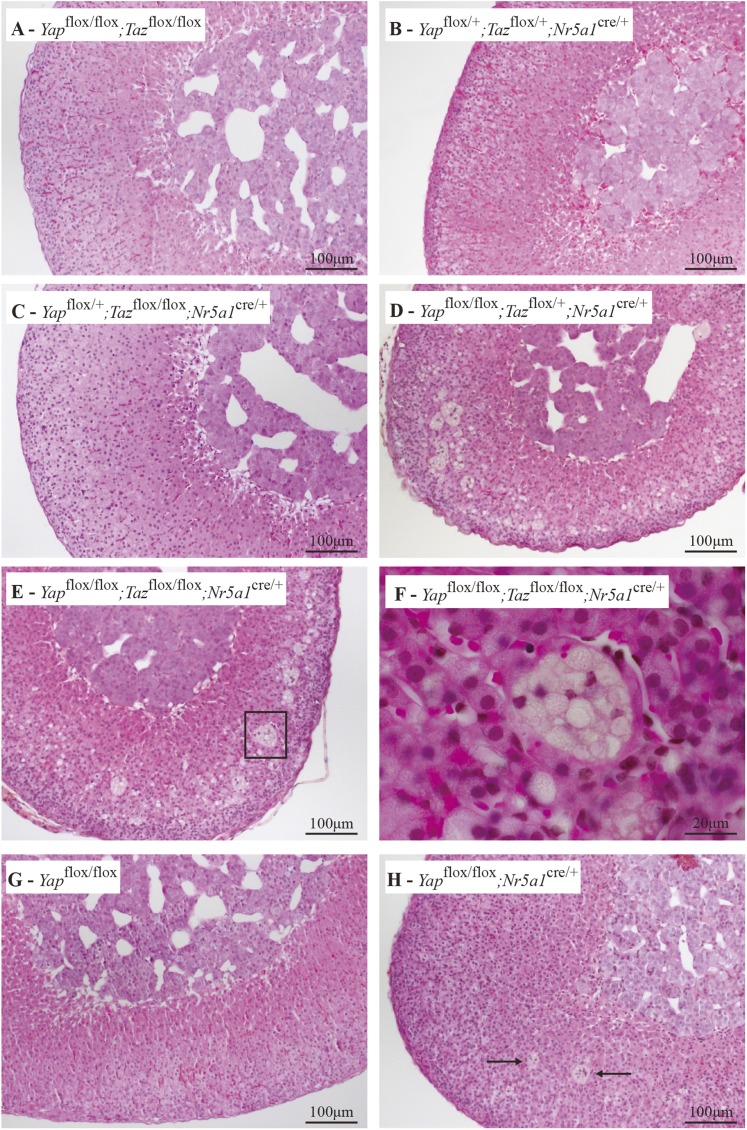
YAP and TAZ are required for the maintenance of the adrenal cortex. (A−E) Photomicrographs comparing the adrenal glands of 20-week-old male (A) Yapflox/flox;Tazflox/flox, (B) Yapflox/+;Tazflox/+;Nr5a1cre/+, (C) Yapflox/+;Tazflox/flox;Nr5a1cre/+, (D) Yapflox/flox;Tazflox/+;Nr5a1cre/+, and (E) Yapflox/flox;Tazflox/flox;Nr5a1cre/+ mice. (F) Higher magnification of the boxed area in photomicrograph (E). (G, H) Photomicrographs comparing the adrenal glands of 20-week-old male (G) Yapflox/flox and (H) Yapflox/flox;Nr5a1cre/+ mice (arrows indicate multinuclear lipoid structures). Hematoxylin, phloxine, and saffron stain.
Figure 4.
Figure 4.
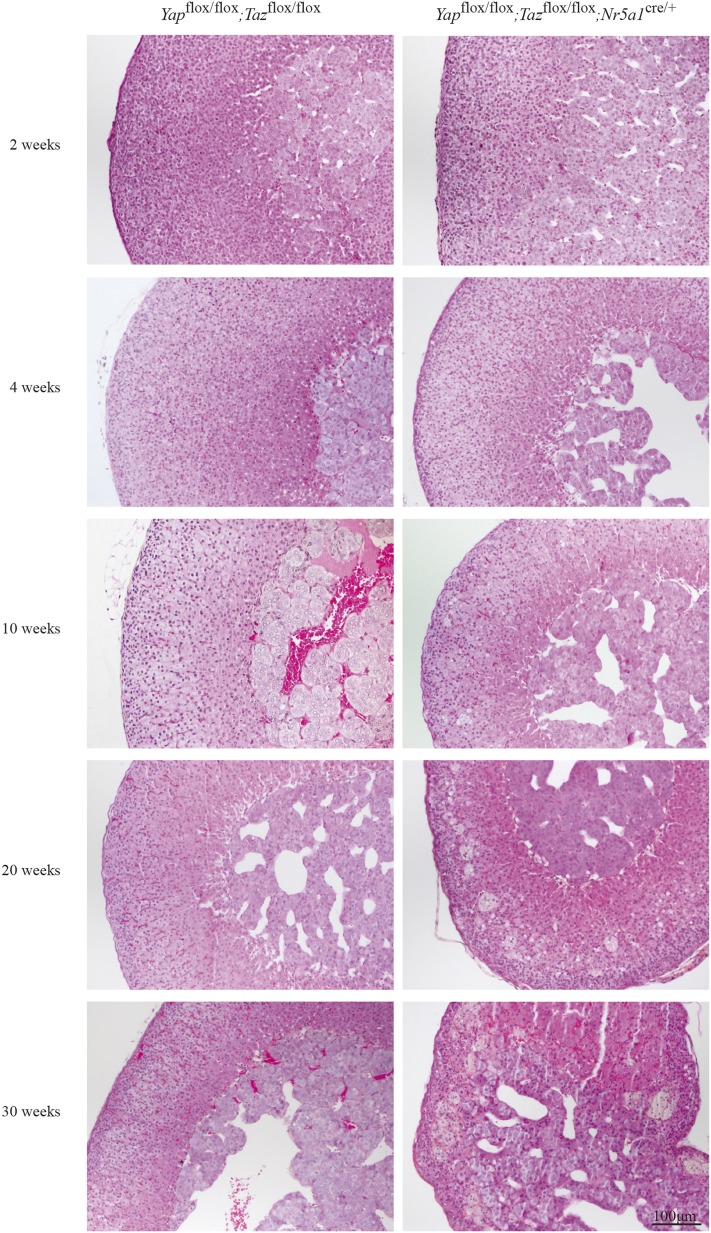
Progressive adrenal cortex degeneration in male Yapflox/flox;Tazflox/flox;Nr5a1cre/+ mice. Photomicrographs comparing adrenal gland histology of Yapflox/flox;Tazflox/flox;Nr5a1cre/+ mice with that of Yapflox/flox;Tazflox/flox controls at the indicated ages. Scale bar (lower right) is valid for all images. Hematoxylin, phloxine, and saffron stain.
Figure 5.
Figure 5.
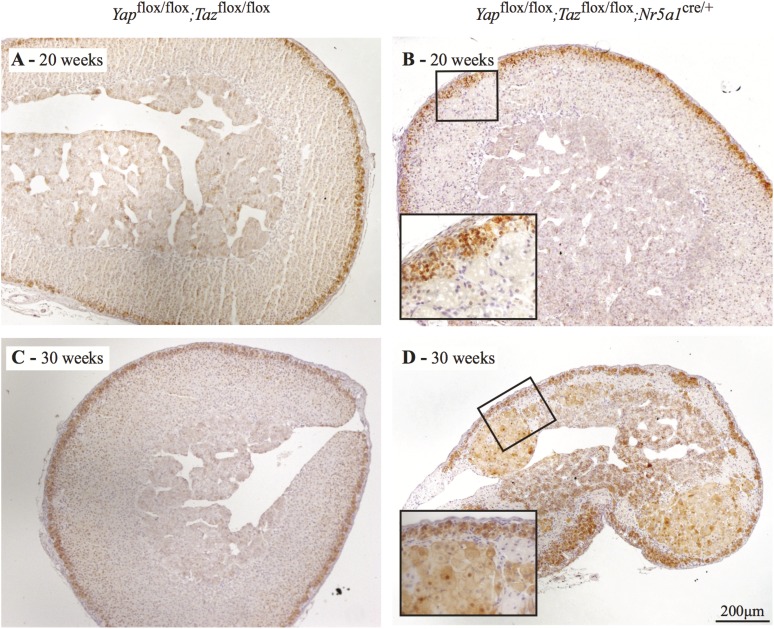
Zonation in Yapflox/flox;Tazflox/flox;Nr5a1cre/+ mice. (A−D) Immunohistochemical analysis of CTNNB1 expression in adrenal glands from 20-week-old male (A) Yapflox/flox;Tazflox/flox, (B) Yapflox/flox;Tazflox/flox;Nr5a1cre/+ mice, (C) 30-week-old male Yapflox/flox;Tazflox/flox, and (D) Yapflox/flox;Tazflox/flox;Nr5a1cre/+ mice. Insets in (B) and (D) show the expression of CTNNB1 in the zG at higher magnification. Insert in (D) also shows the expression of CTNNB1 in hypertrophic cells of the foci in the zF of mutant animals. Scale bar in (D) is valid for all images.
Figure 6.
Figure 6.
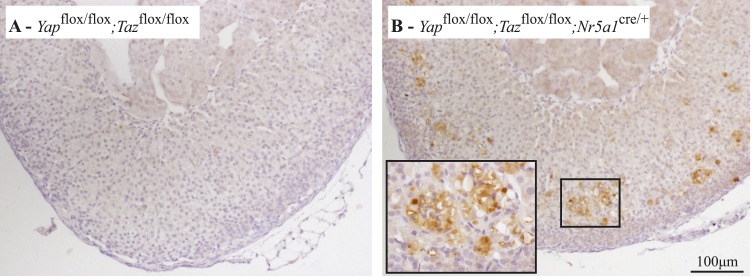
Adrenal gland degeneration in the Yapflox/flox;Tazflox/flox;Nr5a1cre/+ model is associated with apoptosis. (A, B) Immunohistochemical analysis of cleaved caspase-3 in adrenal glands from 20-week-old male (A) Yapflox/flox;Tazflox/flox and (B) Yapflox/flox;Tazflox/flox;Nr5a1cre/+ mice. Insets in (B) show that cleaved caspase-3 expression was associated with the multinucleated vacuolar cells. Scale bar in (B) is valid for both images.
Figure 7.
Figure 7.
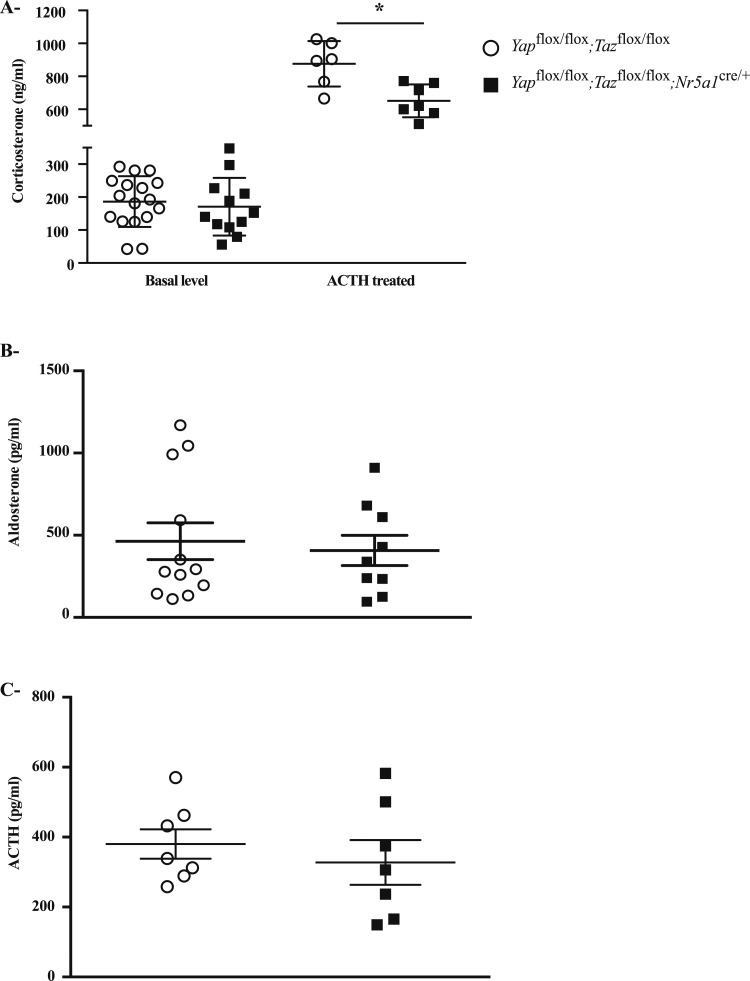
Circulating hormone levels in male Yapflox/flox;Tazflox/flox;Nr5a1cre/+ mice. (A) Serum corticosterone levels from untreated and ACTH-treated 10-week-old male Yapflox/flox;Tazflox/flox and Yapflox/flox;Tazflox/flox;Nr5a1cre/+ mice. (B) Serum aldosterone levels from 20-week-old male Yapflox/flox;Tazflox/flox and Yapflox/flox;Tazflox/flox;Nr5a1cre/+ mice. (C) Plasma ACTH levels in 10-week-old male Yapflox/flox;Tazflox/flox and Yapflox/flox;Tazflox/flox;Nr5a1cre/+ mice. Sample numbers analyzed varied by hormonal test and genotype. Values for Yapflox/flox;Tazflox/flox mice were basal corticosterone: n = 17; ACTH-induced corticosterone: n = 6; aldosterone: n = 12; and ACTH: n = 7. Values for Yapflox/flox;Tazflox/flox;Nr5a1cre/+ mice were basal corticosterone: n = 12; ACTH-induced corticosterone: n = 7; aldosterone: n = 9; and ACTH: n = 7. Data are expressed as mean (columns) ± standard error of the mean (error bars). Asterisks indicate significantly different from control (*P < 0.05).
Figure 8.
Figure 8.
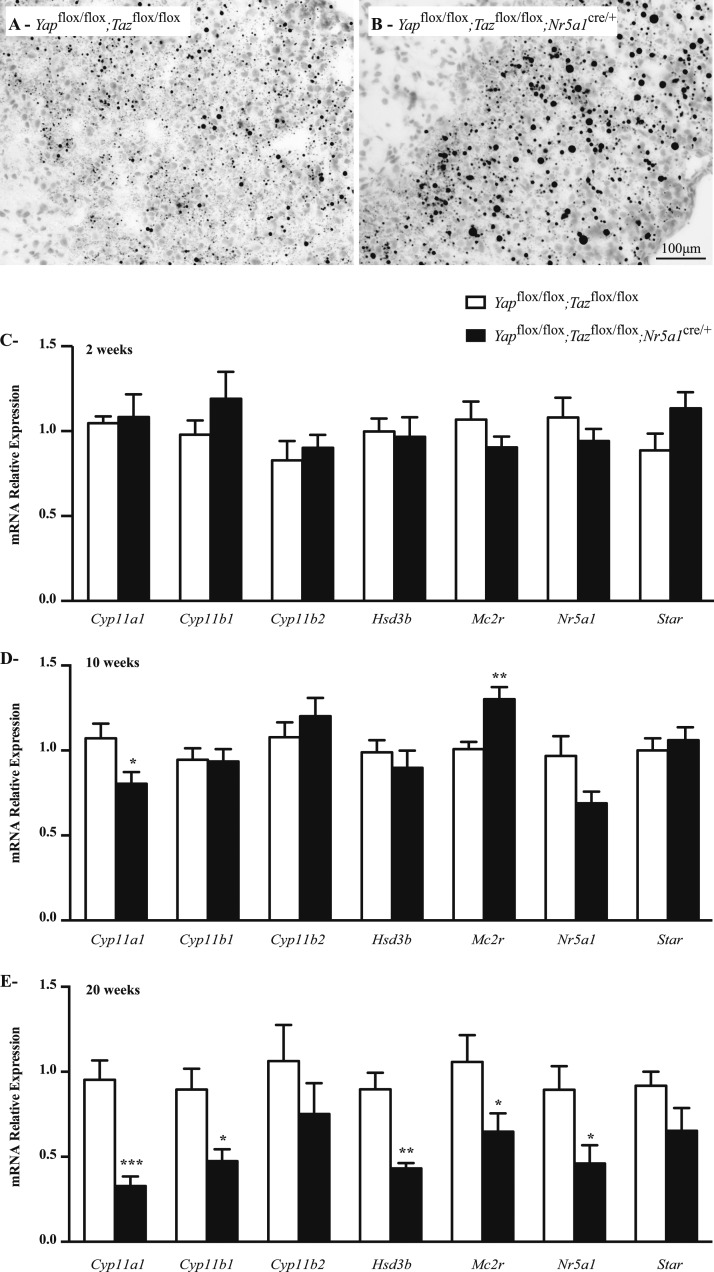
Lipid accumulation and expression of steroidogenic genes were altered in the adrenal glands of male Yapflox/flox;Tazflox/flox;Nr5a1cre/+ mice. (A, B) Oil Red O staining of adrenal glands of 10-week-old male (A) Yapflox/flox;Tazflox/flox and (B) Yapflox/flox;Tazflox/flox;Nr5a1cre/+ mice. (C−E) qRT-PCR analysis of genes involved in steroidogenesis in adrenal gland from (C) 2-week-old, (D) 10-week-old, and (E) 20-week-old male mice of the indicated genotypes (n = 6 animals per genotype). All data were normalized to the housekeeping gene Rpl19 and are expressed as mean (columns) ± standard error of the mean (error bars). Asterisks indicate significantly different from control (*P < 0.05; **P < 0.01; ***P < 0.001).
Figure 9.
Figure 9.
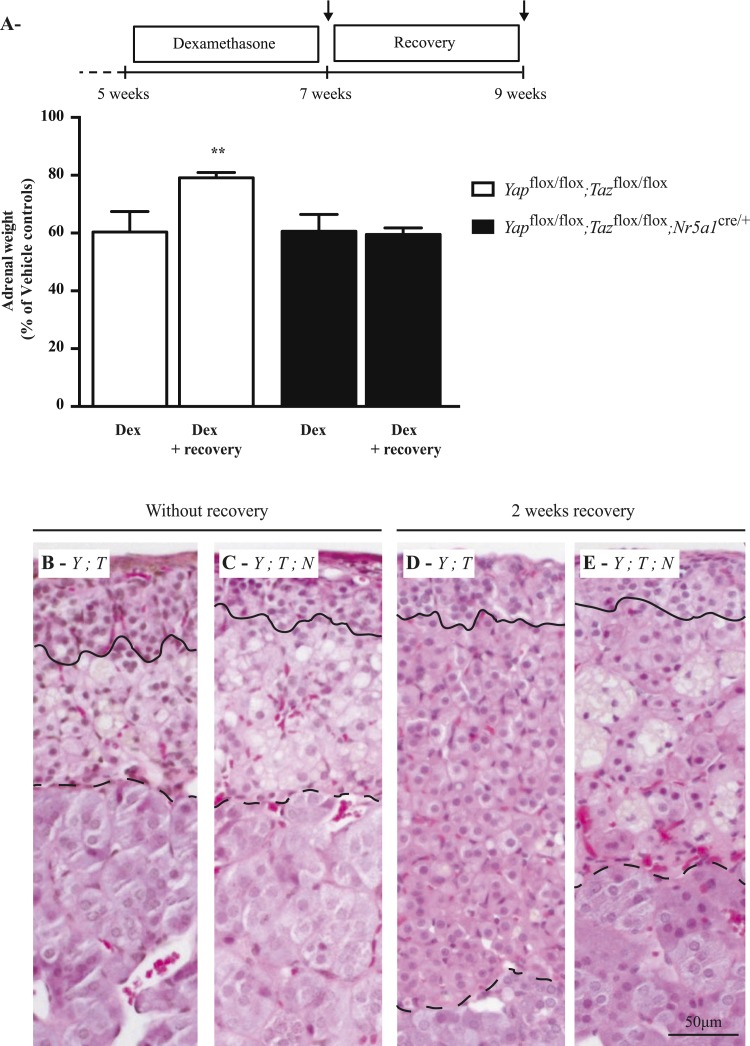
Regeneration of the zF after dexamethasone treatment was impaired in male Yapflox/flox;Tazflox/flox;Nr5a1cre/+ mice. (A) Comparison of adrenal weights of male Yapflox/flox;Tazflox/flox and Yapflox/flox;Tazflox/flox;Nr5a1cre/+ mice 2 weeks after dexamethasone treatment and 2 weeks after dexamethasone treatment with a 2-week recovery period (n = 8 animals per genotype; vehicle = 0.05% ethanol). Data are expressed as means (columns) ± standard error of the mean (error bars) and are presented as percentage of vehicle controls. Asterisks indicate significantly different from control (**P < 0.01). (B−E) Photomicrographs comparing the adrenal glands of (B) Yapflox/flox;Tazflox/flox mice with those of (C) Yapflox/flox;Tazflox/flox;Nr5a1cre/+ mice 2 weeks after dexamethasone treatment, and adrenal glands of (D) Yapflox/flox;Tazflox/flox mice with those of (E) Yapflox/flox;Tazflox/flox;Nr5a1cre/+ mice 2 weeks after dexamethasone treatment with a 2-week recovery period. The line indicates the border between zG and the zF. The dashed line indicates the border between the zF and the medulla. Scale bar (lower right) is valid for all images. Hematoxylin, phloxine, and saffron stain. Dex, dexamethasone; Y;T, Yapflox/flox;Tazflox/flox; Y;T;N, Yapflox/flox;Tazflox/flox;Nr5a1cre/+.
Figure 10.
Figure 10.
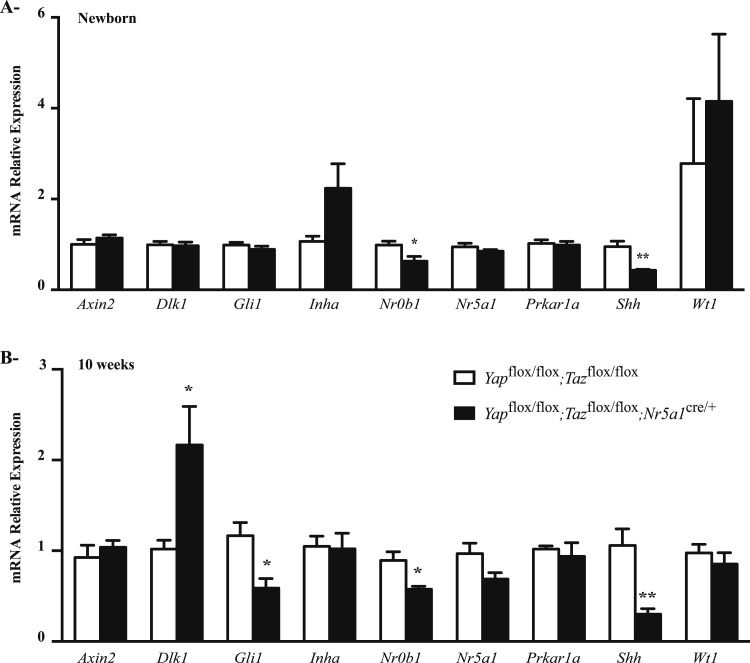
Expression of genes involved in stem cell or progenitor cell maintenance in the adrenal glands of male Yapflox/flox;Tazflox/flox;Nr5a1cre/+ mice. (A, B) qRT-PCR analysis of genes involved in stem cell or progenitor cell maintenance in adrenal glands from (A) newborn and (B) 10-week-old male mice of the indicated genotypes (n = 6 animals per genotype). All data were normalized to the housekeeping gene Rpl19 and are expressed as means (columns) ± standard error of the mean (error bars). Asterisks indicate significantly different from control (*P < 0.05; **P < 0.01).

Similar articles

Cited by

References

    1. Pihlajoki M, Dörner J, Cochran RS, Heikinheimo M, Wilson DB. Adrenocortical zonation, renewal, and remodeling. Front Endocrinol (Lausanne). 2015;6:27. - PMC - PubMed
    1. Walczak EM, Hammer GD. Regulation of the adrenocortical stem cell niche: implications for disease. Nat Rev Endocrinol. 2015;11(1):14–28. - PMC - PubMed
    1. Freedman BD, Kempna PB, Carlone DL, Shah M, Guagliardo NA, Barrett PQ, Gomez-Sanchez CE, Majzoub JA, Breault DT. Adrenocortical zonation results from lineage conversion of differentiated zona glomerulosa cells. Dev Cell. 2013;26(6):666–673. - PMC - PubMed
    1. Morley SD, Viard I, Chung BC, Ikeda Y, Parker KL, Mullins JJ. Variegated expression of a mouse steroid 21-hydroxylase/beta- galactosidase transgene suggests centripetal migration of adrenocortical cells. Mol Endocrinol. 1996;10(5):585–598. - PubMed
    1. Wood MA, Acharya A, Finco I, Swonger JM, Elston MJ, Tallquist MD, Hammer GD. Fetal adrenal capsular cells serve as progenitor cells for steroidogenic and stromal adrenocortical cell lineages in M. musculus. Development. 2013;140(22):4522–4532. - PMC - PubMed