The Association of Estrogen Receptor-β Gene Variation With Salt-Sensitive Blood Pressure
- PMID: 28938457
- PMCID: PMC5673274
- DOI: 10.1210/jc.2017-00957
The Association of Estrogen Receptor-β Gene Variation With Salt-Sensitive Blood Pressure
Abstract
Context: Hypertension in young women is uncommon compared with young men and older women. Estrogen appears to protect most women against hypertension, with incidence increasing after menopause. Because some premenopausal women develop hypertension, estrogen may play a different role in these women. Genetic variations in the estrogen receptor (ER) are associated with cardiovascular disease. ER-β, encoded by ESR2, is the ER predominantly expressed in vascular smooth muscle.
Objective: To determine an association of single nucleotide polymorphisms in ESR2 with salt sensitivity of blood pressure (SSBP) and estrogen status in women.
Methods: Candidate gene association study with ESR2 and SSBP conducted in normotensive and hypertensive women and men in two cohorts: International Hypertensive Pathotype (HyperPATH) (n = 584) (discovery) and Mexican American Hypertension-Insulin Resistance Study (n = 662) (validation). Single nucleotide polymorphisms in ESR1 (ER-α) were also analyzed. Analysis conducted in younger (<51 years, premenopausal, "estrogen-replete") and older women (≥51 years, postmenopausal, "estrogen-deplete"). Men were analyzed to control for aging.
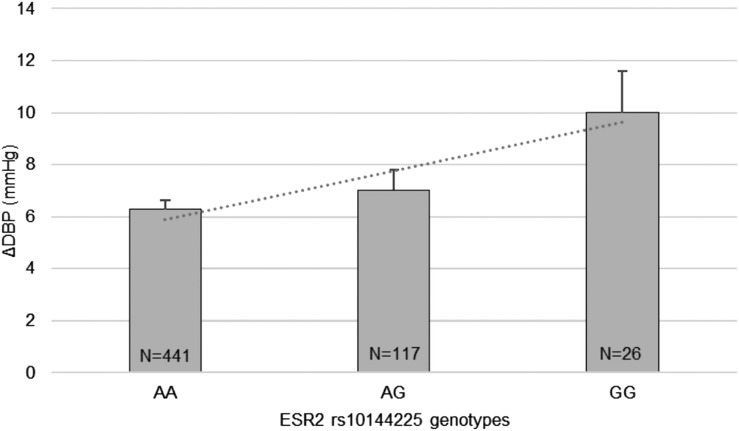
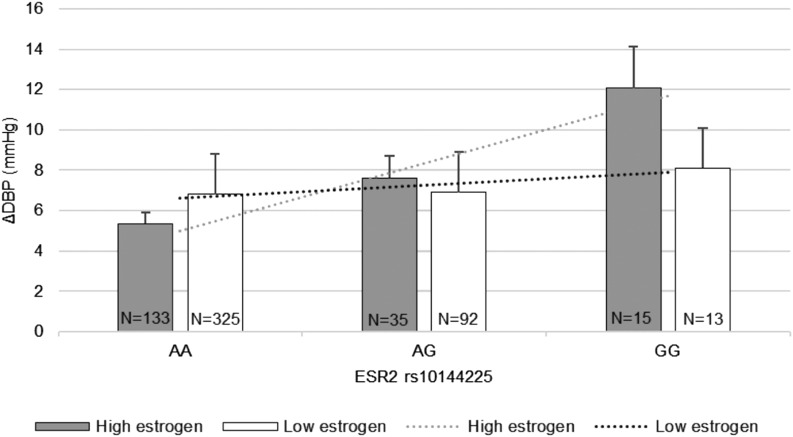
Results: Multivariate analyses of HyperPATH data between variants of ESR2 and SSBP documented that ESR2 rs10144225 minor (risk) allele carriers had a significantly positive association with SSBP driven by estrogen-replete women (β = +4.4 mm Hg per risk allele, P = 0.004). Findings were confirmed in Hypertension Insulin-Resistance Study premenopausal women. HyperPATH cohort analyses revealed risk allele carriers vs noncarriers had increased aldosterone/renin ratios. No associations were detected with ESR1.
Conclusions: The variation at rs10144225 in ESR2 was associated with SSBP in premenopausal women (estrogen-replete) and not in men or postmenopausal women (estrogen-deplete). Inappropriate aldosterone levels on a liberal salt diet may mediate the SSBP.
Copyright © 2017 Endocrine Society
Figures
References
-
- Go AS, Mozaffarian D, Roger VL, Benjamin EJ, Berry JD, Borden WB, Bravata DM, Dai S, Ford ES, Fox CS, Franco S, Fullerton HJ, Gillespie C, Hailpern SM, Heit JA, Howard VJ, Huffman MD, Kissela BM, Kittner SJ, Lackland DT, Lichtman JH, Lisabeth LD, Magid D, Marcus GM, Marelli A, Matchar DB, McGuire DK, Mohler ER, Moy CS, Mussolino ME, Nichol G, Paynter NP, Schreiner PJ, Sorlie PD, Stein J, Turan TN, Virani SS, Wong ND, Woo D, Turner MB; American Heart Association Statistics Committee and Stroke Statistics Subcommittee . Heart disease and stroke statistics 2013 update: a report from the American Heart Association. Circulation. 2013;127(1):e6–e245. - PMC - PubMed
-
- Peter I, Shearman AM, Zucker DR, Schmid CH, Demissie S, Cupples LA, Larson MG, Vasan RS, D’Agostino RB, Karas RH, Mendelsohn ME, Housman DE, Levy D. Variation in estrogen-related genes and cross-sectional and longitudinal blood pressure in the Framingham Heart Study. J Hypertens. 2005;23(12):2193–2200. - PubMed
-
- Daviglus ML, Stamler J, Pirzada A, Yan LL, Garside DB, Liu K, Wang R, Dyer AR, Lloyd-Jones DM, Greenland P. Favorable cardiovascular risk profile in young women and long-term risk of cardiovascular and all-cause mortality. JAMA. 2004;292(13):1588–1592. - PubMed
-
- Rokach A, Pollak A, Rosen L, Friedlander Y, Blumenfeld A, Reznik L, Dresner-Pollak R. Estrogen receptor alpha gene polymorphisms are associated with the angiographic extent of coronary artery disease. J Clin Endocrinol Metab. 2005;90(12):6556–6560. - PubMed
Publication types
MeSH terms
Substances
Grants and funding
LinkOut - more resources
Full Text Sources
Other Literature Sources
Medical
Miscellaneous