Review
. 2017 Jul 6;8(35):59950-59964.
doi: 10.18632/oncotarget.19048. eCollection 2017 Aug 29.

The molecular mechanisms of chemoresistance in cancers

Affiliations
Review

The molecular mechanisms of chemoresistance in cancers

Hua-Chuan Zheng. Oncotarget. .

Abstract

Overcoming intrinsic and acquired drug resistance is a major challenge in treating cancer patients because chemoresistance causes recurrence, cancer dissemination and death. This review summarizes numerous molecular aspects of multi-resistance, including transporter pumps, oncogenes (EGFR, PI3K/Akt, Erk and NF-κB), tumor suppressor gene (p53), mitochondrial alteration, DNA repair, autophagy, epithelial-mesenchymal transition (EMT), cancer stemness, and exosome. The chemoresistance-related proteins are localized to extracellular ligand, membrane receptor, cytosolic signal messenger, and nuclear transcription factors for various events, including proliferation, apoptosis, EMT, autophagy and exosome. Their cross-talk frequently appears, such as the regulatory effects of EGFR-Akt-NF-κB signal pathway on the transcription of Bcl-2, Bcl-xL and survivin or EMT-related stemness. It is essential for the realization of the target, individualized and combine therapy to clarify these molecular mechanisms, explore the therapy target, screen chemosensitive population, and determine the efficacy of chemoreagents by cell culture and orthotopic model.

Keywords: cancer; chemoresistance; chemotherapy; molecular mechanisms.


Conflict of interest statement

CONFLICTS OF INTEREST The authors declare that they have no competing interests.

Figures
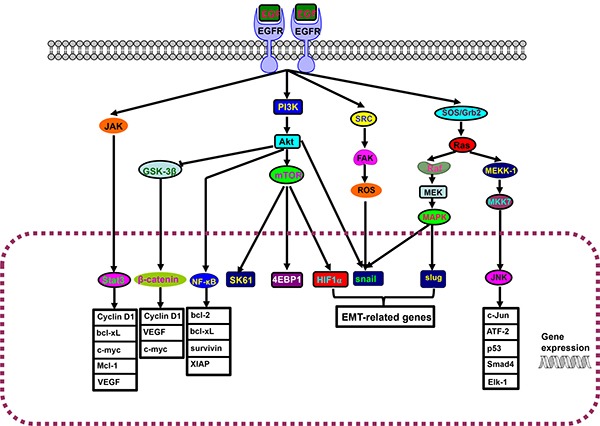
Figure 1
Figure 1. EGFR-Akt-NF-κB pathway
The interaction of epidermal growth factor receptor (EGFR) and its ligand induces the dimerization, activation of intrinsic kinase activity and subsequent autophosphorylation of EGFR Tyr 1092, Tyr 1172, Tyr 1197, Tyr 1110, Tyr 1016. JAK/stat3, PI3K/Akt/mTOR and src/FAK/ROS, SOS/Grb2/Ras pathways are triggered to result in the cytonuclear translocation of Stat3, β-catenin, NF-κB, SK61, 4EBP1, HIF1α, snail, slug and JNK for the transcriptional regulation of downstream genes.
Figure 2
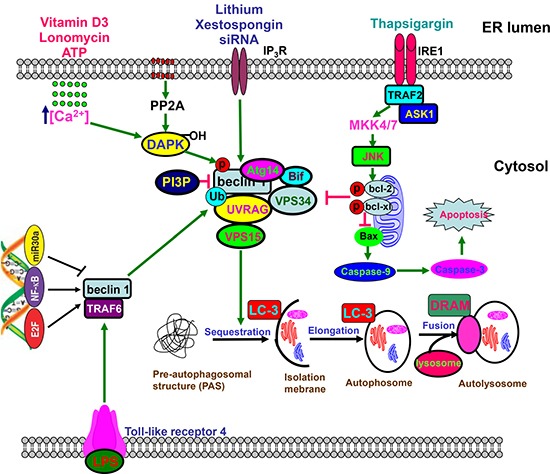
Figure 2. Beclin 1-centered autophagy
Beclin 1 functions as a scaffold for the formation of autophagosome via interaction with Atg14, URAG, Bif, Vps34, and VPS15, which can be disrupted by phosphorylation of Bcl-2 and Beclin 1, or ubiquitination of Beclin 1. The core complex, which is negatively modulated by PI3P, undergoes sequastration and enlongation to form autophosome containing organells and macromolecules, finally to produce autolysome via the fusion with lysosome. Toll-like receptor 4 ubiquitinates Beclin 1 at Lys63 via TNF receptor associated factor 6. Either JNK1-mediated Bcl-2 phosphorylation or DAPK-mediated Beclin 1 phosphorylation causes the dissociation between Beclin 1 and Bcl-2 for the reversal of Bcl-2-mediated autophagic inhibition. Beclin 1-mediated macroautophagy involves the regulation of Caspase-9 expression. However, Caspase 8- or Caspase 3-mediated cleavage of Beclin 1 reduces autophagy and promotes apoptosis. E2F and NF-κB could bind to the promoter of Becn1 for its up-regulation, while versa for miR30a.
Figure 3
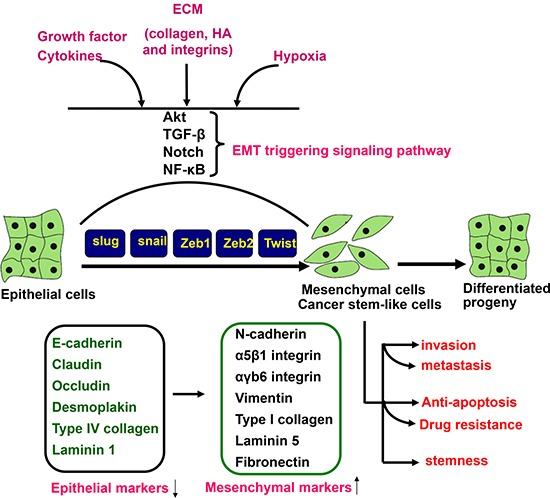
Figure 3. EMT triggering and signal transduction
EMT is triggered by the interplay of extracellular signals (collagen, hyaluronic acid and integrin), growth factors and cytokines (TGF-β, VEGF, EGF and HGF), and hypoxia. The receptor- mediated signal pathways involve Akt, smad, Notch and NF-κB, finally to up-regulate a set of transcription factors including snai1, slug, Zeb1, Zeb2, and Twist, which regulate the expression of epithelial and mesenchymal markers at a transcriptional level. Consequently, there appear the down-regulation of epithelial markers (E-cadherin, claudin, occludin, desmoplakin, type IV collagen, and laminin 1) and up-regulation of mesenchymal markers (N-cadherin, intregrin, vimentin, type I collagen, laminin 5, and fibronectin). The mesenchylmal stem -like cells displayed the aggressive phenotypes, including invasion, metastasis, anti-apoptosis, drug resistance and stemness. HA, hyaluronic acid; ECM, extracellular matrix.
Figure 4
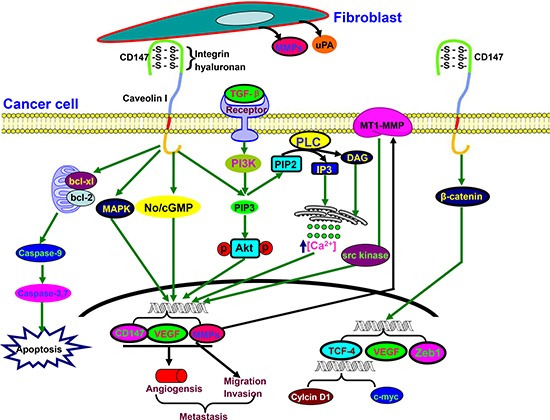
Figure 4. The biological functions of CD147
Activated CD147 might increase tumor invasion by inducing the release of MMPs and uPA in the surrounding stromal cells. It also stimulates tumor angiogenesis by elevating VEGF and MMP expression in neighboring fibroblasts and epithelial cells via microvesicle shedding. Hyaluronan, caveolin, or integrin α3β1 interacts with CD147 in cancer cells and enhances the effect of CD147 on adhesion, invasion and MMPs secretion. Up-regulated CD147 expression is induced by TGF-β coupled with epithelial-mesenchymal transition, and targets PIP3, No/cGMP, and MAPK to induce EMT for cancer invasion and metastasis. Additionally, CD147 suppresses the mitochondria-dependent apoptosis via Bcl-2 and Bcl-xL. CD147 expression is controlled by the cell survival PI3K/Akt/GSK3β signaling pathway, and is directly regulated by the transcription factor Slug. CD147 overexpression promotes the nuclear translocation of β-catenin, which up-regulates the transcriptional level of TCF-4, VEGF and Zeb1.

References

    1. Brasseur K, Gévry N, Asselin E. Chemoresistance and targeted therapies in ovarian and endometrial cancers. Oncotarget. 2017;8:4008–4042. https://doi.org/10.18632/oncotarget.14021. - DOI - PMC - PubMed
    1. Lu C, Shervington A. Chemoresistance in gliomas. Mol Cell Biochem. 2008;312:71–80. - PubMed
    1. Altenberg GA. Structure of multidrug-resistance proteins of the ATP-binding cassette (ABC) superfamily. Curr Med Chem Anticancer Agents. 2004;4:53–62. - PubMed
    1. Cole SP, Bhardwaj G, Gerlach JH, Mackie JE, Grant CE, Almquist KC, Stewart AJ, Kurz EU, Duncan AM, Deeley RG. Overexpression of a transporter gene in a multidrug-resistant human lung cancer cell line. Science. 1992;258:1650–1654. - PubMed
    1. Deeley RG, Cole SP. Substrate recognition and transport by multidrug resistance protein 1 (ABCC1) FEBS Lett. 2006;580:1103–1111. - PubMed