


Chemosensory gene expression in olfactory organs of the anthropophilic Anopheles coluzzii and zoophilic Anopheles quadriannulatus
- PMID: 28938869
- PMCID: PMC5610455
- DOI: 10.1186/s12864-017-4122-7
Chemosensory gene expression in olfactory organs of the anthropophilic Anopheles coluzzii and zoophilic Anopheles quadriannulatus
Abstract
Background: Anopheles (An.) coluzzii, one of Africa's primary malaria vectors, is highly anthropophilic. This human host preference contributes greatly to its ability to transmit malaria. In contrast, the closely related An. quadriannulatus prefers to feed on bovids and is not thought to contribute to malaria transmission. The diverged preference for host odor profiles between these sibling species is likely reflected in chemosensory gene expression levels in the olfactory organs. Therefore, we compared the transcriptomes of the antennae and maxillary palps between An. coluzzii and An. quadriannulatus, focusing on the major chemosensory gene families.
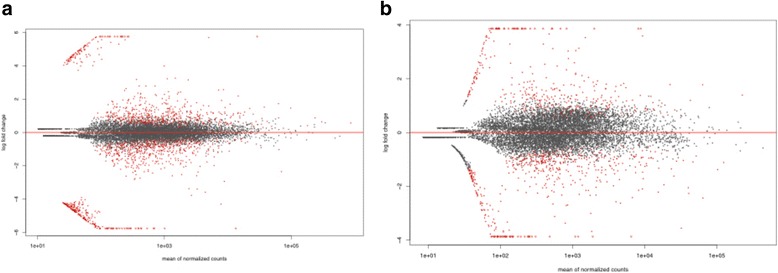
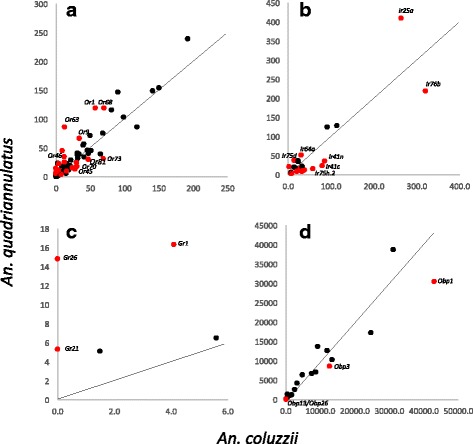
Results: While chemosensory gene expression is strongly correlated between the two species, various chemosensory genes show significantly enhanced expression in one of the species. In the antennae of An. coluzzii the expression of six olfactory receptors (Ors) and seven ionotropic receptors (Irs) is considerably enhanced, whereas 11 Ors and 3 Irs are upregulated in An. quadriannulatus. In the maxillary palps, leaving aside Irs with very low level of expression, one Ir is strongly enhanced in each species. In addition, we find divergence in odorant binding protein (Obp) gene expression, with several highly expressed Obps being enhanced in the antennae and palps of An. coluzzii. Finally, the expression of several gustatory receptors (Grs) in the palps appears to be species-specific, including a homolog of a sugar-sensing Drosophila Gr.
Conclusions: A considerable number of Ors and Irs are differentially expressed between these two closely related species with diverging host preference. These chemosensory genes could play a role in the human host preference of the malaria vector An. coluzzii. Additionally, divergence in Obp expression between the two species suggests a possible role of these odor carrier proteins in determining host preference. Finally, divergence in chemosensory expression in the palps may point towards a possible role for the maxillary palps in host differentiation.
Keywords: Antennae; Chemosensory genes; Host seeking; Malaria vector; Maxillary palp; Olfaction; RNAseq.
Conflict of interest statement
Ethics approval and consent to participate
This study did not include the use of humans, vertebrate animals of plants directly. No ethics approval is required for experimentation of the study organisms;
Competing interests
The authors declare that they have no competing interests
Publisher’s Note
Springer Nature remains neutral with regard to jurisdictional claims in published maps and institutional affiliations.
Figures

References
-
- Pates HV, Takken W, Curtis CF. Laboratory studies on the olfactory behaviour of Anopheles quadriannulatus. Entomologia Experimentalis et Applicata. 2005;114:153–159. doi: 10.1111/j.1570-7458.2005.00249.x. - DOI
MeSH terms
Substances
Grants and funding
LinkOut - more resources
Full Text Sources
Other Literature Sources
Molecular Biology Databases
