


A Distinctive and Host-Restricted Gut Microbiota in Populations of a Cactophilic Drosophila Species
- PMID: 28939605
- PMCID: PMC5691420
- DOI: 10.1128/AEM.01551-17
A Distinctive and Host-Restricted Gut Microbiota in Populations of a Cactophilic Drosophila Species
Abstract
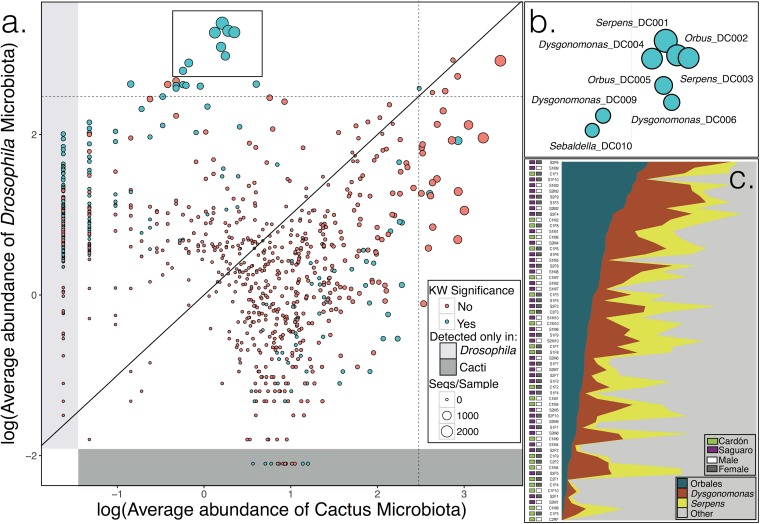
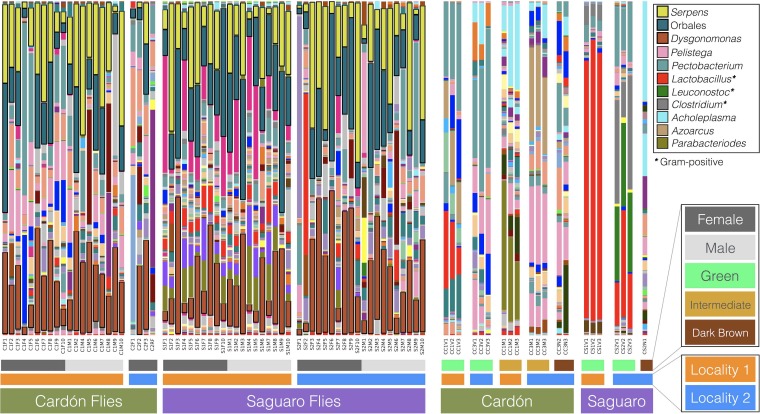
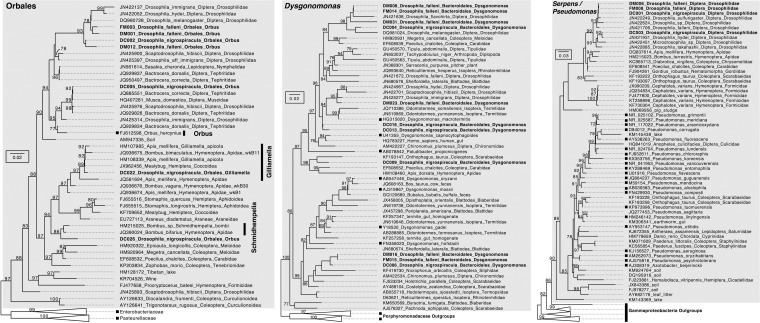
Almost all animals possess gut microbial communities, but the nature of these communities varies immensely. For example, in social bees and mammals, the composition is relatively constant within species and is dominated by specialist bacteria that do not live elsewhere; in laboratory studies and field surveys of Drosophila melanogaster, however, gut communities consist of bacteria that are ingested with food and that vary widely among individuals and localities. We addressed whether an ecological specialist in its natural habitat has a microbiota dominated by gut specialists or by environmental bacteria. Drosophila nigrospiracula is a species that is endemic to the Sonoran Desert and is restricted to decaying tissues of two giant columnar cacti, Pachycereus pringlei (cardón cactus) and Carnegiea gigantea (saguaro cactus). We found that the D. nigrospiracula microbiota differs strikingly from that of the cactus tissue on which the flies feed. The most abundant bacteria in the flies are rare or completely absent in the cactus tissue and are consistently abundant in flies from different cacti and localities. Several of these fly-associated bacterial groups, such as the bacterial order Orbales and the genera Serpens and Dysgonomonas, have been identified in prior surveys of insects from the orders Hymenoptera, Coleoptera, Lepidoptera, and Diptera, including several Drosophila species. Although the functions of these bacterial groups are mostly unexplored, Orbales species studied in bees are known to break down plant polysaccharides and use the resulting sugars. Thus, these bacterial groups appear to be specialized to the insect gut environment, where they may colonize through direct host-to-host transmission in natural settings.IMPORTANCE Flies in the genus Drosophila have become laboratory models for microbiota research, yet the bacteria commonly used in these experiments are rarely found in wild-caught flies and instead represent bacteria also present in the food. This study shows that an ecologically specialized Drosophila species possesses a distinctive microbiome, composed of bacterial types absent from the flies' natural food but widespread in other wild-caught insects. This study highlights the importance of fieldwork-informed microbiota research.
Keywords: Drosophila; Dysgonomonas; Orbales; Serpens; gut microbiota.
Copyright © 2017 American Society for Microbiology.
Figures
References
MeSH terms
Grants and funding
LinkOut - more resources
Full Text Sources
Other Literature Sources
Molecular Biology Databases
