


Frozen embryo transfer can be performed in the cycle immediately following the freeze-all cycle
- PMID: 28939988
- PMCID: PMC5758470
- DOI: 10.1007/s10815-017-1048-6
Frozen embryo transfer can be performed in the cycle immediately following the freeze-all cycle
Abstract
Purpose: In this study, we investigated whether the time interval between oocyte retrieval and frozen embryo transfer (FET) affected the live birth (LB) rates of human segmented-IVF cycles.
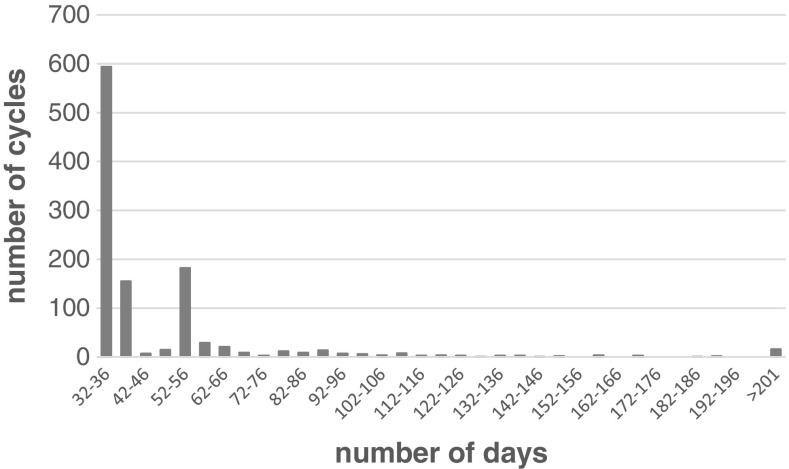
Method: A total of 1338 ICSI freeze-all cycles were performed between February 2015 and January 2016, with 1121 FET cycles being retrospectively analyzed. All vitrified-warmed blastocyst transfers were performed in artificial FET cycles, using gonadotropin-releasing hormone (GnRH) agonist downregulation and oral estrogen endometrial preparation. The primary outcome measure was LB. Cycles were investigated in oocyte retrieval-to-FET interval groups of 32-46, 47-61, 62-76, 77-91, and ≥ 92 days, with the 47-61-day group used as the reference group.
Results: There were no significant differences in LB rates between the groups in the overall analysis, as well as, in sub-analyses investigating LB in terms of single blastocyst transfer (SBT), trigger type (GnRH agonist, triggers including hCG), oocyte number (≤ 5 and ≥ 15), and maternal age (> 35 years).
Conclusion: The present study showed that it is feasible to perform transfers 36 days after oocyte retrieval and that delaying FET in freeze-all beyond the cycle immediately following oocyte retrieval does not increase LB rates.
Keywords: Blastocyst; Delay; Freeze-all; Frozen embryo transfer; Live birth.
Conflict of interest statement
Conflict of interests
The authors declare that they have no conflicts of interest.
Figures
References
-
- Chen YH, Xu XH, Wang Q, Zhang SD, Jiang LL, Zhang CL, et al. Optimum oocyte retrieved and transfer strategy in young women with normal ovarian reserve undergoing a long treatment protocol: a retrospective cohort study. J Assist Reprod Genet. 2015;32:1459–1467. doi: 10.1007/s10815-015-0571-6. - DOI - PMC - PubMed
-
- Papanikolaou EG, Bourgain C, Kolibianakis E, Tournaye H, Devroey P. Steroid receptor expression in late follicular phase endometrium in GnRH antagonist IVF cycles is already altered, indicating initiation of early luteal phase transformation in the absence of secretory changes. Hum Reprod. 2005;20:1541–1547. doi: 10.1093/humrep/deh793. - DOI - PubMed
-
- Van Vaerenbergh I, Van Lommel L, Ghislain V, In’t Veld P, Schuit F, Fatemi HM, et al. In GnRH antagonist/rec-FSH stimulated cycles, advanced endometrial maturation on the day of oocyte retrieval correlates with altered gene expression. Hum Reprod. 2009;24:1085–1091. doi: 10.1093/humrep/den501. - DOI - PubMed
MeSH terms
LinkOut - more resources
Full Text Sources
Other Literature Sources
