


A Randomized Clinical Trial Examining the Effect of Video-Based Prevention of Alcohol and Marijuana Use Among Recent Sexual Assault Victims
- PMID: 28940320
- PMCID: PMC5711597
- DOI: 10.1111/acer.13505
A Randomized Clinical Trial Examining the Effect of Video-Based Prevention of Alcohol and Marijuana Use Among Recent Sexual Assault Victims
Abstract
Background: This study examined whether a brief video intervention (Prevention of Post-Rape Stress [PPRS]) delivered in the emergency department to recent sexual assault (SA) victims reduced alcohol and marijuana use at 3 points over the course of a 6-month follow-up compared to treatment as usual (TAU) and an active control condition (Pleasant Imagery and Relaxation Instruction [PIRI]). Prior assault history, minority status, and pre-SA substance use also were examined as moderators of intervention efficacy.
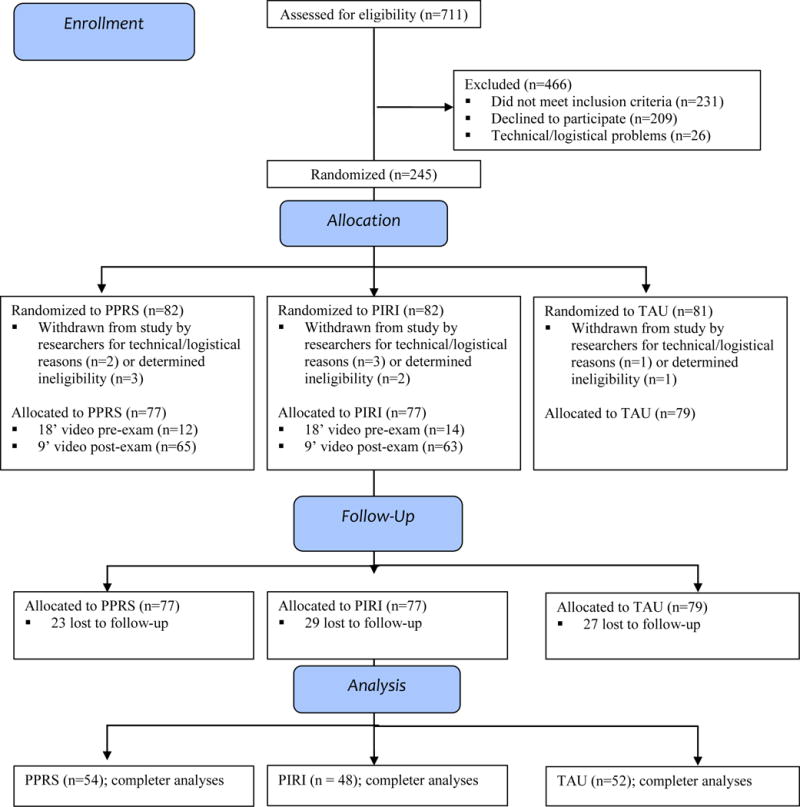
Methods: Women aged 15 and older (N = 154) who participated in a post-SA medical forensic examination were randomly assigned to watch the PPRS video (n = 54) or the PIRI video (n = 48) or receive TAU (n = 52) and completed at least 1 follow-up assessment targeted at 1.5 (T1), 3 (T2), or 6 (T3) months following the examination.
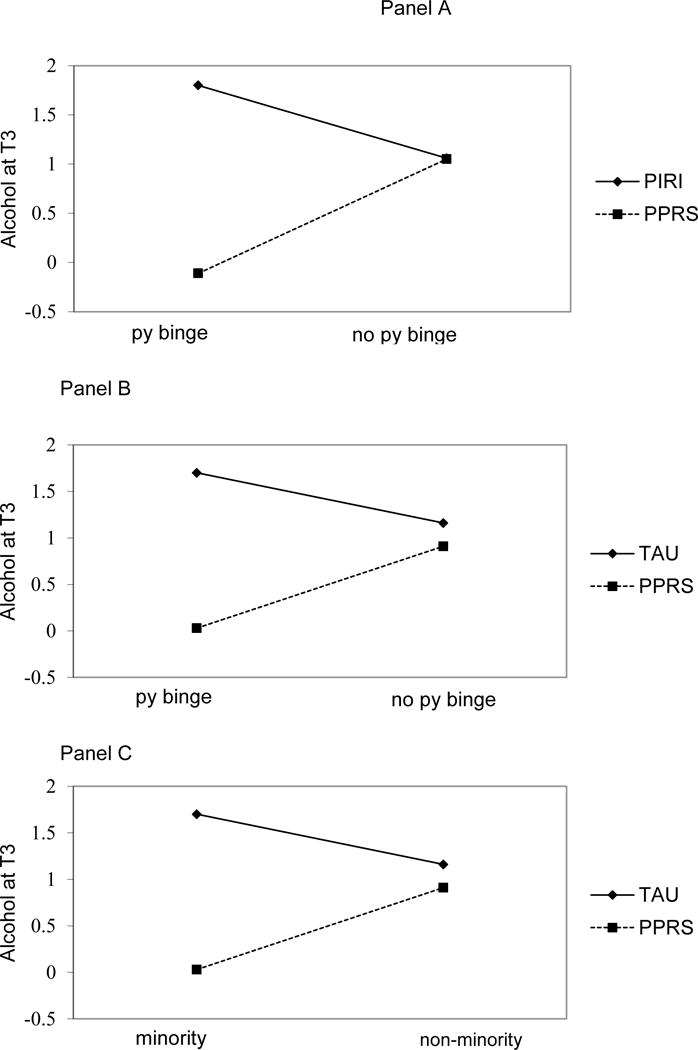
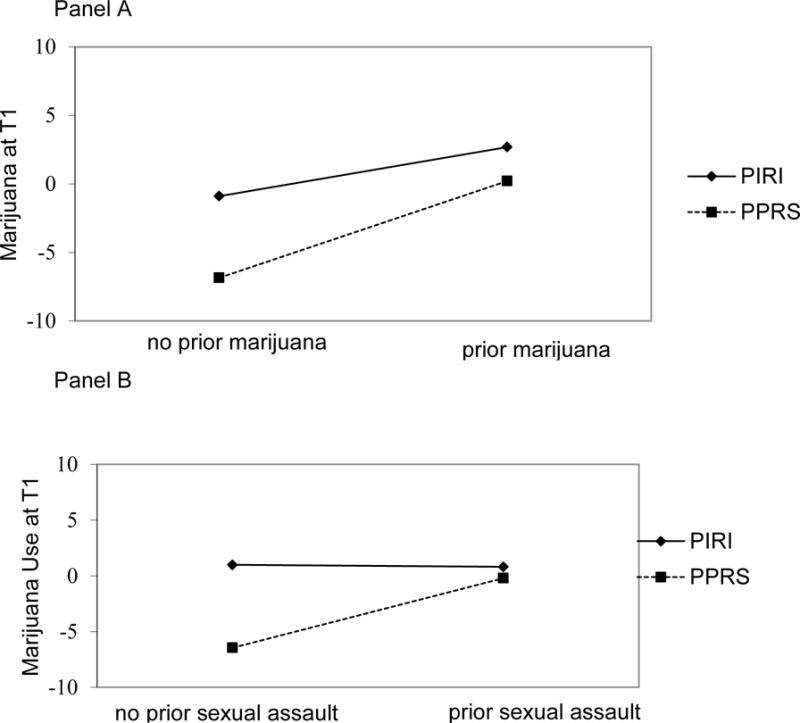
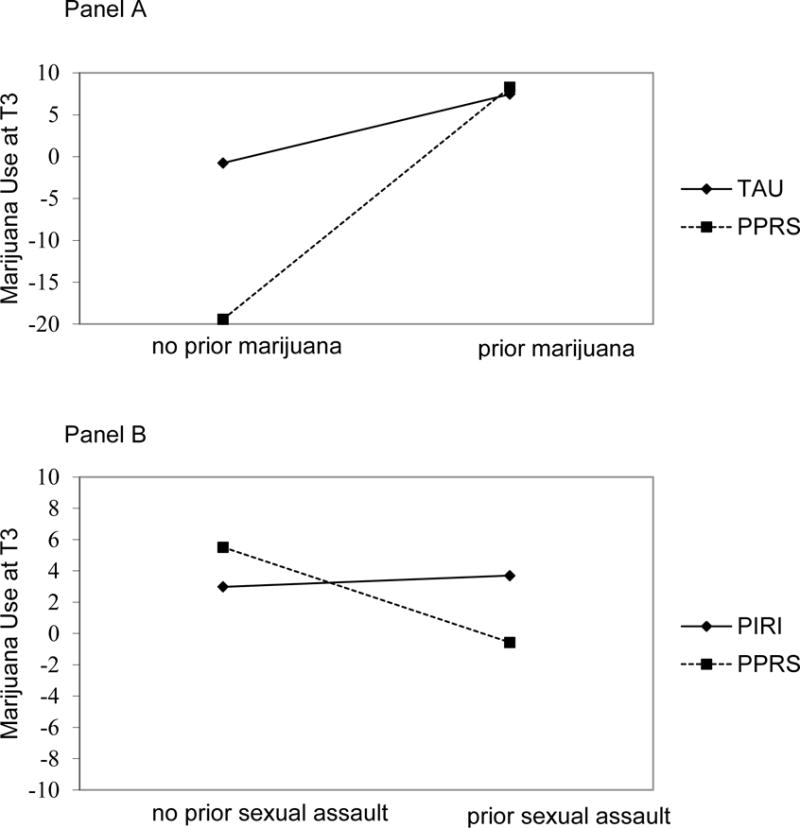
Results: Regression analyses revealed that, relative to TAU, PPRS was associated with less frequent alcohol use at 6 months post-SA among women reporting pre-SA binge drinking and minority women. Relative to TAU, PPRS also was associated with fewer days of marijuana use at T1 among those who did not report pre-SA marijuana use and prior SA. Findings for pre-SA marijuana use were maintained at T3; however, findings for prior SA shifted such that PPRS was associated with fewer days of marijuana use at T3 for women with a prior SA.
Conclusions: PPRS may be effective at reducing substance use for some recent SA victims, including those with a prior SA history, a prior substance use history, and minority women.
Keywords: RCT; Alcohol; Brief Intervention; Marijuana; Sexual Assault.
Copyright © 2017 by the Research Society on Alcoholism.
Conflict of interest statement
The authors have no conflicts of interest to declare.
Figures
References
-
- Avegno J, Mills TJ, Mills LD. Sexual assault victims in the emergency department: analysis by demographic and event characteristics. The Journal of Emergency Medicine. 2009;37:328–334. - PubMed
-
- Black MC, Basile KC, Breiding MJ, Smith SG, Walters ML, Merrick MT, Stevens M. National intimate partner and sexual violence survey. Atlanta, GA: Centers for Disease Control and Prevention; 2011. p. 75.
-
- Bryan AE, Norris J, Abdallah DA, Stappenbeck CA, Morrison DM, Davis KC, George WH, Danube CL, Zawacki T. Longitudinal change in women’s sexual victimization experiences as a function of alcohol consumption and sexual victimization history: A latent transition analysis. Psychology of violence. 2016;6:271–279. - PMC - PubMed
-
- de Meneses-Gaya C, Zuardi AW, Loureiro SR, Crippa JAS. Alcohol Use Disorders Identification Test (AUDIT): An updated systematic review of psychometric properties. Psychology & Neuroscience. 2009;2:83–97.
Publication types
MeSH terms
Grants and funding
LinkOut - more resources
Full Text Sources
Other Literature Sources
Medical
