


B cells in the pathophysiology of myasthenia gravis
- PMID: 28940642
- PMCID: PMC5767142
- DOI: 10.1002/mus.25973
B cells in the pathophysiology of myasthenia gravis
Abstract
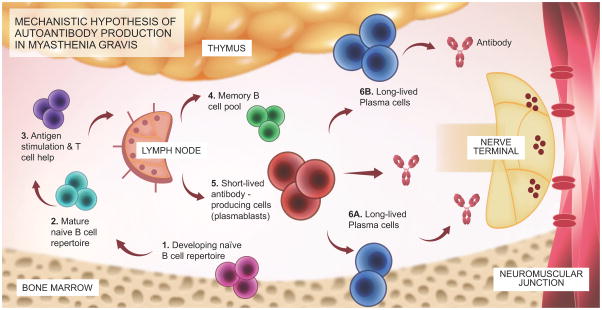
Myasthenia gravis (MG) is an archetypal autoimmune disease. The pathology is characterized by autoantibodies to the acetylcholine receptor (AChR) in most patients or to muscle-specific tyrosine kinase (MuSK) in others and to a growing number of other postsynaptic proteins in smaller subsets. A decrease in the number of functional AChRs or functional interruption of the AChR within the muscle end plate of the neuromuscular junction is caused by pathogenic autoantibodies. Although the molecular immunology underpinning the pathology is well understood, much remains to be learned about the cellular immunology contributing to the production of autoantibodies. This Review documents research concerning the immunopathology of MG, bringing together evidence principally from human studies with an emphasis on the role of adaptive immunity and B cells in particular. Proposed mechanisms for autoimmunity, which take into account that different types of MG may incorporate divergent immunopathology, are offered. Muscle Nerve 57: 172-184, 2018.
Keywords: AChR; B cells; B lymphocytes; MuSK; autoantibodies; autoimmunity; immunopathology; myasthenia gravis.
© 2017 Wiley Periodicals, Inc.
Conflict of interest statement
Conflict of interests/financial disclosures: KCO has received personal compensation in the past year from Genentech for educational activities and from Proclara Biosciences and Editas Medicine for consulting services. JTG has received personal compensation in the past year from Jacobus Pharmaceuticals, argenx, and UCB Pharma for consulting services and from Grifols for educational activities. RJN reports support through an investigator-initiated trial agreement from Genentech for placebo/drug for the currently underway clinical trial (
Figures
Comment in
-
B cells in the pathophysiology of myasthenia gravis: Is there a role for cladribine?Muscle Nerve. 2018 Dec;58(6):E41. doi: 10.1002/mus.26318. Muscle Nerve. 2018. PMID: 30106475 No abstract available.
References
-
- Vincent A. Unravelling the pathogenesis of myasthenia gravis. Nat Rev Immunol. 2002;2(10):797–804. - PubMed
-
- Gilhus NE. Myasthenia Gravis. N Engl J Med. 2016;375(26):2570–2581. - PubMed
-
- Phillips LH., 2nd The epidemiology of myasthenia gravis. Ann N Y Acad Sci. 2003;998:407–412. - PubMed
-
- Santos E, Coutinho E, Moreira I, Silva AM, Lopes D, Costa H, Silveira F, Nadais G, Morais H, Martins J, Branco MC, Veiga A, Silva RS, Ferreira A, Sousa F, Freijo M, Matos I, Andre R, Negrao L, Fraga C, Santos M, Sampaio M, Lopes C, Leite MI, Goncalves G. Epidemiology of myasthenia gravis in Northern Portugal: Frequency estimates and clinical epidemiological distribution of cases. Muscle Nerve. 2016;54(3):413–421. - PubMed
-
- Lefter S, Hardiman O, Ryan AM. A population-based epidemiologic study of adult neuromuscular disease in the Republic of Ireland. Neurology. 2016 - PubMed
Publication types
MeSH terms
Grants and funding
LinkOut - more resources
Full Text Sources
Other Literature Sources
Medical
