


Influence of Various Factors on Circulating 25(OH) Vitamin D Concentrations in Dogs with Cancer and Healthy Dogs
- PMID: 28941306
- PMCID: PMC5697176
- DOI: 10.1111/jvim.14834
Influence of Various Factors on Circulating 25(OH) Vitamin D Concentrations in Dogs with Cancer and Healthy Dogs
Abstract
Background: Low blood 25-hydroxyvitamin D (25(OH)D) concentrations have been associated with cancer in dogs. Little research has examined what other factors may affect 25(OH)D concentrations.
Objectives: (1) To determine whether the presence of cancer (lymphoma, osteosarcoma, or mast cell tumor [MCT]) in dogs is associated with plasma 25(OH)D concentrations and (2) identify other factors related to plasma 25(OH)D concentrations in dogs.
Animals: Dogs newly diagnosed with osteosarcoma (n = 21), lymphoma (n = 27), and MCT (n = 21) presented to a tertiary referral oncology center, and healthy, client-owned dogs (n = 23).
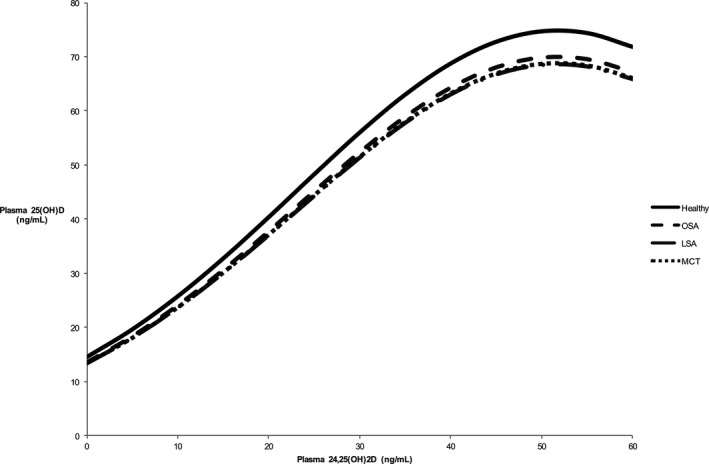
Methods: An observational study design was used. Dietary vitamin D intake, sex, age, body condition score (BCS), muscle condition score (MCS), and plasma concentrations of 25(OH)D, 24,25-dihydroxyvitamin D (24,25(OH)2 D) (a marker of CYP24A1 activity), as well as ionized calcium (ICa), parathyroid hormone, and parathyroid hormone-related protein concentrations were measured. An analysis of covariance was used to model plasma 25(OH)D concentrations.
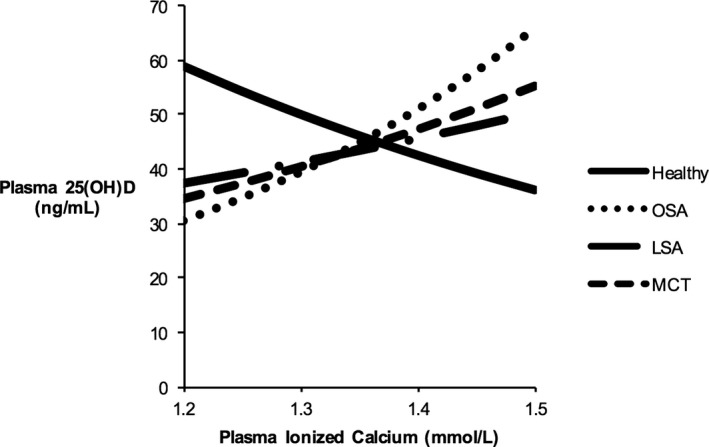
Results: Cancer type (P = 0.004), plasma 24,25(OH)2 D concentrations (P < 0.001), and plasma ICa concentrations (P = 0.047) had significant effects on plasma 25(OH)D concentrations. Effects of age, sex, body weight, BCS, MCS, and plasma PTH concentrations were not identified. A significant interaction between ICa and cancer was found (P = 0.005). Plasma 25(OH)D concentrations increased as ICa concentrations increased in dogs with cancer, whereas plasma 25(OH)D concentrations decreased as ICa concentrations increased in healthy dogs.
Conclusions and clinical importance: Results support a relationship between cancer and altered vitamin D metabolism in dogs, mediated by plasma ICa concentrations. The CYP24A1 activity and plasma ICa should be measured in studies examining plasma 25(OH)D concentrations in dogs.
Keywords: 24,25-dihydroxyvitamin D; 25-hydroxyvitamin D; Lymphoma; Osteosarcoma.
Copyright © 2017 The Authors. Journal of Veterinary Internal Medicine published by Wiley Periodicals, Inc. on behalf of the American College of Veterinary Internal Medicine.
Conflict of interest statement
Julie Bayle is a paid employee of Royal Canin. Adronie Verbrugghe is the Royal Canin Veterinary Diets Endowed Chair in Canine and Feline Clinical Nutrition at the Ontario Veterinary College.
Figures
References
-
- Bronson RT. Variation in age at death of dogs of different sexes and breeds. Am J Vet Res 1982;43:2057–2059. - PubMed
-
- Adams VJ, Evans KM, Sampson J, Wood JL. Methods and mortality results of a health survey of purebred dogs in the UK. J Small Anim Pract 2010;51:512–524. - PubMed
-
- Canadian Cancer Society's Advisory Committee on Cancer Statistics . Canadian Cancer Statistics 2015. Toronto, ON: Canadian Cancer Society; 2015.
-
- World Cancer Research Fund/American Institute for Cancer Research . Food, Nutrition, Physical Activity, and the Prevention of Cancer: A Global Perspective. Washington, DC: World Cancer Research Fund/American Institute for Cancer Research; 2007.
-
- Kushi LH, Doyle C, McCullough M, et al. American Cancer Society Guidelines on nutrition and physical activity for cancer prevention: Reducing the risk of cancer with healthy food choices and physical activity. CA Cancer J Clin 2012;62:30–67. - PubMed
Publication types
MeSH terms
Substances
LinkOut - more resources
Full Text Sources
Other Literature Sources
Medical
Research Materials
Miscellaneous
