Review
. 2017 Oct;64(5):1017-1037.
doi: 10.1016/j.pcl.2017.06.004.

Pathophysiology and Management of Acute Respiratory Distress Syndrome in Children

Affiliations
Review

Pathophysiology and Management of Acute Respiratory Distress Syndrome in Children

Sabrina M Heidemann et al. Pediatr Clin North Am. 2017 Oct.

Abstract

Acute respiratory distress syndrome (ARDS) is a syndrome of noncardiogenic pulmonary edema and hypoxia that accompanies up to 30% of deaths in pediatric intensive care units. Pediatric ARDS (PARDS) is diagnosed by the presence of hypoxia, defined by oxygenation index or Pao2/Fio2 ratio cutoffs, and new chest infiltrate occurring within 7 days of a known insult. Hallmarks of ARDS include hypoxemia and decreased lung compliance, increased work of breathing, and impaired gas exchange. Mortality is often accompanied by multiple organ failure. Although many modalities to treat PARDS have been investigated, supportive therapies and lung protective ventilator support remain the mainstay.

Keywords: Acute lung injury; Acute respiratory distress syndrome; PARDS; Pathophysiology; Pediatrics.


Figures

Figure 1.
Figure 1.
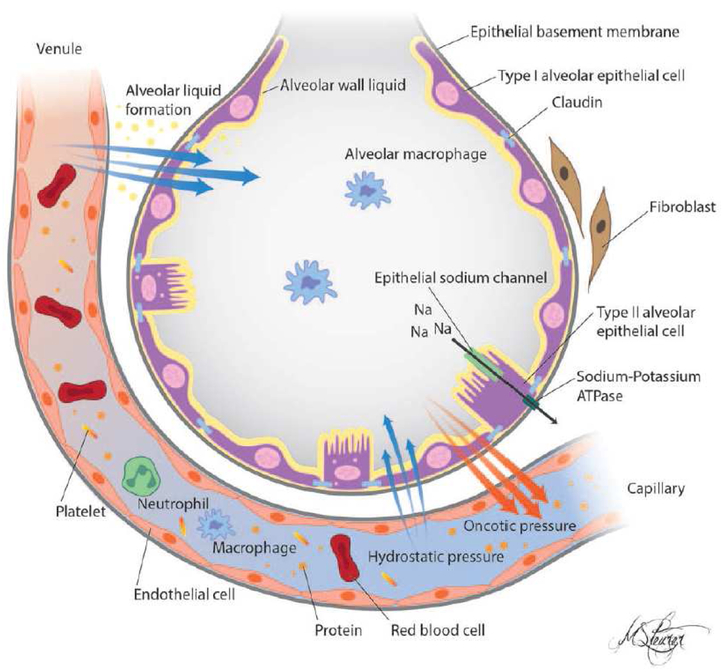
Schematic of a healthy alveolus. The alveolar epithelium and capillary endothelium are intact. The characteristics of the pulmonary circulation and intact epithelial endothelial barrier allow for formation of the alveolar wall liquid (AWL) while maintaining the air-filled, fluid-free, status of the alveoli. The AWL facilitates gas exchange and is a medium for dispersal of surfactant and alveolar macrophages, which is essential for maintaining alveolar stability and host defenses. The intact sodium-dependent vectorial transport across type II alveolar epithelial cells regulates the removal of excess alveolar fluid. From Sapru A, Flori H, et al. Pathobiology of acute respiratory distress syndrome. Pediatr Crit Care Med. 2015 Jun;16(5 Suppl 1):S6–22. doi: 10.1097/PCC.0000000000000431.
Figure 2.
Figure 2.
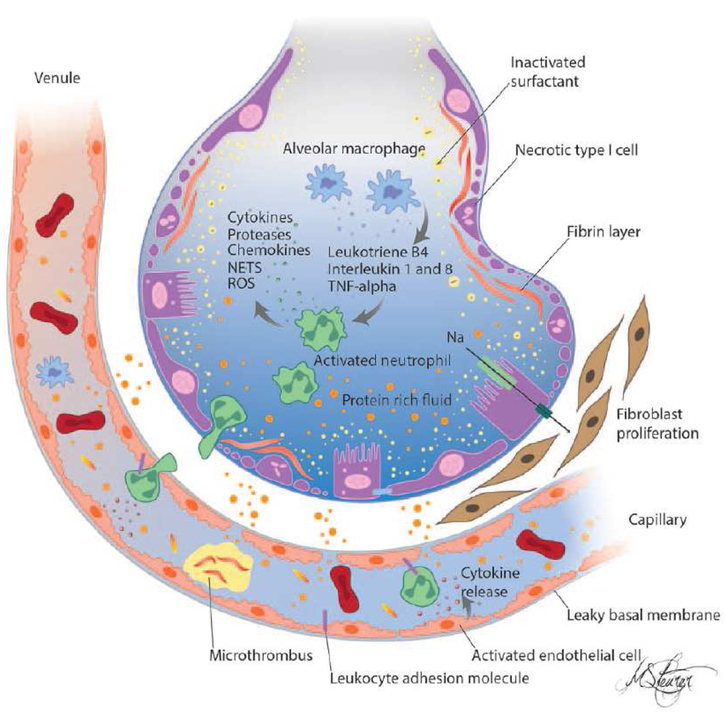
Schematic of pathophysiology in acute respiratory distress syndrome. There is a loss of epithelial and endothelial barrier integrity and loss of function leading to increased permeability pulmonary edema. Solutes and large molecules such as albumin enter the alveolar space. In the presence of proinflammatory mediators and activated endothelium leukocytes traffic into the pulmonary interstitium and alveoli. There is activation of coagulation and deposition of fibrin in capillaries and alveoli with increased concentrations of fibrinogen and fibrin-degradation products in the edema fluid. Surfactant depletion and degradation result in large increases in surface tension and loss of alveolar shape and integrity. Recovery is preceded by fibroblast proliferation. NETs = neutrophil extracellular traps, ROS = reactive oxygen species, TNF = tumor necrosis factor. From Sapru A, Flori H, et al. Pathobiology of acute respiratory distress syndrome. Pediatr Crit Care Med. 2015 Jun;16(5 Suppl 1):S6–22. doi: 10.1097/PCC.0000000000000431.

References

    1. Ware LB, Matthay MA. The Acute Respiratory Distress Syndrome. N Engl J Med 2000;342(18):1334–1349. - PubMed
    1. Sapru A, Flori H, Quasney MW, Dahmer MK. Pathobiology of Acute Respiratory Distress Syndrome. Pediatr Crit Care Med 2015;16(5):S6–S22. doi:10.1097/PCC.0000000000000431. - DOI - PubMed
    1. Ashbaugh DG, Bigelow DB, Petty TL LB. Acute respiratory distress in adults. Lancet. 1967;2(7511):319–323. doi:10.1016/S0140-6736(67)90168-7. - DOI - PubMed
    1. Katz R Adult respiratory distress syndrome in children. Clin Chest Med 1987;8(4):635–639. - PubMed
    1. Sherrill DL, Camilli a, Lebowitz MD. On the temporal relationships between lung function and somatic growth. Am Rev Respir Dis 1989;140(3):638–644. doi:10.1164/ajrccm/140.3.638. - DOI - PubMed