


The Comparative Effectiveness of Treatments for Ureteropelvic Junction Obstruction
- PMID: 28943371
- PMCID: PMC5747973
- DOI: 10.1016/j.urology.2017.09.002
The Comparative Effectiveness of Treatments for Ureteropelvic Junction Obstruction
Abstract
Objective: To examine the effectiveness of the 3 primary treatments for ureteropelvic junction obstruction (ie, open pyeloplasty, minimally invasive pyeloplasty, and endopyelotomy) as assessed by failure rates.
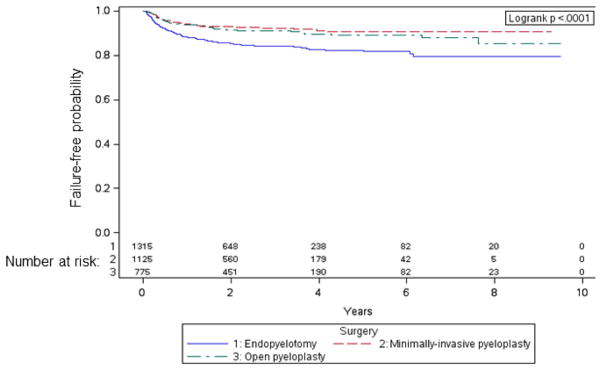
Materials and methods: Using MarketScan data, we identified adults (ages 18-64 years) who underwent treatment for ureteropelvic junction obstruction between 2002 and 2010. Our primary outcome was failure (ie, need for a secondary procedure). We fit a Cox proportional hazards model to examine the effects of different patient, regional, and provider characteristics on treatment failure. We then implemented a survival analysis framework to examine the failure-free probability for each treatment.
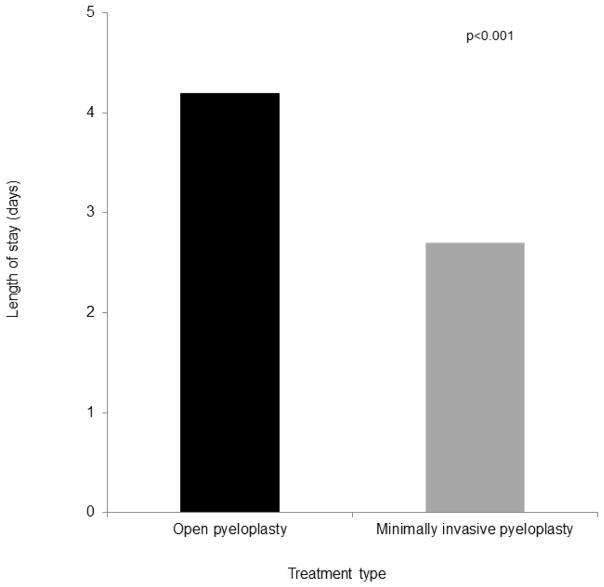
Results: We identified 1125 minimally invasive pyeloplasties, 775 open pyeloplasties, and 1315 endopyelotomies with failure rates of 7%, 9%, and 15%, respectively. Compared with endopyelotomy, minimally invasive pyeloplasty was associated with a lower risk of treatment failure (adjusted hazards ratio [aHR] 0.52; 95% confidence interval [CI], 0.39-0.69). Minimally invasive and open pyeloplasties had similar failure rates. Compared with open pyeloplasty, endopyelotomy was associated with a higher risk of treatment failure (aHR 1.78; 95% CI, 1.33-2.37). The average length of stay was 2.7 days for minimally invasive pyeloplasty and 4.2 days for open pyeloplasty (P <.001).
Conclusion: Endopyelotomy has the highest failure rate, yet it remains a common treatment for ureteropelvic junction obstruction. Future research should examine to what extent patients and physicians are driving the use of endopyelotomy.
Copyright © 2017 Elsevier Inc. All rights reserved.
Figures
References
-
- Hopf HL, Bahler CD, Sundaram CP. Long-term Outcomes of Robot-assisted Laparoscopic Pyeloplasty for Ureteropelvic Junction Obstruction. Urology. 2016;90:106–111. - PubMed
-
- Gogus C, Karamursel T, Tokatli Z, et al. Long-term results of Anderson-Hynes pyeloplasty in 180 adults in the era of endourologic procedures. Urol Int. 2004;73:11–14. - PubMed
-
- Brooks JD, Kavoussi LR, Preminger GM, et al. Comparison of open and endourologic approaches to the obstructed ureteropelvic junction. Urology. 1995;46:791–795. - PubMed
-
- Braga LH, Pace K, DeMaria J, et al. Systematic review and meta-analysis of robotic-assisted versus conventional laparoscopic pyeloplasty for patients with ureteropelvic junction obstruction: effect on operative time, length of hospital stay, postoperative complications, and success rate. Eur Urol. 2009;56:848–857. - PubMed
-
- Lucas SM, Sundaram CP, Wolf JS, Jr, et al. Factors that impact the outcome of minimally invasive pyeloplasty: results of the Multi-institutional Laparoscopic and Robotic Pyeloplasty Collaborative Group. J Urol. 2012;187:522–527. - PubMed
Publication types
MeSH terms
Grants and funding
LinkOut - more resources
Full Text Sources
Other Literature Sources
