


State and trait positive and negative affectivity in relation to restraint intention and binge eating among adults with obesity
- PMID: 28943474
- PMCID: PMC5969992
- DOI: 10.1016/j.appet.2017.09.020
State and trait positive and negative affectivity in relation to restraint intention and binge eating among adults with obesity
Abstract
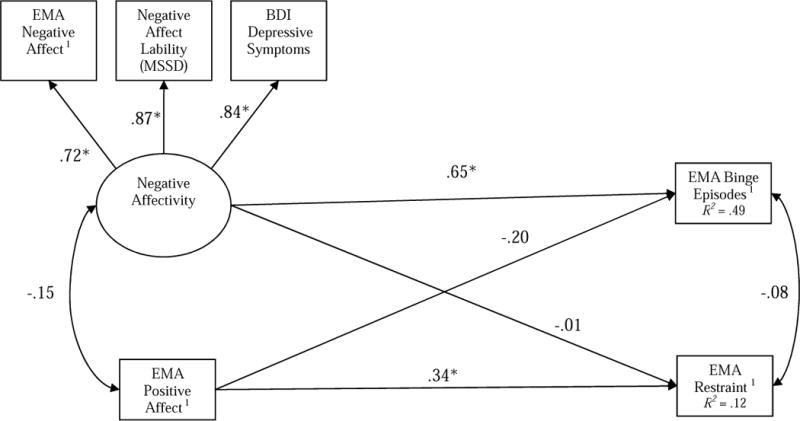
Restraint and binge eating are cognitive and behavioral processes that are particularly important in the context of obesity. While extensive research has focused on negative affect (NA) in relation to binge eating, it is unclear whether affective valence (i.e., positive versus negative) and stability (i.e., state versus trait) differentially predict binge eating and restraint among individuals with obesity. Distinguishing between valence and stability helps elucidate under which affective contexts, and among which individuals, restraint and binge eating are likely to occur. Therefore, the present study examined relationships between trait and state levels of NA and positive affect (PA), binge eating, and restraint intention among 50 adults with obesity (BMI ≥ 30). Participants completed baseline assessments followed by a two-week ecological momentary assessment (EMA) protocol. Structural equation modeling assessed a trait model of person-level measures of affect in relation to overall levels of binge eating and restraint intention, while general estimating equations (GEEs) assessed state models examining relationships between momentary affect and subsequent binge eating and restraint. The trait model indicated higher overall NA was related to more binge eating episodes, but was unrelated to overall restraint intention. Higher overall PA was related to higher overall restraint intention, but was unrelated to binge eating. State models indicated momentary NA was associated with a greater likelihood of subsequent binge eating and lower restraint intention. Momentary PA was unrelated to subsequent binge eating or restraint intention. Together, findings demonstrate important distinctions between the valence and stability of affect in relationship to binge eating and restraint intention among individuals with obesity. While NA is a more salient predictor of binge eating than PA, both overall PA and momentary NA are predictors of restraint intention.
Keywords: Affect; Binge eating; Dietary restraint; Ecological momentary assessment; Obesity.
Published by Elsevier Ltd.
Figures
References
-
- American Psychiatric Association. Diagnostic and Statistical Manual of Mental Disorders. 5th. Washington, DC: Author; 2013.
-
- American Psychiatric Association. Diagnostic and Statistical Manual of Mental Disorders. 4th. Washington, DC: Author; 2000. text rev.
-
- Beck AT, Steer RA, Brow GK. Manual for Beck Depression Inventory II (BDI-II) San Antonio, TX: Psychology Corporation; 1996.
MeSH terms
Grants and funding
LinkOut - more resources
Full Text Sources
Other Literature Sources
Medical
Research Materials
