


Comparison of FDA safety and efficacy data for KAMRA and Raindrop corneal inlays
- PMID: 28944206
- PMCID: PMC5596232
- DOI: 10.18240/ijo.2017.09.18
Comparison of FDA safety and efficacy data for KAMRA and Raindrop corneal inlays
Abstract
Aim: To provide a side-by-side analysis of the summary of safety and effectiveness data (SSED) submitted to the FDA for the KAMRA and Raindrop corneal inlays for the correction of presbyopia.
Methods: SSED reports submitted to the FDA for KAMRA and Raindrop were compared with respect to loss of corrected distance visual acuity (CDVA), adverse event rates, induction of astigmatism, retention of contrast sensitivity, stability of manifest refractive spherical equivalent (MRSE), and achieved monocular uncorrected near visual acuity (UNVA) at 24mo.
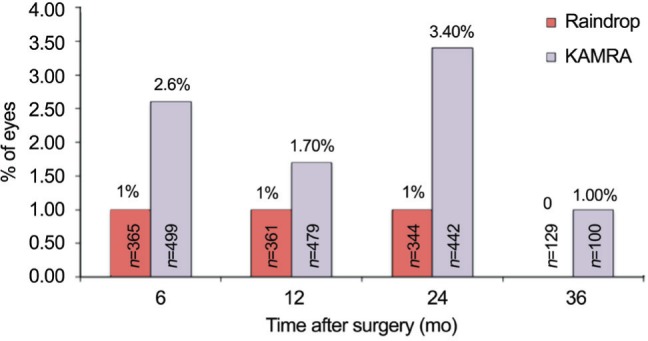
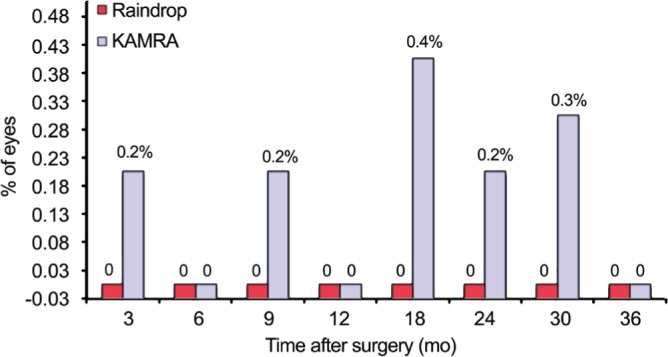
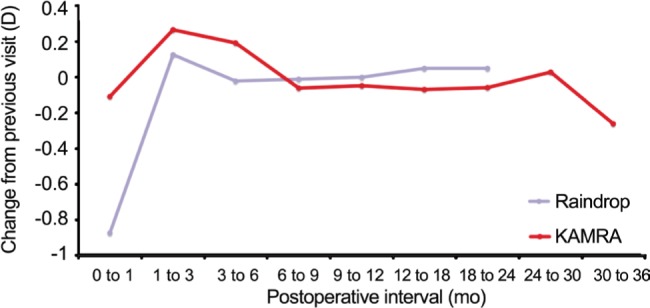
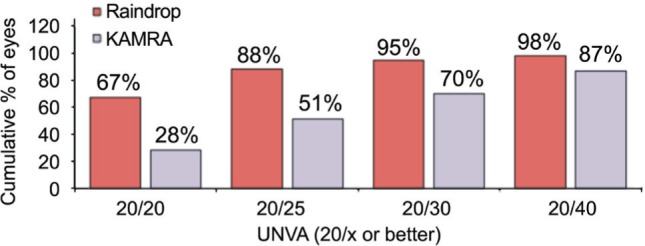
Results: Totally 442/508 of KAMRA patients and 344/373 Raindrop patients remained enrolled in the clinical trials at 24mo. The proportion of KAMRA and Raindrop patients who lost ≥2 lines of CDVA at 24mo was 3.4% and 1%, respectively. The adverse event rate was comparable between the devices. No significant inductions of astigmatism were noted. Both technologies induced a transient myopic shift in MRSE followed by a hyperopic shift and subsequent stabilization. Totally 87% of KAMRA and 98% of Raindrop patients attained a monocular UNVA of J5 (20/40) or better at 24mo, 28% of KAMRA and 67% of Raindrop patients attained a monocular UNVA of J1 (20/20) or better at 24mo.
Conclusion: Both devices can be considered safe and effective, however, the results of corneal inlay implantation are mixed, and long-term patient satisfaction will likely depend on subjective expectations about the capabilities of the inlays. Variability in surgical technique and postoperative care within and between the two clinical trials diminishes the comparative power of this article.
Keywords: KAMRA; Raindrop; corneal inlay; presbyopia.
Figures
References
-
- Glasser A, Campbell MC. Presbyopia and the optical changes in the human crystalline lens with age. Vision Res. 1998;38(2):209–229. - PubMed
-
- Goldberg DB. Computer animated model of accommodation and presbyopia. J Cataract Refract Surg. 2016;41(2):437–445. - PubMed
-
- Schachar RA. Cause and treatment of presbyopia with a method for increasing the amplitude of accommodation. Ann Ophthalmol. 1992;24(12) - PubMed
-
- Holden BA, Fricke TR, Ho SM, Wong R, Schlenther G, Cronjè S, Burnett A, Papas E, Naidoo KS, Frick KD. Global vision impairment due to uncorrected presbyopia. Arch Ophthalmol. 2008;126(12):1731–1739. - PubMed
LinkOut - more resources
Full Text Sources
Other Literature Sources