


Diabetes mitigates the role of memory complaint in predicting dementia risk: Results from the Prevention of Alzheimer's Disease with Vitamin E and Selenium Study
- PMID: 28944218
- PMCID: PMC5607951
- DOI: 10.14283/jpad.2017.7
Diabetes mitigates the role of memory complaint in predicting dementia risk: Results from the Prevention of Alzheimer's Disease with Vitamin E and Selenium Study
Abstract
Background: Subjective memory complaints (SMCs) are associated with increased risk of dementia in older adults, but the role of comorbidities in modifying this risk is unknown.
Objectives: To assess whether comorbidities modify estimated dementia risk based on SMCs.
Design: The Prevention of Alzheimer's Disease with Vitamin E and Selenium Study (PREADVISE) was designed as an ancillary study to the Selenium and Vitamin E Cancer Prevention Trial (SELECT), a randomized, multi-center prostate cancer prevention trial with sites in the Unites States, Puerto Rico, and Canada. In 2009, PREADVISE and SELECT were changed into cohort studies.
Setting: Secondary analysis of PREADVISE data.
Participants: PREADVISE recruited 7,540 non-demented male volunteers from participating SELECT sites from 2002 to 2009. SMCs, demographics, and comorbidities including hypertension, diabetes, coronary artery bypass graft (CABG), stroke, sleep apnea, and head injury were ascertained by participant interview.
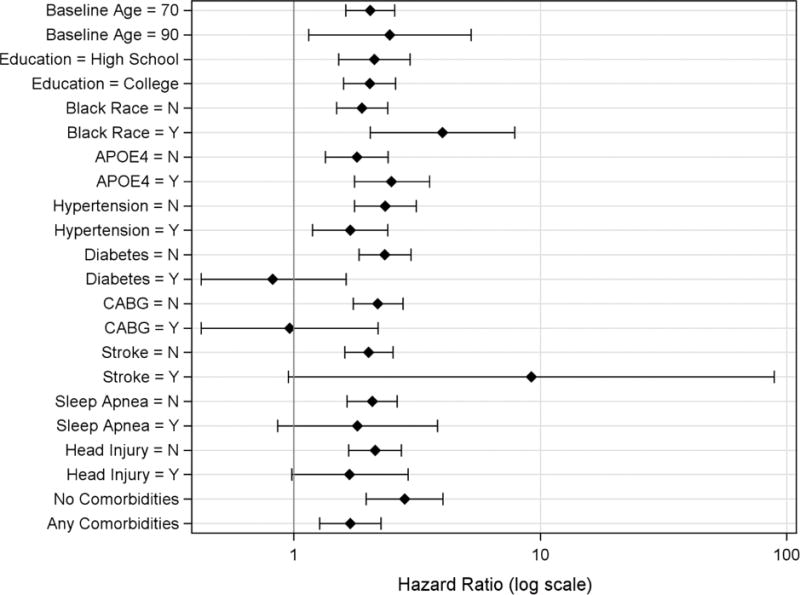
Measurements: Cox models were used to investigate whether baseline comorbidities modified hazard ratios (HR) for SMC-associated dementia risk using two methods: (1) we included one interaction term between SMC and a comorbidity in the model at a time, and (2) we included all two-way interactions between SMC and covariates of interest and reduced the model by "backward" selection. SMC was operationalized as any complaint vs. no complaint.
Results: Baseline SMCs were common (23.6%). In the first analyses, with the exception of stroke, presence of self-reported comorbidities was associated with lower estimated HR for dementia based on SMC status (complaint vs. no complaint), but this difference was only significant for diabetes. In the second analysis, the two-way interactions between SMC and race as well as SMC and diabetes were significant. Here, black men without diabetes who reported SMC had the highest estimated dementia risk (HR=5.05, 95% CI 2.55-10.00), while non-black men with diabetes who reported SMC had the lowest estimated risk (HR=0.71, 95% CI 0.35-1.41).
Conclusions: SMCs were more common among men with comorbidities, but these complaints appeared to be less predictive of dementia risk than those originating from men without comorbidities, suggesting that medical conditions such as diabetes may explain SMCs that are unrelated to an underlying neurodegenerative process.
Keywords: Alzheimer’s disease; Subjective memory complaints (SMCs); comorbidities; dementia; effect measure modification.
Conflict of interest statement
CONFLICT OF INTEREST All authors declare no conflict of interest.
Figures
References
Grants and funding
LinkOut - more resources
Full Text Sources