


Bypassing agent prophylaxis in people with hemophilia A or B with inhibitors
- PMID: 28944952
- PMCID: PMC6483761
- DOI: 10.1002/14651858.CD011441.pub2
Bypassing agent prophylaxis in people with hemophilia A or B with inhibitors
Abstract
Background: People with hemophilia A or B with inhibitors are at high risk of bleeding complications. Infusion of bypassing agents, such as recombinant activated FVII (rFVIIa) and plasma-derived activated prothrombin complex concentrate, are suggested as alternative therapies to factor VIII (haemophilia A) or IX (haemophilia B) for individuals who no longer respond to these treatments because they develop inhibitory antibodies. The ultimate goal of treatment is to preserve the individual's joints, otherwise destroyed by recurrent bleeds.
Objectives: To assess the effects of bypassing agent prophylaxis to prevent bleeding in people with hemophilia A or B and inhibitors.
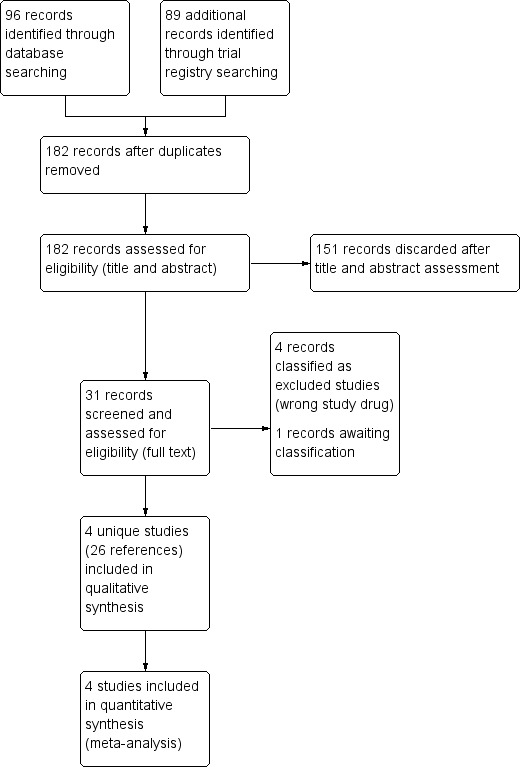
Search methods: We searched for relevant studies from the Cystic Fibrosis and Genetic Disorders Group's Coagulopathies Trials Register, comprising of references identified from comprehensive electronic database searches and handsearches of relevant journals and abstract books of conference proceedings. We also searched trial registries (16 February 2017) and bibliographic references of retrieved studies were reviewed for potential articles to be included in the review.Date of the last search of the Cochrane Cystic Fibrosis and Genetic Disorders Coagulopathies Trials Register: 12 December 2016.
Selection criteria: We included randomized and quasi-randomized controlled studies (cross-over or parallel design) evaluating the effect of prophylaxis treatment with bypassing agents compared with on-demand treatment, or studies evaluating the effects of high-dose compared with low-dose prophylaxis in males of any age with hemophilia with inhibitors.
Data collection and analysis: Two authors independently selected studies and extracted data and assessed the risk of bias according to standard Cochrane criteria. They assessed the quality of the evidence using the GRADE criteria.
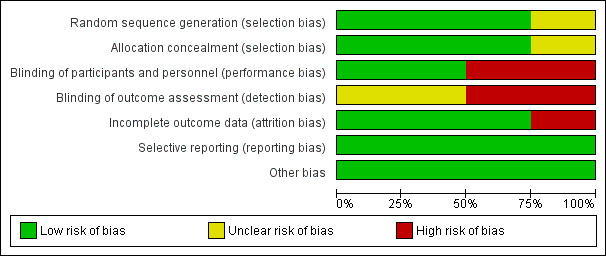
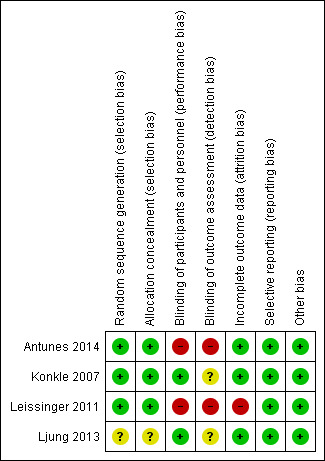
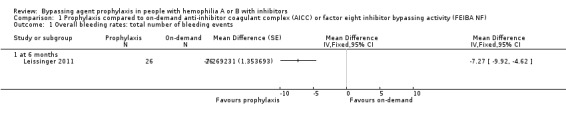
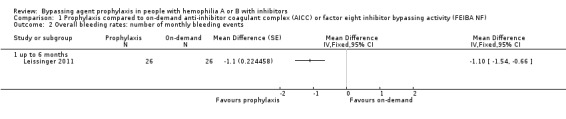
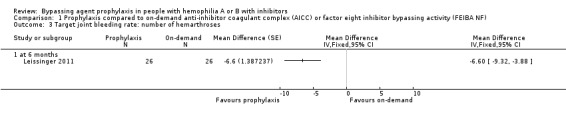
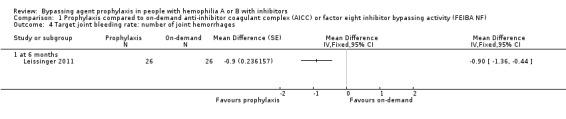
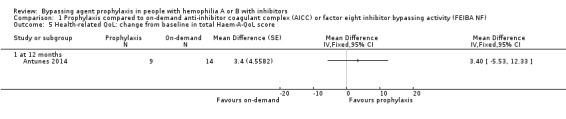
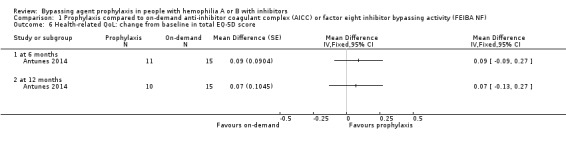
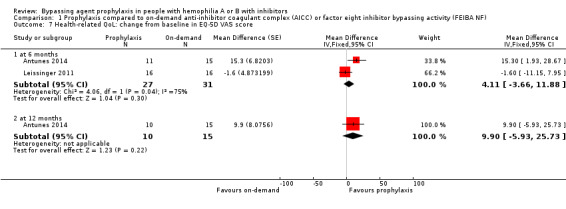
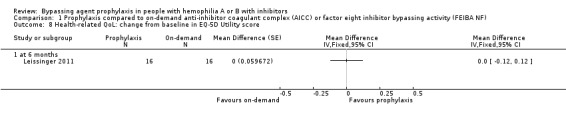
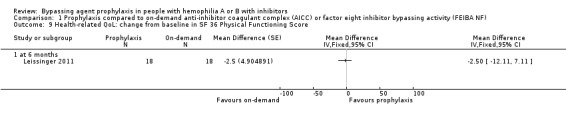
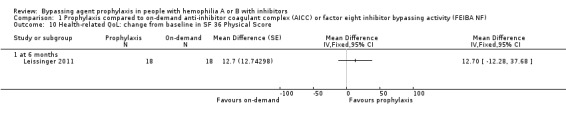
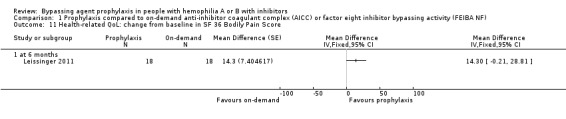
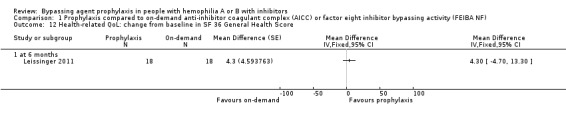
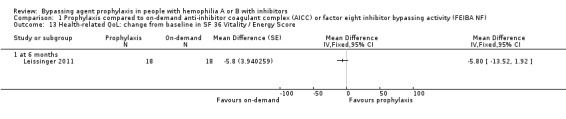
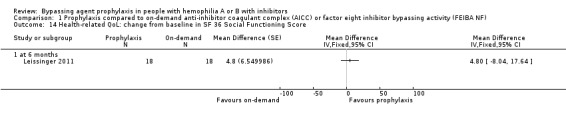
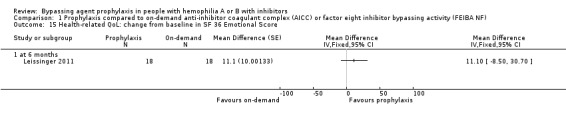
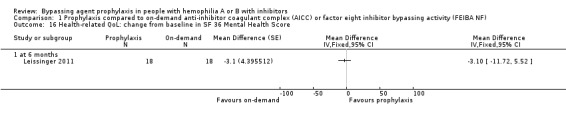
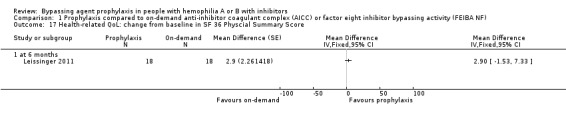
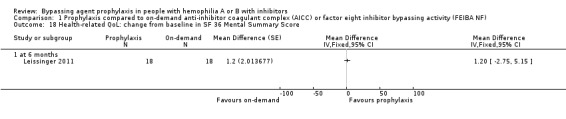
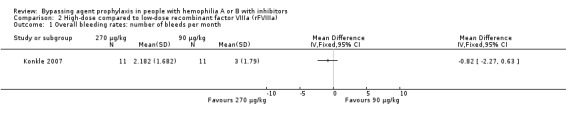
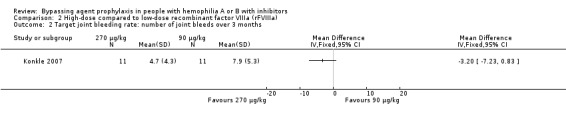
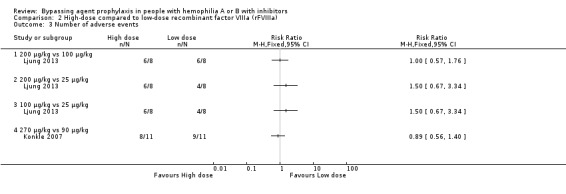
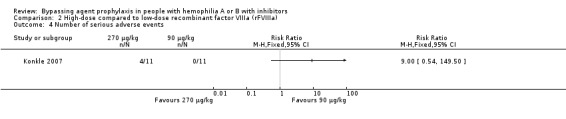
Main results: We included four randomized studies (duration 7 to 15 months) involving 116 males. Risk of bias was judged to be high in two studies due to the open-label study design and in one study due to attrition bias.Two studies compared on-demand treatment to prophylaxis with bypassing agents. In one study (34 males) prophylaxis significantly reduced mean overall bleeding rates, MD - 7.27 (95% CI -9.92 to -4.62) (low quality evidence), mean number of overall bleeding events per month, MD -1.10 (95% CI -1.54 to -0.66), mean number of hemarthrosis, MD -6.60 (95% CI -9.32 to -3.88) (low quality evidence) and mean number of joints that had hemarthrosis, MD -0.90 (95% CI -1.36 to -0.44). The meta-analysis did not conclusively demonstrate significant benefit of prophylaxis on health-related quality of life as measured by Haem-A-QoL score, EQ-5D total score and utility score, EQ-5D VAS and SF-36 physical summary and mental summary score (low quality evidence for all health-related quality of life analyses).The remaining two studies compared dose regimens. The results from one study (22 males) did not conclusively demonstrate benefit or harm of high-dose versus low-dose recombinant activated factor VIIa (rFVIIa) as a prophylaxis for overall bleeding rate, MD -0.82 (95% CI -2.27 to 0.63) (moderate quality evidence), target joint bleeding rate, MD -3.20 (95% CI -7.23 to 0.83) (moderate quality evidence) and serious adverse events, RR 9.00 (95% CI, 0.54 to 149.50) (moderate quality evidence).The overall quality of evidence was moderate to low due to imprecision from limited information provided by studies with small sample sizes and incomplete outcome data in one study.
Authors' conclusions: The evidence suggests that prophylaxis with bypassing agents may be effective in reducing bleeding in males with hemophilia with inhibitors. However, there is a lack of evidence for the superiority of one agent over the other or for the optimum dosage regimen. Further studies are needed to evaluate the benefits and harms of prophylaxis treatment on health-related quality of life, as well as the effects of dose of bypassing agents on the outcomes.
Conflict of interest statement
Clarification statement added from Alan Smyth, Co‐ordinating Editor on 19 March 2020: The published protocol and review was found by the Cochrane Funding Arbiters, post‐publication, to be noncompliant with the
Figures
Update of
References
References to studies included in this review
Antunes 2014 {published data only}
-
- Antunes S, Tangada S, Stasyshyn O, Mamonov V, Phillips J, Guzman‐Becerra N, et al. A prospective, open‐label, randomized, parallel study with AICC to evaluate the efficacy and safety of prophylactic vs. on‐demand treatment in hemophilia A or B subjects with inhibitors. Journal of Thrombosis and Haemostasis: JTH 2013;11 Suppl 2:982. [Abstract no: PB 4.58‐6; CENTRAL: 1014799; CRS: 5500131000000230]
-
- Antunes SV, Tangada S, Phillips J, Stasyshyn O, Mamonov V, Guzman‐Becerra N, et al. Comparison of historic on‐demand versus prospective on‐demand and prophylaxis bleeding episodes in hemophilia A and B patients with inhibitors treated with FEIBA NF. Haemophilia 2014;20:96. [CENTRAL: 1063882; CRS: 5500050000000504; EMBASE: 71475655]
-
- Antunes SV, Tangada S, Stasyshyn O, Mamonov V, Phillips J, Guzman‐Becerra N, et al. Randomized comparison of prophylaxis and on‐demand regimens with FEIBA NF in the treatment of haemophilia A and B with inhibitors. Haemophilia 2013;20(1):65‐72. [CENTRAL: 961365; CRS: 5500050000000036; EMBASE: 2013812414] - PMC - PubMed
-
- Stasyshyn O, Antunes S, Mamanov V, Ye X, Xiong Y, Tangada S. Health‐related quality of life in hemophilia patients with inhibitors receiving prophylaxis with anti‐inhibitor coagulant complex (AICC): results from the AICC prophylaxis study. Journal of Thrombosis and Haemostasis: JTH 2013;11 Suppl 2:719. [CENTRAL: 1014800; CRS: 5500131000000232]
-
- Stasyshyn O, Antunes S, Mamonov V, Ye X, Epstein J, Xiong Y, et al. Prophylaxis with anti‐inhibitor coagulant complex improves health‐related quality of life in haemophilia patients with inhibitors: results from FEIBA NF Prophylaxis Study. Haemophilia 2014;20(5):644‐50. [CENTRAL: 1001041; CRS: 5500131000000129; JID:: 9442916; PUBMED: 24589084] - PubMed
Konkle 2007 {published data only}
-
- Hoots WK, Ebbesen LS, Konkle BA, Auerswald GK, Roberts HR, Weatherall J, et al. Secondary prophylaxis with recombinant activated factor VII improves health‐related quality of life of haemophilia patients with inhibitors. Haemophilia 2008;14(3):466‐75. [CENTRAL: 714802; CRS: 5500100000003373] - PubMed
-
- Konkle B, Friedrich U, Abrams Z. Secondary prophylactic treatment with rFVIIa in patients with haemophilia A or B and inhibitors with high requirements for on‐demand treatment. Haemophilia 2006;12(Suppl 2):14. [Abstract no: PO363; CENTRAL: 593037; CRS: 5500100000002995]
-
- Konkle BA, Ebbesen LS, Auerswald GKH, Friedrich U, Ljung RCR, Roberts HR, et al. Secondary prophylaxis with rFVIIa improves quality of life of hemophilia patients with inhibitors and frequent bleeds. Blood 2006;108(11). [Abstract no: 1028; CENTRAL: 581202; CRS: 5500100000002911]
-
- Konkle BA, Ebbesen LS, Erhardtsen E, Bianco RP, Lissitchkov T, Rusen L, et al. Randomized, prospective clinical trial of recombinant factor VIIa for secondary prophylaxis in hemophilia patients with inhibitors. Journal of Thrombosis and Haemostasis: JTH 2007;5(9):1904‐13. [CENTRAL: 611680; CRS: 5500100000003138; PUBMED: 17723130] - PubMed
-
- Konkle BA, Ebbesen LS, Friedrich U, Bianco RP, Lissitchkov T, Rusen L, et al. Randomized, prospective clinical trial of rFVIIa for secondary prophylaxis in hemophilla patients with inhibitors. Blood 2006;108(11). [Abstract no: 766; CENTRAL: 593038; CRS: 5500100000002996]
Leissinger 2011 {published data only}
-
- Fusco F, Gringeri A, Leissinger C, Cortesi PA, Mantovani LG. Bleeding prophylaxis with an anti‐inhibitor coagulant complex (AICC) in patients with hemophilia A and inhibitors can improve quality of life: results of the PRO‐FEIBA Study. 16th Congress of the European Hematology Association; 2011 June 9‐12; London, UK. 2011. [CENTRAL: 1017613; CRS: 5500131000000290]
-
- Gringeri A, Leissinger C, Cortesi P, Matovani LG. Bleeding prophylaxis with an anti‐inhibitor coagulant complex (AICC) in patients with hemophilia a and inhibitors can improve quality of life: results of the pro‐FEIBA study. Journal of Thrombosis and Haemostasis: JTH 2011;9 Suppl 2:927. [Abstract no: P‐TH‐509; CENTRAL: 1015140; CRS: 5500131000000238]
-
- Gringeri A, Leissinger C, Cortesi PA, Jo H, Fusco F, Riva S, et al. Health‐related quality of life in patients with haemophilia and inhibitors on prophylaxis with anti‐inhibitor complex concentrate: Results from the Pro‐FEIBA study. Haemophilia 2013;19(5):736‐43. [CENTRAL: 918277; CRS: 5500050000000035; EMBASE: 2013536834] - PubMed
-
- Gringeri A, Leissinger CA, Cortesi P, Jo H, Mantovani L. Cost‐effectiveness of prophylaxis with anti‐inhibitor complex concentrate in patients with hemophilia A and inhibitors: results from the Pro‐FEIBA study. Blood 2011;118(21). [Abstract no: 4187; CENTRAL: 883157; CRS: 5500125000000183]
-
- Gringeri A, Lessinger C, Santagostino E, Cortesi P, Mantovani L. Pharmacoeconomic evaluation with an activated prothrombin complex concentrate (APCC) in patients with hemophilia and inhibitors (PRO‐FEIBA Study). Haemophilia 2012;18 Suppl 3:70. [Abstract no: PO‐MO‐052; CENTRAL: 868071; CRS: 5500100000011579]
Ljung 2013 {published data only}
-
- Ljung R, Karim FA, Saxena K, Suzuki T, Arkhammar P, Rosholm A, et al. 40K glycoPEGylated, recombinant FVIIa: 3‐month, double‐blind, randomized trial of safety, pharmacokinetics and preliminary efficacy in hemophilia patients with inhibitors. Journal of Thrombosis and Haemostasis: JTH 2013;11(7):1260‐8. [CENTRAL: 919860; CRS: 5500050000000024; EMBASE: 2013458697] - PubMed
-
- NCT00951405. Safety and efficacy of 3 different doses of long acting factor VII in haemophilia A or B patients with inhibitors [An exploratory multi‐Centre, multi‐national, randomised, double blinded, parallel arm trial evaluating safety, pharmacokinetics and dose‐finding of prophylactic administration of long acting rFVIIa (LA‐rFVIIa) in haemophilia A or B patients with inhibitors]. clinicaltrials.gov/ct2/show/NCT00951405 Date first received: 03 August 2009.
References to studies excluded from this review
NCT02622321 {published data only}
-
- NCT02622321. A study to evaluate the efficacy, safety, and pharmacokinetics of prophylactic emicizumab versus no prophylaxis in hemophilia A patients with inhibitors (HAVEN 1) [A randomized, multicenter, open‐label, phase III clinical trial to evaluate the efficacy, safety, and pharmacokinetics of prophylactic emicizumab versus no prophylaxis in hemophilia A patients with inhibitors]. clinicaltrials.gov/ct2/show/NCT02622321 Date first received: 02 December 2015.
NCT02795767 {unpublished data only}
-
- NCT02795767. A study of once‐weekly emicizumab in children and adolescents with hemophilia A and Factor VIII (FVIII) inhibitors (HAVEN 2) [A single‐arm, multicenter, open‐label, phase III clinical trial to evaluate the efficacy, safety, and pharmacokinetics of once weekly subcutaneous administration of emicizumab in hemophilia A pediatric patients with inhibitors]. clinicaltrials.gov/ct2/show/NCT02795767 Date first received: 07 June 2016.
NCT02847637 {unpublished data only}
-
- NCT02847637. A clinical trial to evaluate the efficacy, safety, and pharmacokinetics of prophylactic emicizumab versus no prophylaxis in hemophilia A participants without inhibitors (HAVEN 3) [A randomized, multicenter, open‐label, phase III clinical trial to evaluate the efficacy, safety, and pharmacokinetics of prophylactic emicizumab versus no prophylaxis in hemophilia A patients without inhibitors]. clinicaltrials.gov/ct2/show/NCT02847637 Date first received: 26 July 2016.
NCT03020160 {published data only}
-
- NCT03020160. A study to evaluate the efficacy, safety, pharmacokinetics, and pharmacodynamics of emicizumab given every 4 weeks in participants with hemophilia A (Haven 4) [A multicenter, open‐label, phase III study to evaluate the efficacy, safety, pharmacokinetics, and pharmacodynamics of emicizumab given every 4 weeks (Q4W) in patients with hemophilia A]. clinicaltrials.gov/ct2/show/NCT03020160 Date first received: 21 December 2016.
References to studies awaiting assessment
NCT01105546 {published data only}
-
- NCT01105546. rFVIIa prophylaxis in children with hemophilia A and inhibitors (ENJOIH) [An investigator‐initiated study on rFVIIa prophylaxis in children with hemophilia A and inhibitors ‐ European initiative to prevent joint damage in hemophilia A children with inhibitors]. ClinicalTrials.gov/show/NCT01105546 Date first received: 15 April 2010.
Additional references
Astermark 2007
-
- Astermark J, Donfield SM, DiMichele DM, Gringeri A, Gilbert SA, Waters J, et al. A randomized comparison of bypassing agents in hemophilia complicated by an inhibitor: the FEIBA NovoSeven Comparative (FENOC) Study. Blood 2007;109(2):546‐51. - PubMed
Astermark 2010a
-
- Astermark J. Inhibitor development: patient‐determined risk factors. Haemophilia 2010;16(102):66‐70. - PubMed
Astermark 2010b
-
- Astermark J, Altisent C, Batorova A, Diniz MJ, Gringeri A, Holme PA, et al. Non‐genetic risk factors and the development of inhibitors in haemophilia: a comprehensive review and consensus report. Haemophilia 2010;16(5):747‐66. - PubMed
Balshem 2011
-
- Balshem H, Helfand M, Schünemann HJ, Oxman AD, Kunz R, Brozek J, et al. GRADE guidelines: 3. Rating the quality of evidence. Journal of Clinical Epidemiology 2011;64(4):401‐6. - PubMed
Berntorp 2006
-
- Berntorp E, Shapiro A, Astermark J, Blanchette VS, Collins PW, Dimichele D, et al. Inhibitor treatment in haemophilias A and B: summary statement for the 2006 international consensus conference. Haemophilia 2006;12 Suppl 6:1‐7. - PubMed
Chuansumrit 2000
-
- Chuansumrit A, Isarangkura P, Angchaisuksiri P, Sriudomporn N, Tanpowpong K, Hathirat P, et al. Controlling acute bleeding episodes with recombinant factor VIIa in haemophiliacs with inhibitor: continuous infusion and bolus injection. Haemophilia 2000;6(2):61‐5. - PubMed
Collins 2013
-
- Collins PW, Chalmers E, Hart DP, Liesner R, Rangarajan S, Talks K, et al. Diagnosis and treatment of factor VIII and IX inhibitors in congenital haemophilia: (4th edition). UK Haemophilia Centre Doctors Organization. British Journal of Haematology 2013;160(2):153‐70. - PubMed
Darby 2004
-
- Darby SC, Keeling DM, Spooner RJ, Wan Kan S, Giangrande PL, Collins PW, et al. The incidence of factor VIII and factor IX inhibitors in the hemophilia population of the UK and their effect on subsequent mortality, 1977‐99. Journal of Thrombosis and Haemostasis 2004;2(7):1047‐54. - PubMed
Deeks 2011
-
- Deeks J, Higgins J, Altman D. Chapter 9: Analysing data and undertaking meta‐analysis. In: Higgins JPT, Green S, editor(s). Cochrane Handbook for Systematic Reviews of Interventions Version 5.1.0 (updated March 2011).The Cochrane Collaboration, 2011.. Available from handbook.cochrane.org.
Elbourne 2002
-
- Elbourne DR, Altman DG, Higgins JPT, Curtin F, Worthington HV, Vail A. Meta‐analyses involving cross‐over trials: methodological issues. International Journal of Epidemiology 2002;31(1):140‐9. - PubMed
Guyatt 2008
Hay 1998
-
- Hay CR. Factor VIII inhibitors in mild and moderate‐severity haemophilia A. Haemophilia 1998;4(4):558‐63. - PubMed
Hay 2012
-
- Hay CR, DiMichele DM. The principal results of the International Immune Tolerance Study: a randomized dose comparison. Blood 2012;119(6):1335‐44. - PubMed
Hedner 2000
-
- Hedner U. Recombinant coagulation factor VIIa: from the concept to clinical application in hemophilia treatment in 2000. Seminars in Thrombosis and Hemostasis 2000;26(4):363‐6. - PubMed
Higgins 2011a
-
- Higgins JPT, Altman DG, editor(s). Chapter 8: Assessing risk of bias in included studies. In: Higgins JPT, Green S, editor(s). Cochrane Handbook for Systematic Reviews of Interventions Version 5.1.0 (updated March 2011). The Cochrane Collaboration, 2011. Available from handbook.cochrane.org.
Higgins 2011b
-
- Higgins JPT, Deeks JJ, Altman DG on behalf of the CSMG. Chapter 16: Special topics in statistics. In: Higgins JPT, Green S, editor(s). Cochrane Handbook of Systematic Reviews of Interventions. Version 5.1 (updated March 2011). The Cochrane Collaboration, 2011. Available from handbook.cochrane.org.
Iorio 2010a
-
- Iorio A, Halimeh S, Holzhauer S, Goldenberg N, Marchesini E, Marcucci M, et al. Rate of inhibitor development in previously untreated hemophilia A patients treated with plasma‐derived or recombinant factor VIII concentrates: a systematic review. Journal of Thrombosis and Haemostasis 2010;8(6):1256‐65. - PubMed
Iorio 2010b
-
- Iorio A, Matino D, D'Amico R, Makris M. Recombinant factor VIIa concentrate versus plasma derived concentrates for the treatment of acute bleeding episodes in people with haemophilia and inhibitors. Cochrane Database of Systematic Reviews 2010, Issue 8. [DOI: 10.1002/14651858.CD004449.pub3] - DOI - PubMed
Iorio 2011
Kavakli 2006
-
- Kavakli K, Makris M, Zulfikar B, Erhardtsen E, Abrams ZS, Kenet G, et al. Home treatment of haemarthroses using a single dose regimen of recombinant activated factor VII in patients with haemophilia and inhibitors. A multi‐centre, randomised, double‐blind, cross‐over trial. Thrombosis and Haemostasis 2006;95(4):600‐5. - PubMed
Lusher 1998
-
- Lusher JM, Roberts HR, Davignon G, Joist JH, Smith H, Shapiro A, et al. A randomized, double‐blind comparison of two dosage levels of recombinant factor VIIa in the treatment of joint, muscle and mucocutaneous haemorrhages in persons with haemophilia A and B, with and without inhibitors. rFVIIa Study Group. Haemophilia 1998;4(6):790‐8. - PubMed
MASAC 2013
-
- National Hemophilia Foundation. MASAC recommendation regarding prophylaxis with bypassing agents in patients with hemophilia and high titer inhibitors. www.hemophilia.org/Researchers‐Healthcare‐Providers/Medical‐and‐Scientif... (accessed prior to 20 June 2017).
Matzinger 1994
-
- Matzinger P. Tolerance, danger, and the extended family. Annual Review of Immunology 1994;12:991‐1045. - PubMed
Matzinger 2012
Pruthi 2007
-
- Pruthi RK, Mathew P, Valentino LA, Sumner MJ, Seremetis S, Hoots WK, et al. Haemostatic efficacy and safety of bolus and continuous infusion of recombinant factor VIIa are comparable in haemophilia patients with inhibitors undergoing major surgery. Results from an open‐label, randomized, multicenter trial. Thrombosis and Haemostasis 2007;98(4):726‐32. - PubMed
Santagostino 2006
-
- Santagostino E, Mancuso ME, Rocino A, Mancuso G, Scaraggi F, Mannucci PM. A prospective randomized trial of high and standard dosages of recombinant factor VIIa for treatment of hemarthroses in hemophiliacs with inhibitors. Journal of Thrombosis and Haemostasis 2006;4(2):367‐71. - PubMed
Scalone 2006
-
- Scalone L, Mantovani LG, Mannucci PM, Gringeri A, COCIS Study Investigators. Quality of life is associated to the orthopaedic status in haemophilic patients with inhibitors. Haemophilia 2006;12(2):154‐62. - PubMed
Seremetis 1994
-
- Seremetis SV. The clinical use of factor VIIa in the treatment of factor VIII inhibitor patients. Seminars in Hematology 1994;31(2 Suppl 4):53‐5. - PubMed
Shapiro 1998
-
- Shapiro AD, Gilchrist GS, Hoots WK, Cooper HA, Gastineau DA. Prospective, randomised trial of two doses of rFVIIa (NovoSeven) in haemophilia patients with inhibitors undergoing surgery. Thrombosis and Haemostasis 1998;80(5):773‐8. - PubMed
Shapiro 2003
-
- Shapiro, A. Inhibitor treatment: state of the art. Disease‐a‐Month 2003;49(1):22‐38. - PubMed
Valentino 2010
-
- Valentino LA. Assessing the benefits of FEIBA prophylaxis in haemophilia patients with inhibitors. Haemophilia 2010;16(2):263‐71. - PubMed
Young 2008
-
- Young G, Shafer FE, Rojas P, Seremetis S. Single 270 microg kg(‐1)‐dose rFVIIa vs. standard 90 microg kg(‐1)‐dose rFVIIa and APCC for home treatment of joint bleeds in haemophilia patients with inhibitors: a randomized comparison. Haemophilia 2008;14(2):287‐94. - PubMed
Publication types
MeSH terms
Substances
LinkOut - more resources
Full Text Sources
Other Literature Sources
Medical
