


Characteristics of Single Vehicle Crashes with a Teen Driver in South Carolina, 2005-2008
- PMID: 28947072
- PMCID: PMC5862731
- DOI: 10.1016/j.aap.2017.08.002
Characteristics of Single Vehicle Crashes with a Teen Driver in South Carolina, 2005-2008
Abstract
Objective: Teens' crash risk is highest in the first years of independent driving. Circumstances surrounding fatal crashes have been widely documented, but less is known about factors related to nonfatal teen driver crashes. This study describes single vehicle nonfatal crashes involving the youngest teen drivers (15-17 years), compares these crashes to single vehicle nonfatal crashes among adult drivers (35-44 years) and examines factors related to nonfatal injury producing crashes for teen drivers.
Methods: Police crash data linked to hospital inpatient and emergency department data for 2005-2008 from the South Carolina Crash Outcomes Data Evaluation System (CODES) were analyzed. Nonfatal, single vehicle crashes involving passenger vehicles occurring on public roadways for teen (15-17 years) drivers were compared with those for adult (35-44 years) drivers on temporal patterns and crash risk factors per licensed driver and per vehicle miles traveled. Vehicle miles traveled by age group was estimated using data from the 2009 National Household Travel Survey. Multivariable log-linear regression analysis was conducted for teen driver crashes to determine which characteristics were related to crashes resulting in a minor/moderate injury or serious injury to at least one vehicle occupant.
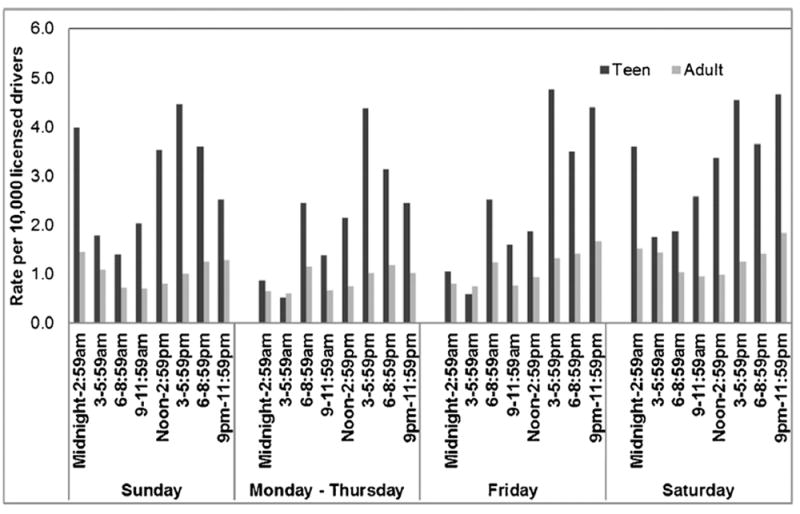
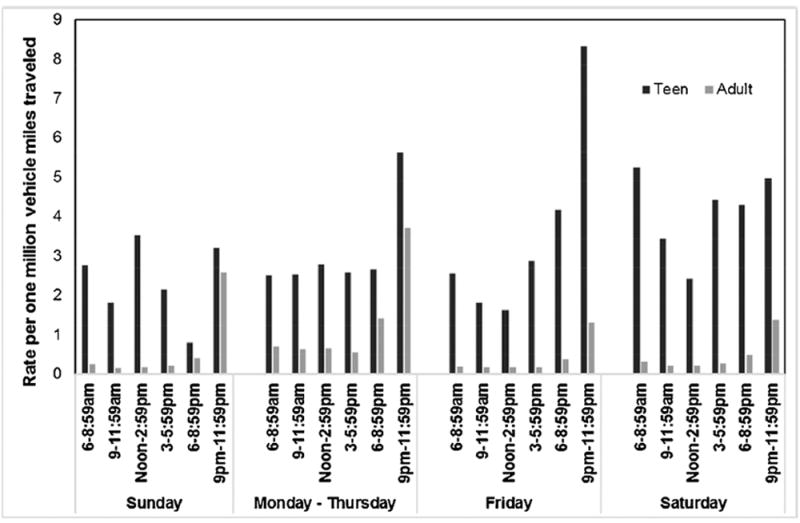
Results: Compared with adult drivers, teen drivers in South Carolina had 2.5 times the single vehicle nonfatal crash rate per licensed driver and 11 times the rate per vehicle mile traveled. Teen drivers were nearly twice as likely to be speeding at the time of the crash compared with adult drivers. Teen driver crashes per licensed driver were highest during the afternoon hours of 3:00-5:59 pm and crashes per mile driven were highest during the nighttime hours of 9:00-11:59 pm. In 66% of the teen driver crashes, the driver was the only occupant. Crashes were twice as likely to result in serious injury when teen passengers were present than when the teen driver was alone. When teen drivers crashed while transporting teen passengers, the passengers were >5 times more likely to all be restrained if the teen driver was restrained. Crashes in which the teen driver was unrestrained were 80% more likely to result in minor/moderate injury and 6 times more likely to result in serious injury compared with crashes in which the teen driver was restrained.
Conclusions: Despite the reductions in teen driver crashes associated with Graduated Driver Licensing (GDL), South Carolina's teen driver crash rates remain substantially higher than those for adult drivers. Established risk factors for fatal teen driver crashes, including restraint nonuse, transporting teen passengers, and speeding also increase the risk of nonfatal injury in single vehicle crashes. As South Carolina examines strategies to further reduce teen driver crashes and associated injuries, the state could consider updating its GDL passenger restriction to either none or one passenger <21years and dropping the passenger restriction exemption for trips to and from school. Surveillance systems such as CODES that link crash data with health outcome data provide needed information to more fully understand the circumstances and consequences of teen driver nonfatal crashes and evaluate the effectiveness of strategies to improve teen driver safety.
Keywords: CODES; Graduated driver licensing; Motor vehicle crashes; Seat belt use; Speeding; Teen driving.
Published by Elsevier Ltd.
Figures
References
-
- Braitman KA, Kirley BB, McCartt AT, Chaudhary NK. Crashes of novice teenage drivers: characteristics and contributing factors. J Saf Res. 2008;39:47–54. - PubMed
-
- Carney C, McGehee DV, Harland K, Weiss M, Raby M. Using Naturalistic Driving Data to Assess the Prevalence of Environmental Factors and Driver Behaviors in Teen Driver Crashes. [11 July 2017];2015 Available at: https://www.aaafoundation.org/sites/default/files/2015TeenCrashCausation....
-
- Centers for Disease Control and Prevention (CDC) Prevention Status Reports. [11 July 2017];2016 Available at: https://www.cdc.gov/psr/
-
- Chapman EA, Masten SV, Browning KK. Crash and Traffic violation rates before and after licensure for novice California drivers subject to different driver licensing requirements. J Saf Res. 2014;50:125–138. - PubMed
-
- Cook LJ, Thomas A, Olson C, Funai T, Simmons T. Crash Outcome Data Evaluation System (CODES): An Examination of Methodologies and Multi-state Traffic Safety Applications. Department of Transportation, National Highway Traffic Safety Administration; Washington, DC: U.S: 2015. Report No. DOT HS 812 179.
Publication types
MeSH terms
Grants and funding
LinkOut - more resources
Full Text Sources
Other Literature Sources
Medical
Research Materials
