


A Case of Persistent Low Back Pain in a Young Female Caused by a Trauma-Induced Schmorl's Node in the Lumbar Spine Five Vertebra
- PMID: 28948122
- PMCID: PMC5608482
- DOI: 10.7759/cureus.1502
A Case of Persistent Low Back Pain in a Young Female Caused by a Trauma-Induced Schmorl's Node in the Lumbar Spine Five Vertebra
Abstract
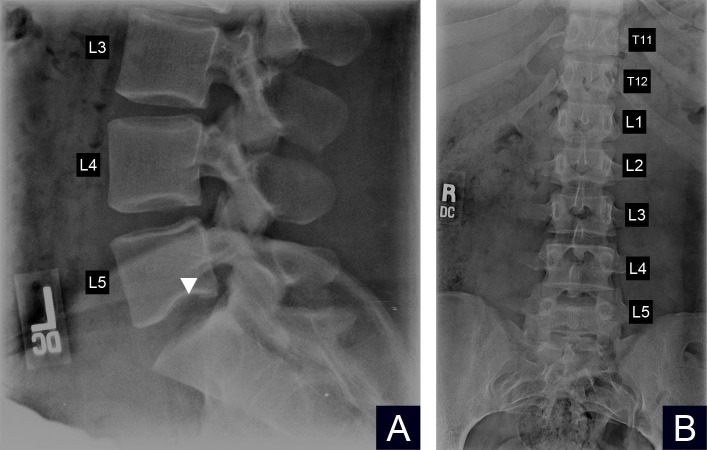
Physicians are often faced with managing difficult conditions such as chronic lower back pain. Intervertebral disk herniation typically occurs horizontally, leading to impingement of the spinal cord which can potentially cause radicular symptoms or other spinal cord pathologies; however, disk herniations can also occur vertically and extend through the endplate of an adjacent cranial or caudal vertebra: a phenomenon known as a Schmorl's node. Although Schmorl's nodes can be seen in many asymptomatic individuals, they can be a cause of degenerative disk disease and low back pain. An 18-year-old female with a history of trauma presented to urgent care with increasing lower back pain for the past six weeks. Four months prior, she was struck by a motor vehicle while riding her bicycle, and she had residual back pain since then. Plain radiography at the time of the accident showed no acute abnormalities. She had no other associated symptoms. On presentation, her vital signs were within normal limits, and her physical examination was largely unremarkable except for point tenderness along the lumbar (L4-L5) region of the spine. A complete blood count showed no leukocytosis and plain radiography of the lumbosacral spine showed a Schmorl's node in the inferior endplate of L5. The patient was diagnosed with a trauma-induced Schmorl's node and was treated with physical therapy, ice packs, and non-steroidal anti-inflammatory drugs. Her symptoms improved over the next several months. For patients with a history of axial load trauma and persistent back pain, clinicians should consider the possibility of a trauma-induced Schmorl's node. Plain radiography or magnetic resonance imaging can help with the diagnosis and guide further management.
Keywords: intervertebral disk; low back pain; schmorl’s nodes.
Conflict of interest statement
The authors have declared that no competing interests exist.
Figures
References
-
- A systematic review of the global prevalence of low back pain. Hoy D, Bain C, Williams G, et al. Arthritis Rheumatol. 2012;64:2028–2037. - PubMed
-
- Adolescent back pain. Kim HJ, Green DW. Curr Opin Pediatr. 2008;20:37–45. - PubMed
-
- Diagnosis and treatment of low back pain: A joint clinical practice guideline from the American College of Physicians and the American Pain Society. Chou R, Qaseem A, Snow V, et al. Ann Intern Med. 2007;147:478–491. - PubMed
-
- Schmorl's nodes: Current pathophysiological, diagnostic, and therapeutic paradigms. Mattei TA, Rehman AA. Neurosurg Rev. 2014;37:39–46. - PubMed
Publication types
LinkOut - more resources
Full Text Sources
Other Literature Sources
Miscellaneous