. 2018 Oct;9(4):377-386.
doi: 10.1007/s12687-017-0336-2. Epub 2017 Sep 26.

Chromosomal disorders: estimating baseline birth prevalence and pregnancy outcomes worldwide

Collaborators, Affiliations

Chromosomal disorders: estimating baseline birth prevalence and pregnancy outcomes worldwide

Sowmiya Moorthie et al. J Community Genet. 2018 Oct.

Abstract

Chromosomal disorders, of which Down syndrome is the most common, can cause multi-domain disability. In addition, compared to the general population, there is a higher frequency of death before the age of five. In many settings, large gaps in data availability have hampered policy-making, programme priorities and resource allocation for these important conditions. We have developed methods, which overcome this lack of data and allow estimation of the burden of affected pregnancies and their outcomes in different settings worldwide. For example, the methods include a simple equation relating the percentage of mothers 35 and over to Down syndrome birth prevalence. The results obtained provide a starting point for consideration of services that can be implemented for the care and prevention of these disorders.

Keywords: Birth prevalence; Chromosomal disorders; Disability; Mortality.


Conflict of interest statement

Conflict of interest

The authors declare that they have no conflict of interest.

Figures
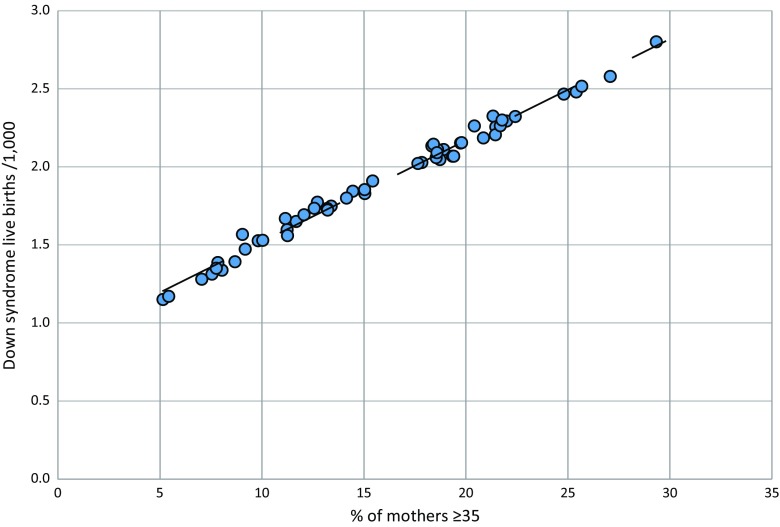
Fig. 1
Fig. 1
Relationship between percentage of mothers ≥ 35 plus and Down syndrome potential live birth prevalence. Live birth prevalence was estimated using the full range of risks in Table 2 for 54 high-income and eastern European countries with reliable demographic data. The selection covers a wide spread of rates because the proportion of older mothers is high in high-income countries but low in eastern Europe. Calculations are for 2005–2009, but results are similar for any time interval. Coefficient of correlation = 0.9944
Fig. 2
Fig. 2
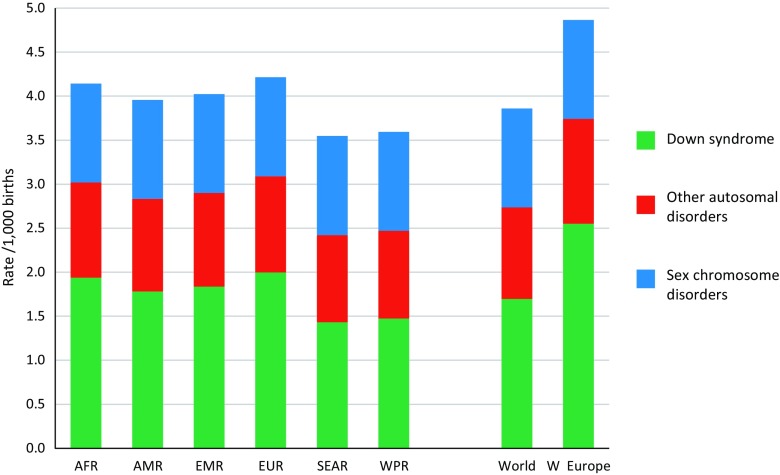
Estimated baseline total, birth prevalence of chromosomal disorders by WHO region in 2010–2014. AFR: African, AMR: American, EMR: Eastern Mediterranean, SEAR: South-East Asian, WPR: Western Pacific Region, W. Europe: Western Europe
Fig. 3
Fig. 3
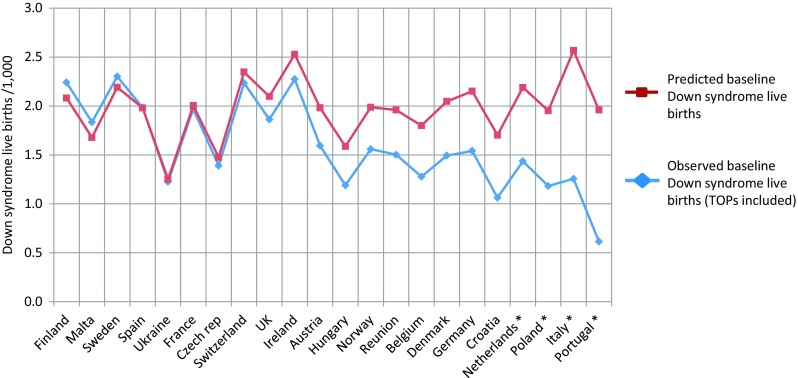
Comparison of estimated potential Down syndrome live births/1000 with observed potential live births calculated from EUROCAT registry data for 2000–2009. In order to make the comparison, EUROCAT total Down syndrome birth prevalence was converted to potential live birth prevalence, by deducting 5% to allow for potential foetal deaths, and deducting 30% from reported terminations to allow for spontaneous losses had these pregnancies continued. Countries ranked in descending order of discrepancy. *Countries with the widest discrepancy
Fig. 4
Fig. 4
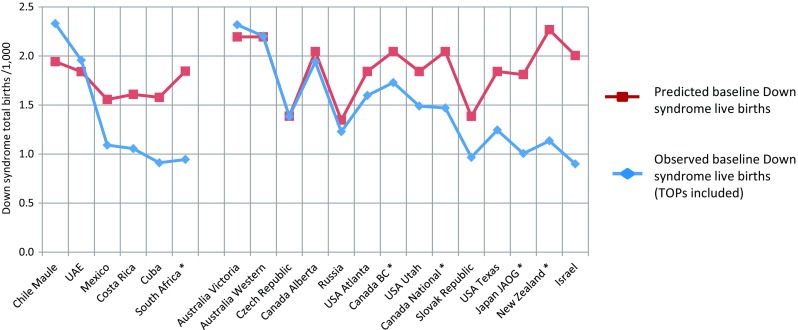
Comparison of estimated potential Down syndrome live births/1000, with observed potential live births calculated from ICBDSR registry data for 2000–2005. The six left-hand registries report from lower-income settings, and the right hand registries report from higher-income settings. *Registers where termination for foetal impairment is legal but not reported

References

    1. Alberman ED, Creasy MR. Frequency of chromosomal abnormalities in miscarriages and perinatal deaths. J Med Genet. 1977;14:313–315. doi: 10.1136/jmg.14.5.313. - DOI - PMC - PubMed
    1. Bishop J, Huether CA, Torfs C, Lorey F, Deddens J. Epidemiologic study of Down syndrome in a racially diverse California population, 1989–1991. Am J Epidemiol. 1997;145:134–147. doi: 10.1093/oxfordjournals.aje.a009084. - DOI - PubMed
    1. Blencowe H, Moorthie S, Darlison M, Gibbons S, Lawn J, Modell B, Congenital Disorders Expert Group (2017) The effect of interventions on the outcomes of congenital disorders. J Community Genet (in prep)
    1. Bojesen A, Gravholt CH. Klinefelter syndrome in clinical practice. Nat Clin Pract Urol. 2007;4:192–204. doi: 10.1038/ncpuro0775. - DOI - PubMed
    1. Bojesen A, Juul S, Gravholt CH. Prenatal and postnatal prevalence of Klinefelter syndrome: a national registry study. J Clin Endocrinol Metab. 2003;88:622–626. doi: 10.1210/jc.2002-021491. - DOI - PubMed

LinkOut - more resources