


Cancer Incidence in Saudi Arabia: 2012 Data from the Saudi Cancer Registry
- PMID: 28952273
- PMCID: PMC5720648
- DOI: 10.22034/APJCP.2017.18.9.2437
Cancer Incidence in Saudi Arabia: 2012 Data from the Saudi Cancer Registry
Abstract
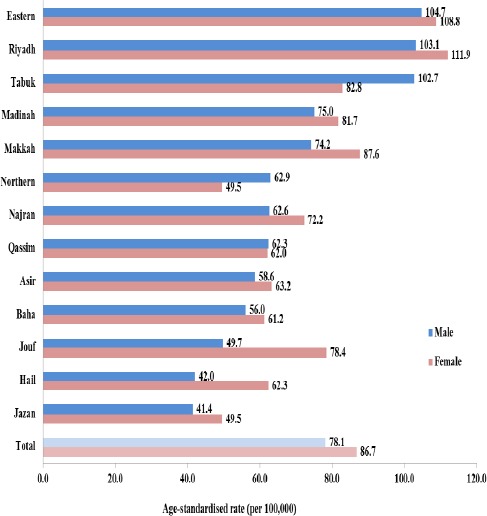
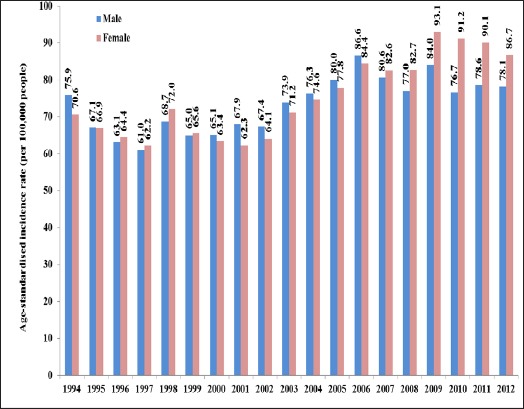
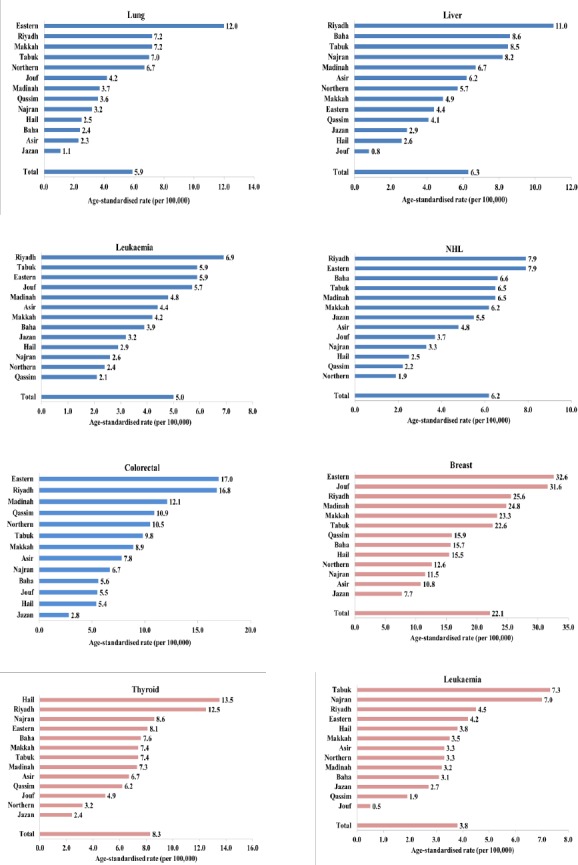
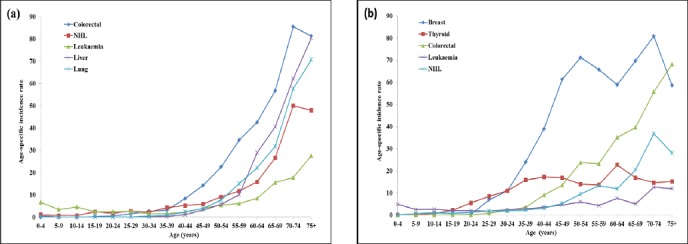
Background: In order to most appropriately allocate healthcare and research funding for cancer, it is important to have accurate population-based incidence data. The Saudi Cancer Registry (SCR) provides such information, covering the time period from 1994 to the present day. The current report concerns an overview of cancer incidence statistics for Saudi Arabia in 2012. Methods: The SCR collects data from healthcare facilities throughout the Kingdom of Saudi Arabia. All newly diagnosed cases of cancer are recorded, with information on site and histology. For the present report, age-standardised and age-specific incidence rates (ASR, AIR, respectively) were calculated, with attention to gender-specific and regional differences. Results: The total number of incident cases of cancer identified by the SCR in 2012 was 14,336, with 6,791 (47.5%) among males and 7,545 (52.6%) among females. Of this total, 11,034 cases (76.9%) occurred in patients of Saudi origin. For Saudi males, the overall ASR (inc. all cancer sites) was 78.1 per 100,000 people, while that for females was 86.7. Incidence varied by region, with the Eastern region and Riyadh displaying the highest ASRs for both males and females, and Hail and Jazan displaying the lowest. Incidence varied by gender, with colorectal cancer (13.3%), non-Hodgkin lymphoma (NHL; 8.4%), and leukaemia (8.2%) being the most common types in males, and breast (25.8%), thyroid (11.7%), and colorectal cancers (9.3%) being the most common in females. Conclusions: This analysis of cancer incidence in Saudi Arabia demonstrated significant differences according to gender, age, and region of the Kingdom. The data should help ensure the most appropriate allocation of resources, with the aim of minimising the healthcare burden associated with cancer.
Keywords: Cancer; incidence; Saudi Arabia; registry.
Creative Commons Attribution License
Figures
References
-
- Al-Faleh FZ, Ayoola EA, Al-Jeffry M, et al. Integration of hepatitis B vaccine into the expanded program on immunization:The Saudi Arabian experience. Ann Saudi Med. 1993;13:231–6. - PubMed
