


Additive Manufacturing of Poly(3-hydroxybutyrate-co-3-hydroxyhexanoate)/poly(ε-caprolactone) Blend Scaffolds for Tissue Engineering
- PMID: 28952527
- PMCID: PMC5590465
- DOI: 10.3390/bioengineering4020049
Additive Manufacturing of Poly(3-hydroxybutyrate-co-3-hydroxyhexanoate)/poly(ε-caprolactone) Blend Scaffolds for Tissue Engineering
Abstract
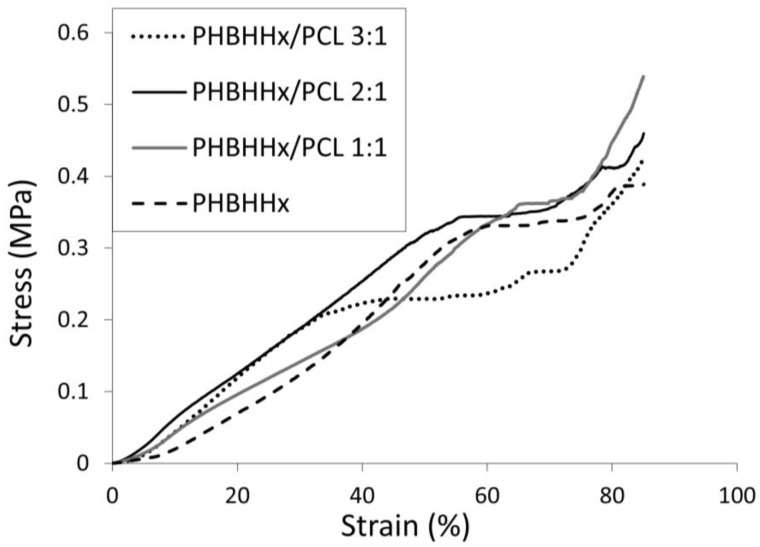
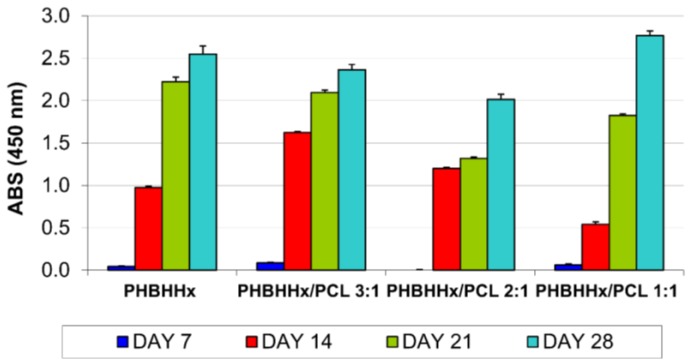
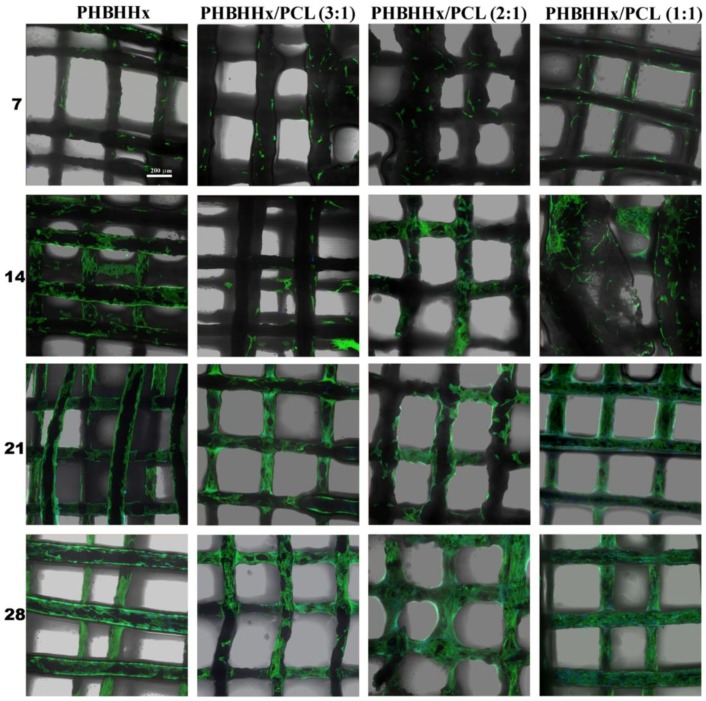
Additive manufacturing of scaffolds made of a polyhydroxyalkanoate blended with another biocompatible polymer represents a cost-effective strategy for combining the advantages of the two blend components in order to develop tailored tissue engineering approaches. The aim of this study was the development of novel poly(3-hydroxybutyrate-co-3-hydroxyhexanoate)/ poly(ε-caprolactone) (PHBHHx/PCL) blend scaffolds for tissue engineering by means of computer-aided wet-spinning, a hybrid additive manufacturing technique suitable for processing polyhydroxyalkanoates dissolved in organic solvents. The experimental conditions for processing tetrahydrofuran solutions containing the two polymers at different concentrations (PHBHHx/PCL weight ratio of 3:1, 2:1 or 1:1) were optimized in order to manufacture scaffolds with predefined geometry and internal porous architecture. PHBHHx/PCL scaffolds with a 3D interconnected network of macropores and a local microporosity of the polymeric matrix, as a consequence of the phase inversion process governing material solidification, were successfully fabricated. As shown by scanning electron microscopy, thermogravimetric, differential scanning calorimetric and uniaxial compressive analyses, blend composition significantly influenced the scaffold morphological, thermal and mechanical properties. In vitro biological characterization showed that the developed scaffolds were able to sustain the adhesion and proliferation of MC3T3-E1 murine preosteoblast cells. The additive manufacturing approach developed in this study, based on a polymeric solution processing method avoiding possible material degradation related to thermal treatments, could represent a powerful tool for the development of customized PHBHHx-based blend scaffolds for tissue engineering.
Keywords: additive manufacturing; computer-aided wet-spinning; poly(3-hydroxybutyrate-co-3-hydroxyhexanoate); poly(ε-caprolactone); polyhydroxyalkanoates; polymers blend; scaffolds; tissue engineering.
Conflict of interest statement
The authors declare no conflict of interest.
Figures
References
-
- Puppi D., Chiellini F., Dash M., Chiellini E. Biodegradable Polymers for Biomedical Applications. In: Felton G.P., editor. Biodegradable Polymers: Processing, Degradation and Applications. Nova Science Publishers, Inc.; Hauppauge, NY, USA: 2011. pp. 545–604.
-
- Woodruff M.A., Lange C., Reichert J., Berner A., Chen F., Fratzl P., Schantz J.-T., Hutmacher D.W. Bone tissue engineering: From bench to bedside. Mater. Today. 2012;15:430–435. doi: 10.1016/S1369-7021(12)70194-3. - DOI
-
- Puppi D., Chiellini F., Piras A.M., Chiellini E. Polymeric materials for bone and cartilage repair. Prog. Polym. Sci. 2010;35:403–440. doi: 10.1016/j.progpolymsci.2010.01.006. - DOI
-
- Morelli A., Puppi D., Chiellini F. Polymers from Renewable Resources. J. Renew. Mater. 2013;1:83–112. doi: 10.7569/JRM.2012.634106. - DOI
LinkOut - more resources
Full Text Sources
Other Literature Sources
