Impact of environmental factors on neglected emerging arboviral diseases
- PMID: 28953892
- PMCID: PMC5633201
- DOI: 10.1371/journal.pntd.0005959
Impact of environmental factors on neglected emerging arboviral diseases
Abstract
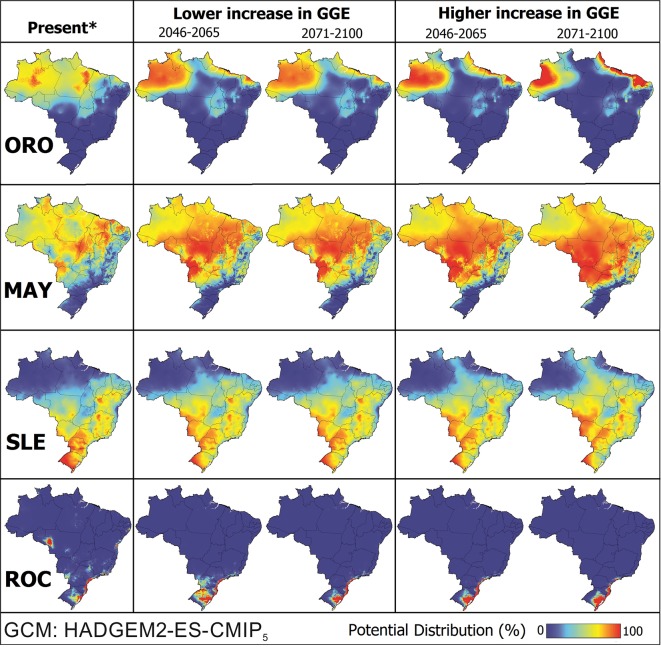
Background: Brazil is a tropical country that is largely covered by rainforests and other natural ecosystems, which provide ideal conditions for the existence of many arboviruses. However, few analyses have examined the associations between environmental factors and arboviral diseases. Thus, based on the hypothesis of correlation between environment and epidemiology, the proposals of this study were (1) to obtain the probability of occurrence of Oropouche, Mayaro, Saint Louis and Rocio fevers in Brazil based on environmental conditions corresponding to the periods of occurrence of the outbreaks; (2) to describe the macroclimatic scenario in Brazil in the last 50 years, evaluating if there was any detectable tendency to increase temperatures and (3) to model future expansion of those arboviruses in Brazil based on future temperature projections.
Methodology/principal findings: Our model assessed seven environmental factors (annual rainfall, annual temperature, elevation, seasonality of temperature, seasonality of precipitation, thermal amplitude, and daytime temperature variation) for their association with the occurrence of outbreaks in the last 50 years. Our results suggest that various environmental factors distinctly influence the distribution of each arbovirus, with temperature being the central determinant of disease distribution in all high-risk areas. These areas are subject to change, since the average temperature of some areas has increased significantly over the time.
Conclusions/significance: This is the first spatio-temporal study of the Oropouche, Mayaro, Saint Louis, and Rocio arboviruses, and our results indicate that they may become increasingly important public health problems in Brazil. Thus, next studies and control programs should include these diseases and also take into consideration key environmental elements.
Conflict of interest statement
The authors have declared that no competing interests exist.
Figures
References
-
- Rust RS. Human arboviral encephalitis. Seminar Ped Neurol. 2012. 130–151. - PubMed
-
- Anyamba A, Linthicum KJ, Small JL, Collins KM, Tucker CJ, Pak EW, Russell KL. Climate teleconnections and recent patterns of human and animal disease outbreaks. PLoS Negl Trop Dis. 2012; 6(1), e1465 doi: 10.1371/journal.pntd.0001465 - DOI - PMC - PubMed
-
- Gubler DJ. Human arbovirus infections worldwide. Ann NY Acad Sci. 2001; 951(1): 13–24. - PubMed
-
- Epstein PR. Climate change and human health. N Engl J Med. 2005; 353(14):1433–36. doi: 10.1056/NEJMp058079 - DOI - PubMed
-
- Instituto Brasileiro de Geografia e Estatística. 2015. Available from: http://www.ibge.gov.br/
MeSH terms
LinkOut - more resources
Full Text Sources
Other Literature Sources