


Mii-vitaliSe: a pilot randomised controlled trial of a home gaming system (Nintendo Wii) to increase activity levels, vitality and well-being in people with multiple sclerosis
- PMID: 28954791
- PMCID: PMC5623500
- DOI: 10.1136/bmjopen-2017-016966
Mii-vitaliSe: a pilot randomised controlled trial of a home gaming system (Nintendo Wii) to increase activity levels, vitality and well-being in people with multiple sclerosis
Abstract
Objectives: While the health and well-being benefits of physical activity are recognised, people with multiple sclerosis (MS) often face greater barriers than the general population. The Nintendo Wii potentially offers a fun, convenient way of overcoming some of these. The aim was to test the feasibility of conducting a definitive trial of the effectiveness and cost-effectiveness of Mii-vitaliSe; a home-based, physiotherapist-supported Nintendo Wii intervention.
Design: A single-centre wait-list randomised controlled study.
Setting: MS service in secondary care.
Participants: Ambulatory, relatively inactive people with clinically confirmed MS.
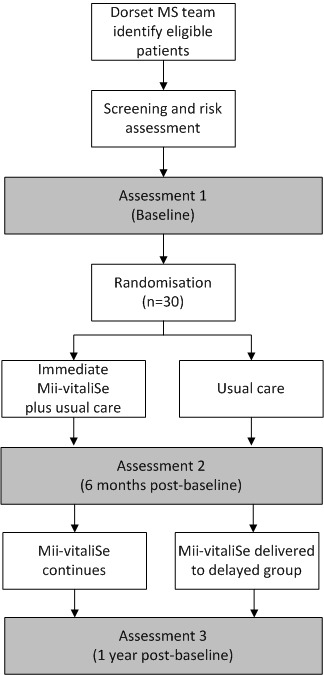
Intervention: Thirty participants were randomised to receive Mii-vitaliSe either immediately (for 12 months) or after a 6-month wait (for 6 months). Mii-vitaliSe consisted of two supervised Nintendo Wii familiarisation sessions in the hospital followed by home use (Wii Sports, Sports Resort and Fit Plus software) with physiotherapist support and personalised resources.
Outcomes: Included self-reported physical activity levels, quality of life, mood, self-efficacy, fatigue and assessments of balance, gait, mobility and hand dexterity at baseline, 6 and 12 months. Interviews (n=25) explored participants' experiences and, at study end, the two Mii-vitaliSe facilitators' experiences of intervention delivery (main qualitative findings reported separately).
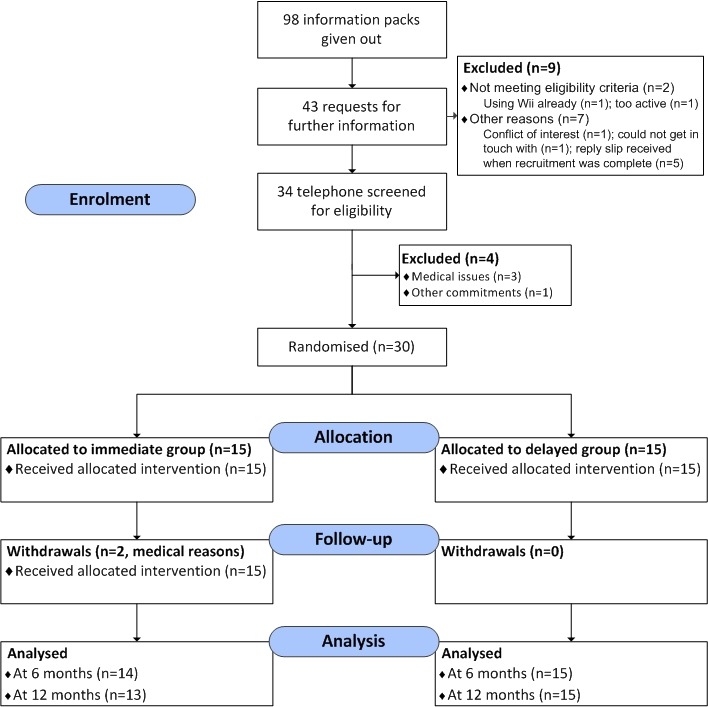
Results: Mean (SD) age was 49.3 (8.7) years, 90% female, with 47% diagnosed with MS <6 years ago and 60% new to active gaming. The recruitment rate was 31% (95% CI 20% to 44%). Outcome data were available for 29 (97%) at 6 months and 28 (93%) at 12 months. No serious adverse events were reported during the study. Qualitative data indicated that Mii-vitaliSe was well-received. Mean Wii use across both groups over the initial 6-month intervention period was twice a week for 27 min/day. Mean cost of delivering Mii-vitaliSe was £684 per person.
Discussion: Mii-vitaliSe appears acceptable and a future trial feasible and warranted. These findings will inform its design.
Trial registration: ISRCTN49286846.
Keywords: Active Gaming; Behaviour change; Exercise; Feasibility; Multiple Sclerosis; Physical Activity; Virtual Reality.
© Article author(s) (or their employer(s) unless otherwise stated in the text of the article) 2017. All rights reserved. No commercial use is permitted unless otherwise expressly granted.
Conflict of interest statement
Competing interests: None declared.
Figures
References
-
- Latimer-Cheung AE, Pilutti LA, Hicks AL, et al. Effects of exercise training on fitness, mobility, fatigue, and health-related quality of life among adults with multiple sclerosis: a systematic review to inform guideline development. Arch Phys Med Rehabil 2013;94:1800–28. 10.1016/j.apmr.2013.04.020 - DOI - PubMed
Publication types
MeSH terms
LinkOut - more resources
Full Text Sources
Other Literature Sources
Medical
Molecular Biology Databases
