


Prevalence and predictors of US medical graduates' federal F32, mentored-K, and R01 awards: a national cohort study
- PMID: 28954846
- PMCID: PMC5964605
- DOI: 10.1136/jim-2017-000515
Prevalence and predictors of US medical graduates' federal F32, mentored-K, and R01 awards: a national cohort study
Abstract
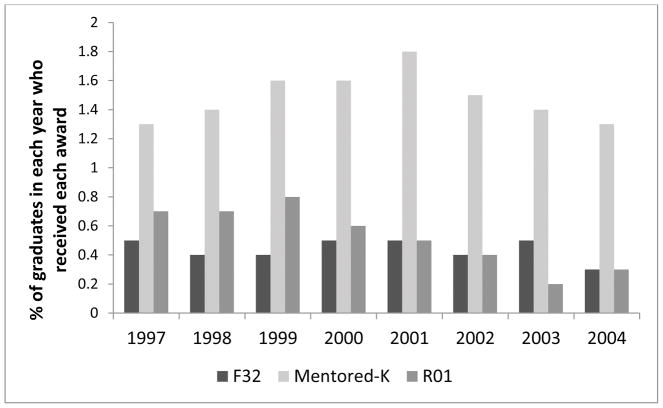
The size and diversity of the physician-scientist workforce are issues of national concern. In this retrospective, national cohort study of US medical school matriculants who graduated in 1997-2004, we describe the prevalence and predictors of federal F32, mentored-K, and R01 awards among physicians. In multivariable logistic regression models, we identified demographic, educational, and professional development variables independently associated with each award through August 2014, reporting adjusted odds ratios and 95% confidence intervals (AOR (95% CI)). Among 117,119 graduates with complete data (97.7% of 119,906 graduates in 1997-2004), 509 (0.4%) received F32, 1740 (1.5%) received mentored-K, and 597 (0.5%) received R01 awards. Adjusting for all variables except US Medical Licensing Examination Step 1 scores, black (vs white) graduates were less likely to receive F32 (0.48 (0.28-0.82)), mentored-K (0.56 (0.43-0.72)), and R01 (0.48 (0.28-0.82)) awards; Hispanic graduates were less likely to receive mentored-K awards (0.68 (0.52-0.88)), and women less likely to receive F32 (0.81 (0.67-0.98)) and R01 (0.59 (0.49-0.71)) awards. After adding Step 1 scores, these race/ethnicity effects were not significant, but women (0.62 (0.51-0.75)) were still less likely to receive R01 awards. Graduates reporting both (vs neither) medical school research elective and authorship were more likely to receive F32 (1.89 (1.45-2.48)), mentored-K (2.48 (2.13-2.88)), and R01 (2.00 (1.54-2.60)) awards. Prior F32 (2.17 (1.46-3.21)) and mentored-K (28.08 (22.94-34.38)) awardees more likely received R01 awards. Findings highlight the need for research-experiential interventions along the medical education continuum to promote greater participation and diversity of US medical graduates in the federally funded, biomedical research workforce.
Keywords: biomedical research; ethnic groups; medical education; schools; students.
© American Federation for Medical Research (unless otherwise stated in the text of the article) 2018. All rights reserved. No commercial use is permitted unless otherwise expressly granted.
Conflict of interest statement
Competing interests: DBJ and DAA used grant funds for travel to the National Institute of General Medical Sciences annual grantees’ meetings and to various meetings of the Association of American Medical Colleges (AAMC) to present their work from this study. Colleagues at the AAMC did not receive compensation from the authors for their support, but grant funds were used to compensate the AAMC for time and effort to provide us with the data.
Figures
References
-
- National Institutes of Health. [Accessed August 13, 2017];Physician-Scientist Workforce Working Group Report. 2014 Jun; Available at: http://acd.od.nih.gov/reports/PSW_Report_ACD_06042014.pdf. - PMC - PubMed
-
- Association of Professors of Medicine. Association of Professors of Medicine Physician-Scientist Initiative: Recommendations for revitalizing the nation’s physician-scientist workforce. Washington DC: 2008. [Accessed August 13, 2017]. Available at: http://www.freddynguyen.org/sites/default/files/2008_-_association_of_pr....
-
- Association of American Medical Colleges. Diversity in medical education: facts & figures, 2012. Washington, D.C: Association of American Medical Colleges; 2012.
-
- American Board of Medical Specialties. [Accessed August 13, 2017];Report of the special committee on physician-scientist & continuing certification. 2016 Jun; Available at: http://www.abms.org/media/119931/abms_physicianscientists_report.pdf.
MeSH terms
Grants and funding
LinkOut - more resources
Full Text Sources
Other Literature Sources
