Review
. 2017 Sep 1;9(9):2428-2443.
doi: 10.1093/gbe/evx164.

Functional Mechanisms of Microsatellite DNA in Eukaryotic Genomes

Affiliations
Review

Functional Mechanisms of Microsatellite DNA in Eukaryotic Genomes

Andrew T M Bagshaw. Genome Biol Evol. .

Abstract

Microsatellite repeat DNA is best known for its length mutability, which is implicated in several neurological diseases and cancers, and often exploited as a genetic marker. Less well-known is the body of work exploring the widespread and surprisingly diverse functional roles of microsatellites. Recently, emerging evidence includes the finding that normal microsatellite polymorphism contributes substantially to the heritability of human gene expression on a genome-wide scale, calling attention to the task of elucidating the mechanisms involved. At present, these are underexplored, but several themes have emerged. I review evidence demonstrating roles for microsatellites in modulation of transcription factor binding, spacing between promoter elements, enhancers, cytosine methylation, alternative splicing, mRNA stability, selection of transcription start and termination sites, unusual structural conformations, nucleosome positioning and modification, higher order chromatin structure, noncoding RNA, and meiotic recombination hot spots.

Keywords: eQTL; repeat; review; short; tandem; transcription.


Figures

<sc>Fig.</sc> 1.
Fig. 1.
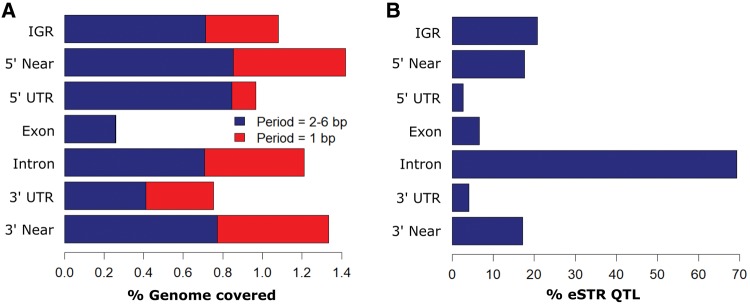
—(A) Distribution among human intergenic (IGR), near-genic (within 2 kb of transcription start or end sites), exonic, intronic and untranslated regions of ∼1.4 million microsatellites identified by Willems etal. (2014). Minimum length thresholds were 12 repeat copies for mononucleotide runs, 6 for dinucleotides and 4 for 3–6 bp repeat periods. (B) Distribution of microsatellites (periodicity 2–6 bp) with length variants showing significant effects on transcription (eSTRs) in lymphoblastoid cell lines (Gymrek etal. 2016).
<sc>Fig</sc>. 2.
Fig. 2.
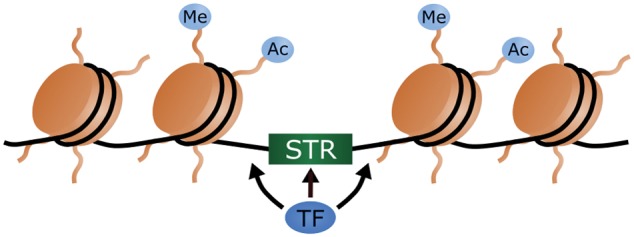
—Several types of microsatellite have been shown to resist packaging into nucleosomes, facilitating the binding of transcription factors (TF) and other proteins to nearby DNA. This sometimes involves induced nonB-DNA structure formation by the microsatellite. TFs also bind directly to some microsatellites. Additionally, STR eQTLs have been associated with epigenetic chemical modifications of nucleosomes, including regulatory methylation and acetylation of histone proteins.
<sc>Fig</sc>. 3.
Fig. 3.
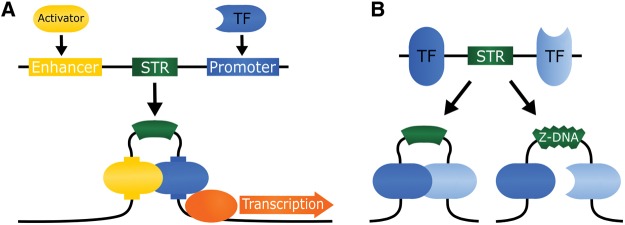
—Microsatellite change of length mutations may act by altering distances between flanking protein binding sites. Observations of high DNA flexibility at microsatellite sequences, and of periodicity approximating helical turn length in a correlation between microsatellite copy number and transcription, suggest the potential for looping to mediate this mechanism where sufficient distance exists between interacting elements, although closer interactions could occur without looping. Two possible scenarios are binding between an enhancer and a transcription factor flanking a microsatellite (TF; A), and between two TFs (B). Adoption of a nonB-DNA structure such as Z-DNA by the microsatellite could also play a role, because such structures absorb supercoiling energy and should thereby reduce the bending potential of surrounding DNA (B).
<sc>Fig</sc>. 4.
Fig. 4.
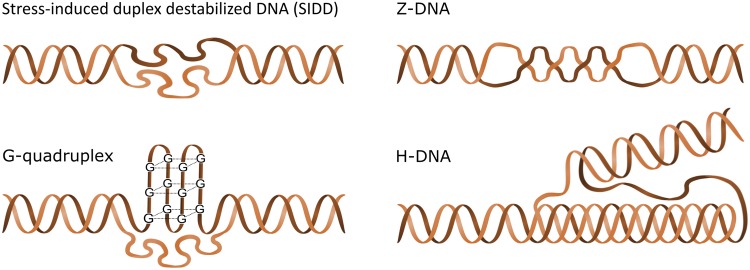
—Unusual structural conformations adopted by microsatellites. A/T-rich sequences can form SIDD, Z-DNA can be formed by poly-AC and poly-CG repeats, sequences with four closely spaced stretches of multiple guanine residues can fold into G-quadruplexes, and H-DNA can be adopted by poly-purine sequences with mirror symmetry including poly-AG.
<sc>Fig</sc>. 5.
Fig. 5.
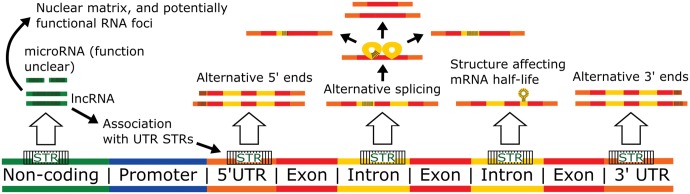
—Effects of microsatellites at the level of RNA. Long noncoding RNAs (lncRNAs) predominantly consisting of microsatellites have been observed to function in the nuclear matrix and to aggregate into nuclear foci with indications of functional significance. They have also been shown to associate with DNA microsatellites in UTRs. Microsatellite-dominated microRNAs have been observed, but their function is not yet clear. Intronic microsatellites can modulate splicing efficiency, including exon skipping and splice site selection, and UTR repeats can influence the locations of the sites of transcription initiation and termination. Transcribed microsatellites can also affect mRNA half-life, which may be due to formation of secondary structures such as hairpins.

References

    1. Adkins NL, Hagerman TA, Georgel P.. 2006. GAGA protein: a multi-faceted transcription factor. Biochem Cell Biol. 84(4):559–567. - PubMed
    1. Agarwal AK, et al.2000. CA-Repeat polymorphism in intron 1 of HSD11B2 : effects on gene expression and salt sensitivity. Hypertens (Dallas Tex 1979) 36(2):187–194. - PubMed
    1. Albanese V, et al.2001. Quantitative effects on gene silencing by allelic variation at a tetranucleotide microsatellite. Hum Mol Genet. 10(17):1785–1792. - PubMed
    1. Amiteye S, et al.2013. Novel microRNAs and microsatellite-like small RNAs in sexual and apomictic Boechera species. MicroRNA (Shariqah, United Arab Emirates) 2(1):45–62. - PubMed
    1. Ananda G, et al.2013. Distinct mutational behaviors differentiate short tandem repeats from microsatellites in the human genome. Genome Biol Evol. 5(3):606–620. - PMC - PubMed

Publication types

Substances

LinkOut - more resources