


Racial/Ethnic and Nativity Differences in Cognitive Life Expectancies Among Older Adults in the United States
- PMID: 28958071
- PMCID: PMC6417765
- DOI: 10.1093/geront/gnx142
Racial/Ethnic and Nativity Differences in Cognitive Life Expectancies Among Older Adults in the United States
Abstract
Background and objectives: To document racial/ethnic and nativity differences by gender in cognitive life expectancies among older adults in the United States.
Research design and methods: Sullivan-based life tables were used to estimate cognitively normal, cognitively impaired/no dementia (CIND), and dementia life expectancies by gender for White, Black, U.S.-born Hispanic, and foreign-born Hispanic adults 50 years and older in the Health and Retirement Study.
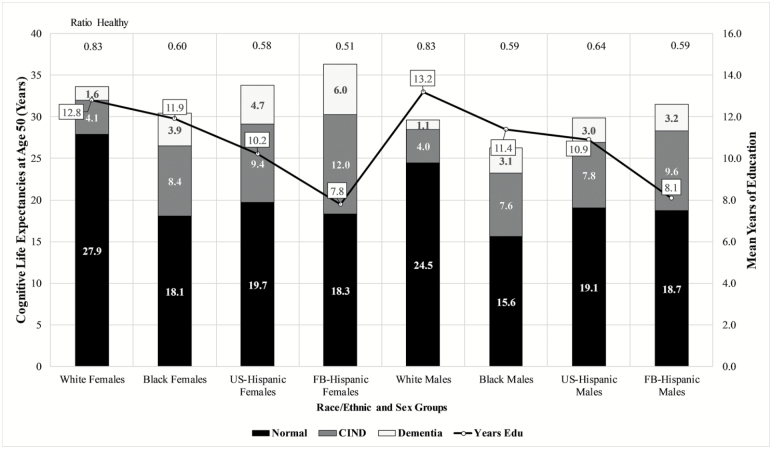
Results: Among women, the number of years spent living with dementia for Whites, Blacks, U.S.-born Hispanics, and foreign-born Hispanics was 1.6, 3.9, 4.7, and 6.0 years, respectively. For men, Whites lived 1.1 years with dementia compared to 3.1 years for Blacks, 3.0 years for U.S.-born Hispanics and 3.2 years for foreign-born Hispanics. Similar patterns were observed for race/ethnic and nativity differences in CIND life expectancies. Blacks and Hispanics spend a larger fraction of their remaining years with CIND and dementia relative to Whites, regardless of gender. Foreign-born Hispanic men and women and Black men are particularly disadvantaged in the proportion of years spent after age 50 with CIND and/or dementia.
Discussion and implications: Disparities in cognitive life expectancies indicate that intervention strategies should target the specific needs of minority and immigrant older adults with dementia. Given that education is a strong predictor of cognitive health, improving access to the social and economic resources that delay dementia onset is key to improving the well-being of diverse older adults.
Keywords: Cognitive impairment; Dementia; Life expectancy; Nativity; Race/ethnicity.
© The Author(s) 2017. Published by Oxford University Press on behalf of The Gerontological Society of America. All rights reserved. For permissions, please e-mail: journals.permissions@oup.com.
Figures
References
-
- Arias E. (2010). United States life tables by Hispanic origin. Vital and Health Statistics, 2, 1–33. - PubMed
-
- Barnes L. L., Wilson R. S., Li Y., Aggarwal N. T., Gilley D. W., McCann J. J., & Evans D. A (2005). Racial differences in the progression of cognitive decline in Alzheimer disease. Am J Geriatr Psychiatry, 13, 959–967. doi:10.1176/appi.ajgp.13.11.959 - PubMed
-
- Brandt J., Spencer M., & Folstein M (1988). The telephone interview for cognitive status. Neuropsychiatry, Neuropsychology, and Behavioral Neurology, 1, 111–118.
Publication types
MeSH terms
Grants and funding
LinkOut - more resources
Full Text Sources
Other Literature Sources
Medical
