


Very Poorly Controlled Asthma in Urban Minority Children: Lessons Learned
- PMID: 28958744
- PMCID: PMC5862725
- DOI: 10.1016/j.jaip.2017.08.007
Very Poorly Controlled Asthma in Urban Minority Children: Lessons Learned
Abstract
Background: Very poorly controlled (VPC) asthma in children is associated with ongoing acute exacerbations but factors associated with VPC are understudied.
Objective: To examine the risk factors associated with VPC asthma in urban minority children.
Methods: This descriptive study examined asthma control levels (well-controlled [WC], not well-controlled [NWC], and VPC) at baseline and 6 months in children participating in an ongoing randomized controlled trial of an emergency department/home environmental control intervention. Data collection occurred during the index emergency department visit and included allergen-specific IgE and salivary cotinine testing and caregiver interview of sociodemographic and child health characteristics. Follow-up data were collected at 6 months. Unadjusted analyses examined the association of sociodemographic and health characteristics by level of asthma control. Multivariate analysis tested significant factors associated with VPC asthma at 6 months.
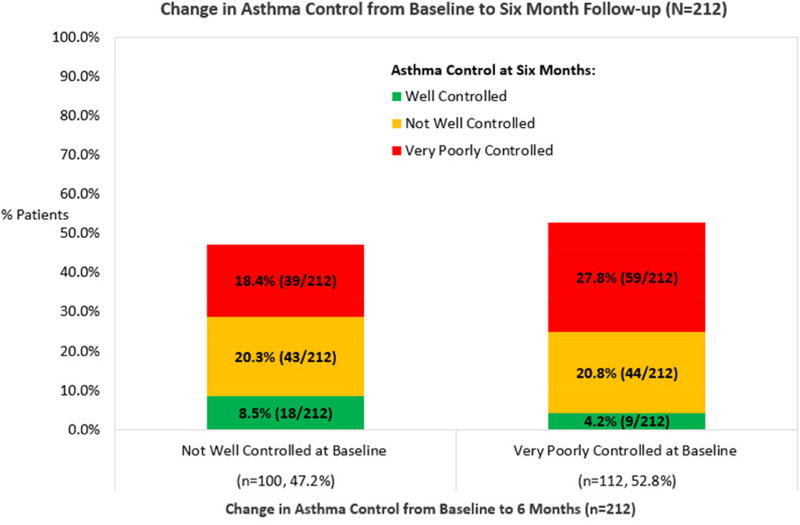
Results: At baseline most children were categorized with VPC asthma (WC, 0%; NWC, 47%; VPC, 53%) and rates of VPC minimally improved at 6 months (WC, 13%; NWC, 41%; VPC, 46%). Risk for VPC asthma was twice as likely in children with allergic rhinitis (odds ratio [OR], 2.42), having 2 or more primary care provider asthma visits within the past 3 months (OR, 2.77), or caregiver worry about medication side effects (OR, 2.13) and 3 to 4 times more likely when asthma control was assessed during the fall or spring season (OR: fall, 3.32; spring, 4.14).
Conclusions: Improving asthma control in low-income, high-risk children with VPC asthma requires treatment of comorbidities, attention to caregiver medication beliefs, and adept use of stepwise therapy.
Trial registration: ClinicalTrials.gov NCT01981564.
Keywords: Asthma control; Children; Stepwise therapy; Very poorly controlled asthma.
Copyright © 2017 American Academy of Allergy, Asthma & Immunology. Published by Elsevier Inc. All rights reserved.
Figures
Comment in
-
Rethinking Access to Care.J Allergy Clin Immunol Pract. 2018 May-Jun;6(3):853-854. doi: 10.1016/j.jaip.2017.10.013. J Allergy Clin Immunol Pract. 2018. PMID: 29747988 No abstract available.
References
-
- Akinbami LJ, Moorman JE, Garbe PL, Sondik EJ. Status of childhood asthma in the United States. 1980–2007. Pediatrics. 2009;123(Suppl 3):S131–145. - PubMed
-
- USDHHS. The National Asthma Education and Prevention Program. Expert Panel Report 3 (EPR3): Guidelines for the Diagnosis and Management of Asthma. 2007 NIH Publication No. 07-4051.
-
- Haselkorn T, Fish JE, Zeiger RS, Szefler SJ, Miller DP, Chipps BE, et al. Consistently very poorly controlled asthma, as defined by the impairment domain of the Expert Panel Report 3 guidelines, increases risk for future severe asthma exacerbations in the Epidemiology and Natural History of Asthma: Outcomes and Treatment Regimens (TENOR) study. J Allergy Clin Immunol. 2009;124:895–902. - PubMed
-
- Guilbert TW, Garris C, Jhingran P, Bonafede M, Tomaszewski KJ, Bonus T, et al. Asthma that is not well controlled is associated with increased healthcare utilization and decreased quality of life. J Asthma. 2011;48:126–132. - PubMed
Publication types
MeSH terms
Substances
Associated data
Grants and funding
LinkOut - more resources
Full Text Sources
Other Literature Sources
Medical
Miscellaneous
