. 2017 Sep 11:8:1098.
doi: 10.3389/fimmu.2017.01098. eCollection 2017.

Immunological Control of Viral Infections in Bats and the Emergence of Viruses Highly Pathogenic to Humans

Affiliations

Immunological Control of Viral Infections in Bats and the Emergence of Viruses Highly Pathogenic to Humans

Tony Schountz et al. Front Immunol. .

Abstract

Bats are reservoir hosts of many important viruses that cause substantial disease in humans, including coronaviruses, filoviruses, lyssaviruses, and henipaviruses. Other than the lyssaviruses, they do not appear to cause disease in the reservoir bats, thus an explanation for the dichotomous outcomes of infections of humans and bat reservoirs remains to be determined. Bats appear to have a few unusual features that may account for these differences, including evidence of constitutive interferon (IFN) activation and greater combinatorial diversity in immunoglobulin genes that do not undergo substantial affinity maturation. We propose these features may, in part, account for why bats can host these viruses without disease and how they may contribute to the highly pathogenic nature of bat-borne viruses after spillover into humans. Because of the constitutive IFN activity, bat-borne viruses may be shed at low levels from bat cells. With large naive antibody repertoires, bats may control the limited virus replication without the need for rapid affinity maturation, and this may explain why bats typically have low antibody titers to viruses. However, because bat viruses have evolved in high IFN environments, they have enhanced countermeasures against the IFN response. Thus, upon infection of human cells, where the IFN response is not constitutive, the viruses overwhelm the IFN response, leading to abundant virus replication and pathology.

Keywords: Chiroptera; antibody repertoire; bats; emerging infectious disease; virus ecology; zoonosis.


Figures
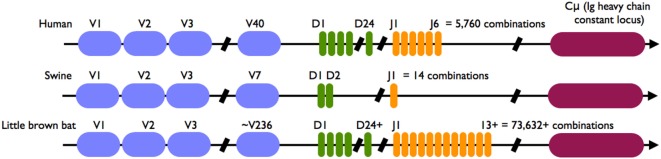
Figure 1
Figure 1
Immunoglobulin VDJ combinatorial diversity potential of humans, swine and little brown bats. The human heavy (H) chain locus has about 40 variable (V), 24 diversity (D) and 6 joining (J) segments that are functional. Rearrangement of the locus occurs during B cell development in the bone marrow and provides the repertoire of immunoglobulin specificities that are clonotypic in naive B cells, usually with IgM constant (Cμ) heavy chains, which populate peripheral lymphoid tissues, such as lymph nodes and the spleen. The theoretical number of human H chain specificities is 40 × 24 × 6 = 5,760. In contrast, swine have 7 V, 2 D, and 1 J segments that are functional, totaling 14. In the little brown bat (Myotis lucifugus), the functional H chain locus is estimated to have 236 V segments, at least 24 D segments, and at least 13 J segments, for a theoretical number of at least 73,632 specificities in the naive B cell repertoire. Blue, V gene segments; green, D gene segments; orange, J chain segments; purple, C gene (IgM); other C genes not shown.
Figure 2
Figure 2
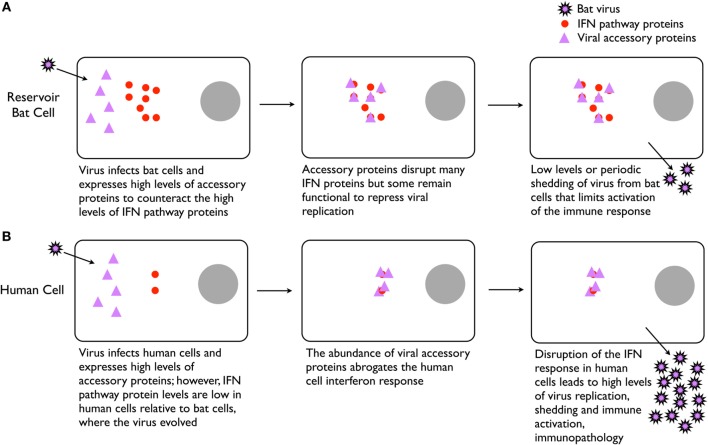
Potential explanation for high virulence of certain bat-borne viruses in humans. (A) Infection of bat cells leads to high expression of viral accessory proteins that repress the constitutively active type I interferon (IFN) system, leading to low levels of virus replication and shedding. Low level or intermittent replication of virus delays and reduces stimulation of the immune system, thus resulting in weak adaptive immunity and poor antibody responses. (B) In human cells, the high expression of viral accessory proteins significantly disrupts the cell’s ability to control the infection, leading to high levels of virus replication and immune stimulation that contributes to pathogenesis.

References

    1. Calisher CH, Childs JE, Field HE, Holmes KV, Schountz T. Bats: important reservoir hosts of emerging viruses. Clin Microbiol Rev (2006) 19(3):531–45. 10.1128/CMR.00017-06 - DOI - PMC - PubMed
    1. Lau SK, Li KS, Tsang AK, Lam CS, Ahmed S, Chen H, et al. Genetic characterization of Betacoronavirus lineage C viruses in bats reveals marked sequence divergence in the spike protein of pipistrellus bat coronavirus HKU5 in Japanese pipistrelle: implications for the origin of the novel Middle East respiratory syndrome coronavirus. J Virol (2013) 87(15):8638–50. 10.1128/JVI.01055-13 - DOI - PMC - PubMed
    1. Luis AD, Hayman DT, O’Shea TJ, Cryan PM, Gilbert AT, Pulliam JR, et al. A comparison of bats and rodents as reservoirs of zoonotic viruses: are bats special? Proc Biol Sci (2013) 280(1756):20122753. 10.1098/rspb.2012.2753 - DOI - PMC - PubMed
    1. Olival KJ, Hosseini PR, Zambrana-Torrelio C, Ross N, Bogich TL, Daszak P. Host and viral traits predict zoonotic spillover from mammals. Nature (2017) 546(7660):646–50. 10.1038/nature22975 - DOI - PMC - PubMed
    1. Benton MJ, Ayala FJ. Dating the tree of life. Science (2003) 300(5626):1698–700. 10.1126/science.1077795 - DOI - PubMed

LinkOut - more resources