Review
doi: 10.1126/sciadv.aao2110.
eCollection 2017 Sep.
How do lncRNAs regulate transcription?
Affiliations
- PMID: 28959731
- PMCID: PMC5617379
- DOI: 10.1126/sciadv.aao2110
Item in Clipboard
Review
How do lncRNAs regulate transcription?
Sci Adv.
.
Abstract
It has recently become apparent that RNA, itself the product of transcription, is a major regulator of the transcriptional process. In particular, long noncoding RNAs (lncRNAs), which are so numerous in eukaryotes, function in many cases as transcriptional regulators. These RNAs function through binding to histone-modifying complexes, to DNA binding proteins (including transcription factors), and even to RNA polymerase II. In other cases, it is the act of lncRNA transcription rather than the lncRNA product that appears to be regulatory. We review recent progress in elucidating the molecular mechanisms by which lncRNAs modulate gene expression and future opportunities in this research field.
Figures
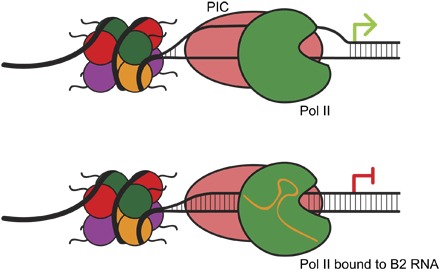
In the absence of B2 RNA, a functional closed preinitiation complex (PIC) can assemble. (Top) This complex can melt the dsDNA duplex, forming an open preinitiation complex to promote transcription initiation. In contrast, B2 RNA directly binds to RNA Pol II in a nonfunctional closed complex. (Bottom) B2 RNA precludes Pol II from making functional DNA contacts and thereby prevents dsDNA melting and open complex formation.
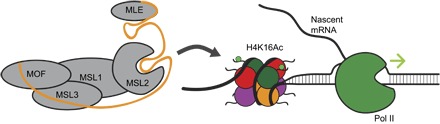
The DCC consists of five proteins (gray) and roX1 or roX2 RNA (orange line). The MLE helicase remodels roX RNAs into a tandem stem-loop structure that is incorporated into a functional DCC. When fully assembled, this ribonucleoprotein complex is recruited to the X chromosome and acetylates Lys16 on histone 4. This PTM results in chromosome decompression and hyperactive transcription. H4K16 acetylation of the X chromosome does not occur in the absence of roX RNA transcripts.
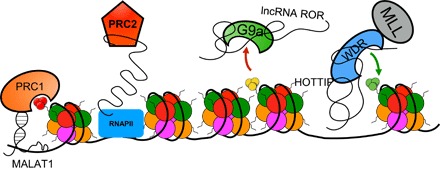
PRC1 interacts with lncRNA, either TUG1 or MALAT1. These interactions regulate methylation status and localization of PRC1. PRC2 is inhibited by binding lncRNA or nascent pre-mRNA. lncRNAs Kcnq1ot1, Air, and ROR (regulator of reprogramming) regulate the activity of G9a, an enzyme that methylates H3K9. HOTTIP interacts with the WDR5-MLL complex and localizes the complex to the 5′HOXA locus. RNAPII, RNA polymerase II; MALAT1, metastasis-associated lung adenocarcinoma transcript 1.
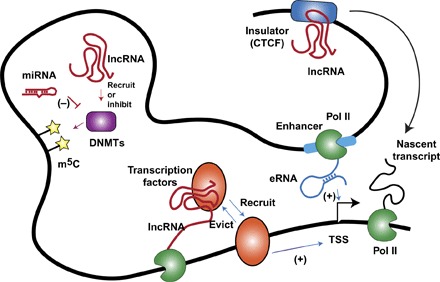
lncRNAs (and sometimes miRNAs) interact with DNMTs, resulting in recruitment or inhibition of DNMTs at chromatin loci. Alteration of DNA methylation (m5C) level generally affects local transcription. lncRNA–transcription factor interactions can either recruit or evict transcription factors from chromatin, and this action can be either in cis (demonstrated in figure) or in trans. eRNA transcribed from an enhancer region can contribute to chromatin looping and gene activation. lncRNAs interact with the chromatin insulator CCCTC-binding factor (CTCF) and regulate transcription. The mechanism may involve CTCF’s action in chromatin looping and nuclear architecture. TSS, transcription start site.
References
-
- Liu S. J., Horlbeck M. A., Cho S. W., Birk H. S., Malatesta M., He D., Attenello F. J., Villalta J. E., Cho M. Y., Chen Y., Mandegar M. A., Olvera M. P., Gilbert L. A., Conklin B. R., Chang H. Y., Weissman J. S., Lim D. A., CRISPRi-based genome-scale identification of functional long noncoding RNA loci in human cells. Science 355, eaah7111 (2017). - PMC - PubMed
-
- Li W., Notani D., Rosenfeld M. G., Enhancers as non-coding RNA transcription units: Recent insights and future perspectives. Nat. Rev. Genet. 17, 207–223 (2016). - PubMed
-
- Cech T. R., Steitz J. A., The noncoding RNA revolution—Trashing old rules to forge new ones. Cell 157, 77–94 (2014). - PubMed
Publication types
MeSH terms
Substances
Grants and funding
LinkOut - more resources
Full Text Sources
Other Literature Sources
Molecular Biology Databases