


Anorexia, functional capacity, and clinical outcome in patients with chronic heart failure: results from the Studies Investigating Co-morbidities Aggravating Heart Failure (SICA-HF)
- PMID: 28960880
- PMCID: PMC5695184
- DOI: 10.1002/ehf2.12209
Anorexia, functional capacity, and clinical outcome in patients with chronic heart failure: results from the Studies Investigating Co-morbidities Aggravating Heart Failure (SICA-HF)
Abstract
Aims: We aimed to assess determinants of anorexia, that is loss of appetite in patients with heart failure (HF) and aimed to further elucidate the association between anorexia, functional capacity, and outcomes in affected patients.
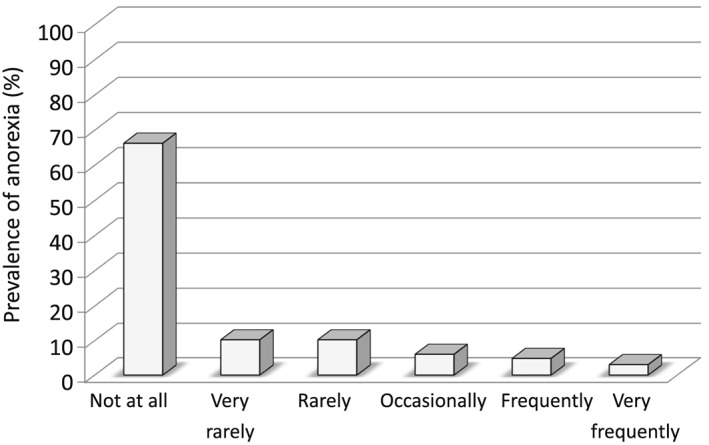
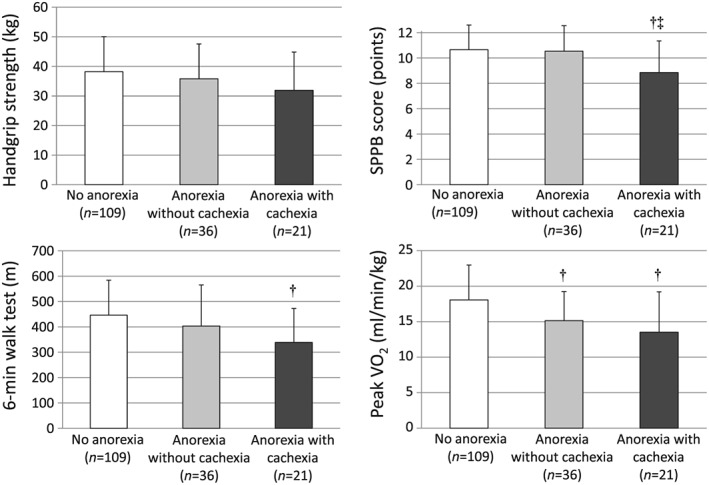
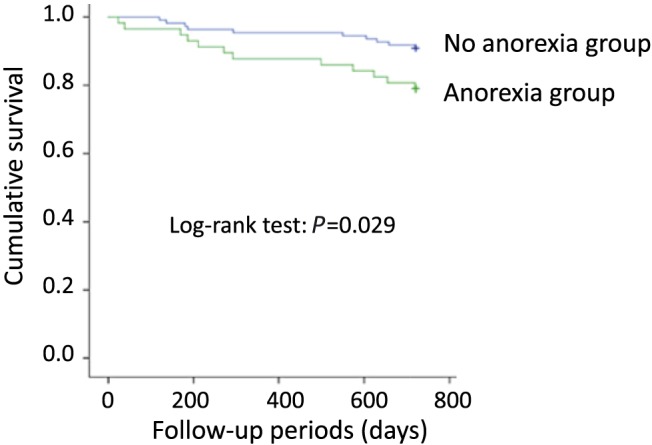
Methods and results: We assessed anorexia status among 166 patients with HF (25 female, 66 ± 12 years) who participated in the Studies Investigating Co-morbidities Aggravating HF. Anorexia was assessed by a 6-point Likert scale (ranging from 0 to 5), wherein values ≥1 indicate anorexia. Functional capacity was assessed as peak oxygen uptake (peak VO2 ), 6 min walk test, and short physical performance battery test. A total of 57 patients (34%) reported any anorexia, and these patients showed lower values of peak VO2 , 6 min walk distance, and short physical performance battery score (all P < 0.05). Using multivariate analysis adjusting for clinically important factors, only high-sensitivity C-reactive protein [odds ratio (OR) 1.24, P = 0.04], use of loop diuretics (OR 5.76, P = 0.03), and the presence of cachexia (OR 2.53, P = 0.04) remained independent predictors of anorexia. A total of 22 patients (13%) died during a mean follow-up of 22.5 ± 5.1 months. Kaplan-Meier curves for cumulative survival showed that those patients with anorexia presented higher mortality (Log-rank test P = 0.03).
Conclusions: Inflammation, use of loop diuretics, and cachexia are associated with an increased likelihood of anorexia in patients with HF, and patients with anorexia showed impaired functional capacity and poor outcomes.
Keywords: Anorexia; Cachexia; Functional capacity; Heart failure.
© 2017 The Authors. ESC Heart Failure published by John Wiley & Sons Ltd on behalf of the European Society of Cardiology.
Figures
References
-
- Go AS, Mozaffarian D, Roger VL, Benjamin EJ, Berry JD, Borden WB, Bravata DM, Dai S, Ford ES, Fox CS, Franco S, Fullerton HJ, Gillespie C, Hailpern SM, Heit JA, Howard VJ, Huffman MD, Kissela BM, Kittner SJ, Lackland DT, Lichtman JH, Lisabeth LD, Magid D, Marcus GM, Marelli A, Matchar DB, McGuire DK, Mohler ER, Moy CS, Mussolino ME, Nichol G, Paynter NP, Schreiner PJ, Sorlie PD, Stein J, Turan TN, Virani SS, Wong ND, Woo D, Turner MB, American Heart Association Statistics Committee and Stroke Statistics Subcommittee . Heart disease and stroke statistics–2013 update: a report from the American Heart Association. Circulation 2013; 127: e6–e245. - PMC - PubMed
-
- Fülster S, Tacke M, Sandek A, Ebner N, Tschöpe C, Doehner W, Anker SD, von Haehling S. Muscle wasting in patients with chronic heart failure: results from the studies investigating co‐morbidities aggravating heart failure (SICA‐HF). Eur Heart J 2013; 34: 512–519. - PubMed
-
- Bekfani T, Pellicori P, Morris DA, Ebner N, Valentova M, Steinbeck L, Wachter R, Elsner S, Sliziuk V, Schefold JC, Sandek A, Doehner W, Cleland JG, Lainscak M, Anker SD, von Haehling S. Sarcopenia in patients with heart failure with preserved ejection fraction: impact on muscle strength, exercise capacity and quality of life. Int J Cardiol 2016; 222: 41–46. - PubMed
-
- Anker SD, Ponikowski P, Varney S, Chua TP, Clark AL, Webb‐Peploe KM, Harrington D, Kox WJ, Poole‐Wilson PA, Coats AJ. Wasting as independent risk factor for mortality in chronic heart failure. Lancet 1997; 349: 1050–1053. - PubMed
Publication types
MeSH terms
LinkOut - more resources
Full Text Sources
Other Literature Sources
Medical
Research Materials
Miscellaneous
