


Comparison of the susceptibility of Plasmodium knowlesi and Plasmodium falciparum to antimalarial agents
- PMID: 28961865
- PMCID: PMC5890772
- DOI: 10.1093/jac/dkx279
Comparison of the susceptibility of Plasmodium knowlesi and Plasmodium falciparum to antimalarial agents
Abstract
Background: The simian malaria parasite Plasmodium knowlesi is now a well-recognized pathogen of humans in South-East Asia. Clinical infections appear adequately treated with existing drug regimens, but the evidence base for this practice remains weak. The availability of P. knowlesi cultures adapted to continuous propagation in human erythrocytes enables specific studies of in vitro susceptibility of the species to antimalarial agents, and could provide a surrogate system for testing investigational compounds against Plasmodium vivax and other non-Plasmodium falciparum infections that cannot currently be propagated in vitro.
Objectives: We sought to optimize protocols for in vitro susceptibility testing of P. knowlesi and to contrast outputs with those obtained for P. falciparum under comparable test conditions.
Methods: Growth monitoring of P. knowlesi in vitro was by DNA quantification using a SYBR Green fluorescent assay or by colorimetric detection of the lactate dehydrogenase enzyme. For comparison, P. falciparum was tested under conditions identical to those used for P. knowlesi.
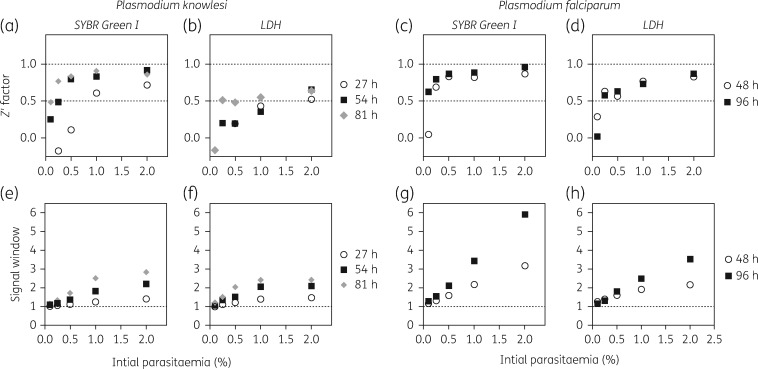
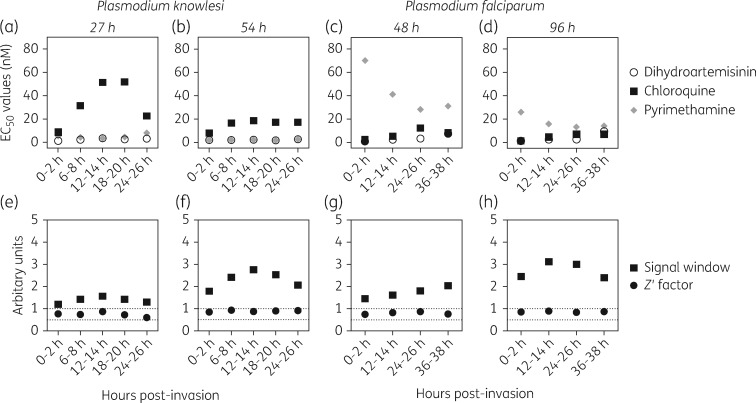
Results: The SYBR Green I assay proved the most robust format over one (27 h) or two (54 h) P. knowlesi life cycles. Unexpectedly, P. knowlesi displays significantly greater susceptibility to the dihydrofolate reductase inhibitors pyrimethamine, cycloguanil and trimethoprim than does P. falciparum, but is less susceptible to the selective agents blasticidin and DSM1 used in parasite transfections. Inhibitors of dihydroorotate dehydrogenase also demonstrate lower activity against P. knowlesi.
Conclusions: The fluorescent assay system validated here identified species-specific P. knowlesi drug susceptibility profiles and can be used for testing investigational compounds for activity against non-P. falciparum malaria.
© The Author 2017. Published by Oxford University Press on behalf of the British Society for Antimicrobial Chemotherapy.
Figures
References
Publication types
MeSH terms
Substances
Grants and funding
LinkOut - more resources
Full Text Sources
Other Literature Sources
