


Sexual maturation and fertility of mice exposed to triphenyltin during prepubertal and pubertal periods
- PMID: 28962375
- PMCID: PMC5598530
- DOI: 10.1016/j.toxrep.2014.12.006
Sexual maturation and fertility of mice exposed to triphenyltin during prepubertal and pubertal periods
Abstract
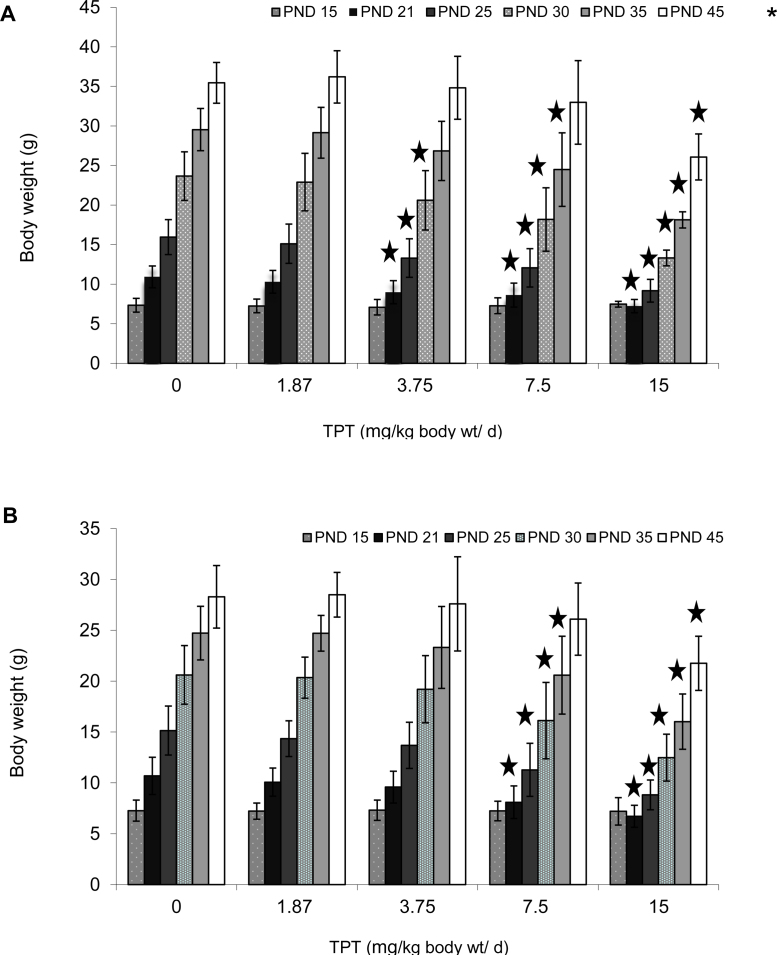
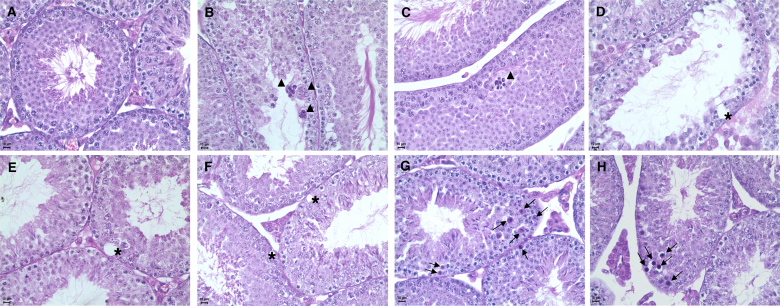
This study investigated the effects of pre- and peripubertal exposure (PND 15-45) to triphenyltin hydroxide (TPT: 0, 1.875, 3.75, 7.5 and 15 mg/kg bw/d po) on mouse sexual maturation and fertility. Half of the mice were euthanized on PND 46 and the remaining mice were submitted to fertility tests on PND 65-75. TPT caused a transient decrease of weight gain at 3.75 mg/kg bw/d, and deaths and body weight deficits at higher doses. Delays of testes descent (TD), vaginal opening (VO) and first estrus (FE) occurred at doses ≥3.75 (TD) and ≥7.5 mg/kg bw/d (VO, FE), respectively. Body weight on the days of TD, VO and FE did not differ among groups. TPT at doses ≥3.75 mg/kg decreased sperm and spermatid counts at the end of treatment (PND 46) but no alteration was noted later on PND 75. Testicular histopathology (PND 46) showed a dose-dependent reduction of seminiferous tubules diameter, a greater degree of vacuolation in Sertoli cells and germ cell degeneration and necrosis in TPT-treated mice. TPT did not affect the outcome of fertility tests. Study-derived NOAEL was 1.875 mg TPT/kg bw/d for males and 3.75 mg TPT/kg bw/d for females. The detrimental effects of TPT on spermatogenesis were reversed after treatment discontinuation.
Keywords: Fertility; Organotin compounds; Postnatal exposure; Puberty; TPTH; Triphenyltin.
Figures
References
-
- Airaksinen R., Rantakokko P., Turunen A.W., Vartiainen T., Vuorinen P.J., Lappalainen A., Vihervuori A., Mannio J., Hallikainen A. Organotin intake through fish consumption in Finland. Environ. Res. 2010;110(6):544–547. - PubMed
-
- Cooke G.M., Forsyth D.S., Bondy G.S., Tachon R., Tague B., Coady L. Organotin speciation and tissue distribution in rat dams, fetuses, and neonates following oral administration of tributyltin chloride. J. Toxicol. Environ. Health A. 2008;71(6):384–395. - PubMed
-
- Delgado I.F., Viana V.G., Sarpa M., Paumgartten F.J. Postnatal development and resistance to Plasmodium yoelii infection of mice prenatally exposed to triphenyltin hydroxide. Environ. Toxicol. 2009;24(6):629–635. - PubMed
-
- Grote K., Andrade A.J., Grande S.W., Kuriyama S.N., Talsness C.E., Appel K.E., Chahoud I. Effects of peripubertal exposure to triphenyltin on female sexual development of the rat. Toxicology. 2006;222(1–2):17–24. - PubMed
LinkOut - more resources
Full Text Sources
Other Literature Sources
