


Project TEAMS (Talking about Eating, Activity, and Mutual Support): a randomized controlled trial of a theory-based weight loss program for couples
- PMID: 28962602
- PMCID: PMC5622424
- DOI: 10.1186/s12889-017-4732-7
Project TEAMS (Talking about Eating, Activity, and Mutual Support): a randomized controlled trial of a theory-based weight loss program for couples
Abstract
Background: Obesity risk is shared between spouses, yet existing weight loss programs focus on individuals and not the marital dyad. Given the interdependence of weight in couples, weight management outcomes might be improved by targeting joint weight loss and the creation of an interpersonal milieu that supports long-term behavior change. According to Self-Determination Theory (SDT), greater autonomous self-regulation of behaviors, and subsequently better treatment outcomes, are observed in needs supportive environments in which personally meaningful choice is supported and criticism and control are minimized. Correlational analyses confirm these pathways in weight management, with needs support from one's spouse or partner emerging as a distinct predictor of weight loss success. Research is now needed to establish causal links and to develop and test weight loss interventions designed to facilitate the needs supportive behavior of spouses.
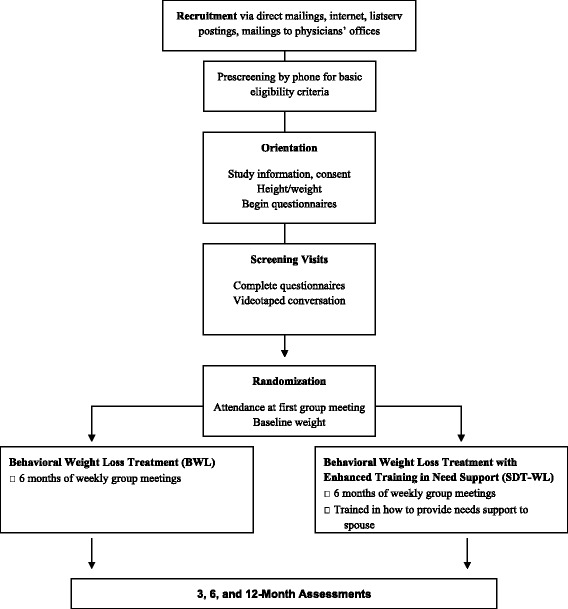
Methods: Project TEAMS (Talking about Eating, Activity, and Mutual Support) is a randomized controlled trial testing a couples-based intervention, grounded in SDT, designed to change the social context of weight loss by training spouses to provide needs support for each other's eating and physical activity behavior. Sixty-four couples will be randomized to either 6 months of behavioral weight loss treatment informed by SDT (SDT-WL) or to 6 months of standard behavioral weight loss treatment (BWL). Couples will attend weekly sessions for 6 months and will be assessed at 0, 3, 6, and 12 months. By bolstering needs support, SDT-WL is predicted to increase autonomous self-regulation and perceived competence and produce greater weight loss and maintenance than standard behavioral treatment. Exploratory analyses will examine the SDT process model prediction that the influence of needs support on treatment outcomes will be mediated by autonomous self-regulation and perceived competence.
Discussion: This study addresses the fundamental importance of interpersonal support in weight management by focusing on couples rather than individuals and using a rich theoretical framework to train spouses in supportive behaviors.
Trial registration: Clinicaltrials.gov ; NCT02570009 .
Keywords: Couples; Dyadic weight management; Home environment; Self-Determination Theory; Social support.
Conflict of interest statement
Ethics approval and consent to participate
This protocol was approved by the University of Connecticut’s Institutional Review Board (reference # H15–017).
Consent for publication
Not applicable.
Competing interests
The authors declare that they have no competing interests.
Publisher’s Note
Springer Nature remains neutral with regard to jurisdictional claims in published maps and institutional affiliations.
References
Publication types
MeSH terms
Associated data
Grants and funding
LinkOut - more resources
Full Text Sources
Other Literature Sources
Medical
