


Comprehensive Metabolomic Profiling and Incident Cardiovascular Disease: A Systematic Review
- PMID: 28963102
- PMCID: PMC5721826
- DOI: 10.1161/JAHA.117.005705
Comprehensive Metabolomic Profiling and Incident Cardiovascular Disease: A Systematic Review
Abstract
Background: Metabolomics is a promising tool of cardiovascular biomarker discovery. We systematically reviewed the literature on comprehensive metabolomic profiling in association with incident cardiovascular disease (CVD).
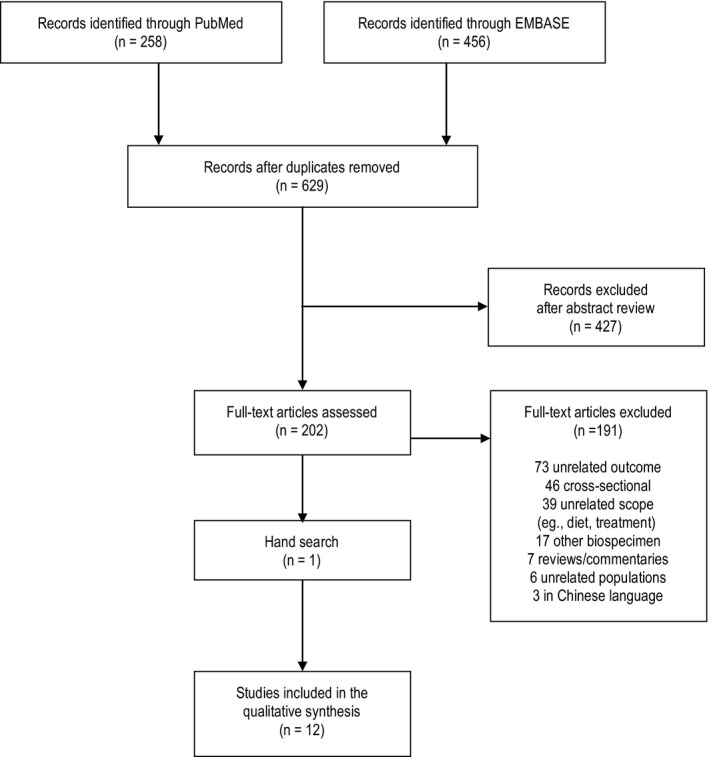
Methods and results: We searched MEDLINE and EMBASE from inception to January 2016. Studies were eligible if they pertained to adult humans; followed an agnostic and/or comprehensive approach; used serum or plasma (not urine or other biospecimens); conducted metabolite profiling at baseline in the context of examining prospective disease; and included myocardial infarction, stroke, and/or CVD death in the CVD outcome definition. We identified 12 original articles (9 cohort and 3 nested case-control studies); participant numbers ranged from 67 to 7256. Mass spectrometry was the predominant analytical method. The number and chemical diversity of metabolites were very heterogeneous, ranging from 31 to >10 000 features. Four studies used untargeted profiling. Different types of metabolites were associated with CVD risk: acylcarnitines, dicarboxylacylcarnitines, and several amino acids and lipid classes. Only tiny improvements in CVD prediction beyond traditional risk factors were observed using these metabolites (C index improvement ranged from 0.006 to 0.05).
Conclusions: There are a limited number of longitudinal studies assessing associations between comprehensive metabolomic profiles and CVD risk. Quantitatively synthesizing the literature is challenging because of the widely varying analytical tools and the diversity of methodological and statistical approaches. Although some results are promising, more research is needed, notably standardization of metabolomic techniques and statistical approaches. Replication and combinations of novel and holistic methodological approaches would move the field toward the realization of its promise.
Keywords: epidemiology; metabolomics; myocardial infarction; stroke.
© 2017 The Authors. Published on behalf of the American Heart Association, Inc., by Wiley.
References
-
- Mozaffarian D, Benjamin EJ, Go AS, Arnett DK, Blaha MJ, Cushman M, Das SR, de Ferranti S, Després J‐P, Fullerton HJ, Howard VJ, Huffman MD, Isasi CR, Jiménez MC, Judd SE, Kissela BM, Lichtman JH, Lisabeth LD, Liu S, Mackey RH, Magid DJ, McGuire DK, Mohler ER, Moy CS, Muntner P, Mussolino ME, Nasir K, Neumar RW, Nichol G, Palaniappan L, Pandey DK, Reeves MJ, Rodriguez CJ, Rosamond W, Sorlie PD, Stein J, Towfighi A, Turan TN, Virani SS, Woo D, Yeh RW, Turner MB. Heart disease and stroke statistics—2016 update: a report from the American Heart Association. Circulation. 2016;133:e38–e60. - PubMed
-
- Roth GA, Nguyen G, Forouzanfar MH, Mokdad AH, Naghavi M, Murray CJL. Estimates of global and regional premature cardiovascular mortality in 2025. Circulation. 2015;132:1270–1282. - PubMed
-
- Taegtmeyer H, Young ME, Lopaschuk GD, Abel ED, Brunengraber H, Darley‐Usmar V, Des Rosiers C, Gerszten R, Glatz JF, Griffin JL, Gropler RJ, Holzhuetter H‐G, Kizer JR, Lewandowski ED, Malloy CR, Neubauer S, Peterson LR, Portman MA, Recchia FA, Van Eyk JE, Wang TJ. Assessing cardiac metabolism. A scientific statement from the American Heart Association. Circ Res. 2016;118:1659–1701. - PMC - PubMed
Publication types
MeSH terms
Substances
Grants and funding
LinkOut - more resources
Full Text Sources
Other Literature Sources
