


The peak frequency of motor-related gamma oscillations is modulated by response competition
- PMID: 28966082
- PMCID: PMC5826720
- DOI: 10.1016/j.neuroimage.2017.09.059
The peak frequency of motor-related gamma oscillations is modulated by response competition
Abstract
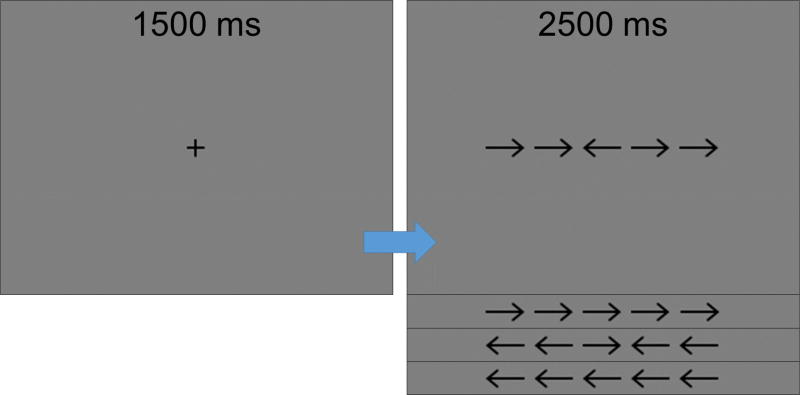
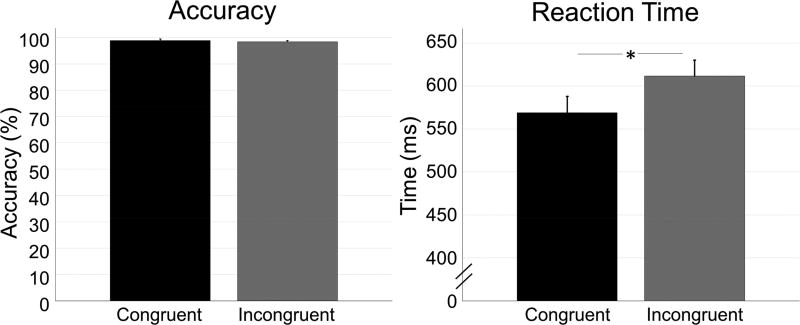
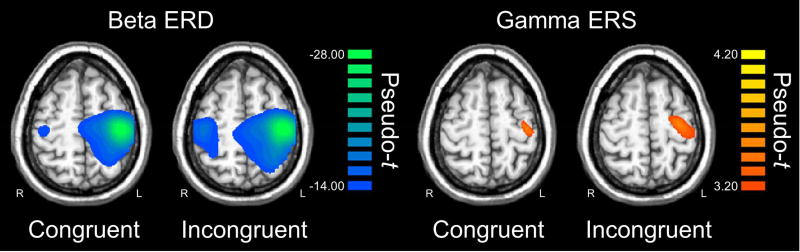
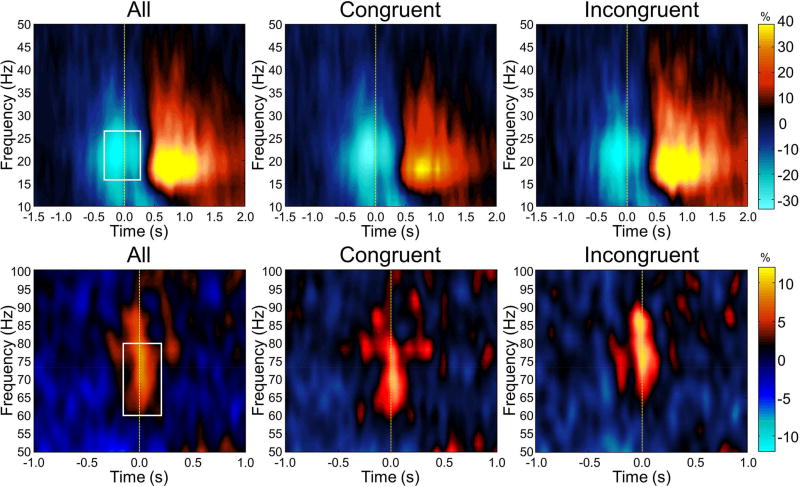
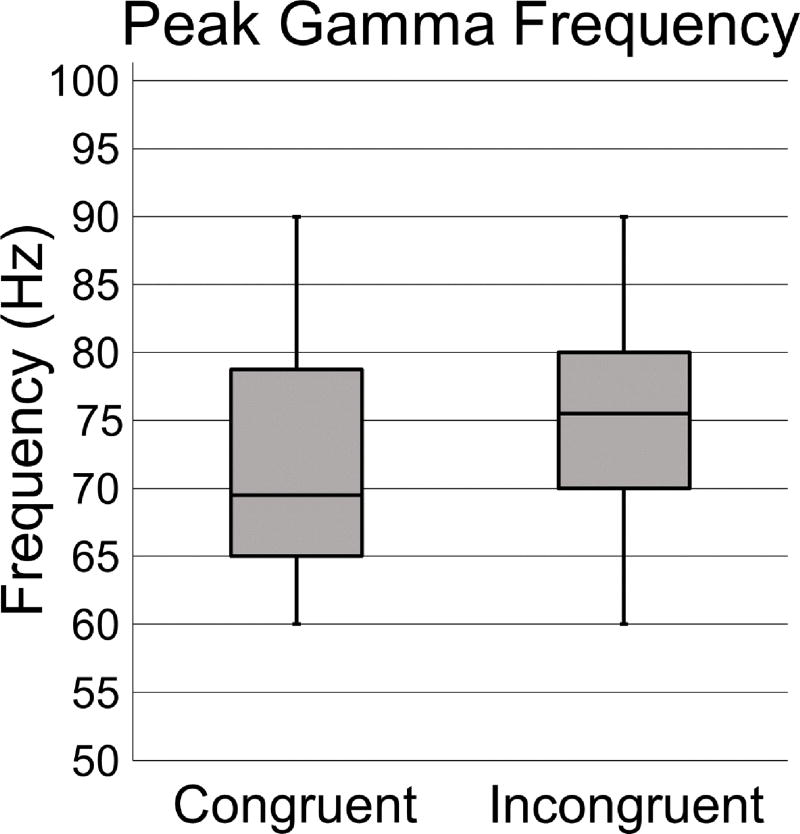
Movement execution generally occurs in an environment with numerous distractors, and requires the selection of a motor plan from multiple possible alternatives. However, the impact of such distractors on cortical motor function during movement remains largely unknown. Previous studies have identified two movement-related oscillatory responses that are critical to motor planning and execution, and these responses include the peri-movement beta event-related desynchronization (ERD) and the movement-related gamma synchronization (MRGS). In the current study, we investigate how visual distractors cuing alternative movements modulate the beta ERD and MRGS responses. To this end, we recorded magnetoencephalography (MEG) during an arrow-based version of the Eriksen flanker task in 42 healthy adults. All MEG data were transformed in to the time-frequency domain and the beta ERD and MRGS responses were imaged using a beamformer. Virtual sensors (voxel time series) were then extracted from the peak voxels of each response for the congruent and incongruent flanker conditions separately, and these data were examined for conditional differences during the movement. Our results indicated that participants exhibited the classic "flanker effect," as they responded significantly slower during incongruent relative to congruent trials. Our most important MEG finding was a significant increase in the peak frequency of the MRGS in the incongruent compared to the congruent condition, with no conditional effect on response amplitude. In addition, we found significantly stronger peri-movement beta ERD responses in the ipsilateral motor cortex during incongruent compared to congruent trials, but no conditional effect on frequency. These data are the first to show that the peak frequency of the MRGS response is linked to the task parameters, and varies from trial to trial in individual participants. More globally, these data suggest that beta and gamma oscillations are modulated by visual distractors causing response competition.
Keywords: Beta ERD; Flanker; MEG; Magnetoencephalography; Movement; Oscillations.
Copyright © 2017 Elsevier Inc. All rights reserved.
Conflict of interest statement
Figures
References
-
- Alegre M, Alvarez-Gerriko I, Valencia M, Iriarte J, Artieda J. Oscillatory changes related to the forced termination of a movement. Clin Neurophysiol. 2008;119:290–300. - PubMed
-
- Alegre M, Gurtubay IG, Labarga A, Iriarte J, Malanda A, Artieda J. Alpha and beta oscillatory changes during stimulus-induced movement paradigms: effect of stimulus predictability. Neuroreport. 2003;14:381–385. - PubMed
-
- Alegre M, Gurtubay IG, Labarga A, Iriarte J, Valencia M, Artieda J. Frontal and central oscillatory changes related to different aspects of the motor process: a study in go/no-go paradigms. Exp Brain Res. 2004;159:14–22. - PubMed
-
- Botvinick M, Nystrom LE, Fissell K, Carter CS, Cohen JD. Conflict monitoring versus selection-for-action in anterior cingulate cortex. Nature. 1999;402:179–181. - PubMed
-
- Bunge SA, Hazeltine E, Scanlon MD, Rosen AC, Gabrieli JD. Dissociable contributions of prefrontal and parietal cortices to response selection. Neuroimage. 2002;17:1562–1571. - PubMed
Publication types
MeSH terms
Grants and funding
LinkOut - more resources
Full Text Sources
Other Literature Sources
