. 2018 Jan;39(1):40-51.
doi: 10.1002/humu.23334. Epub 2017 Oct 17.

HUMA: A platform for the analysis of genetic variation in humans

Affiliations

HUMA: A platform for the analysis of genetic variation in humans

David K Brown et al. Hum Mutat. 2018 Jan.

Abstract

The completion of the human genome project at the beginning of the 21st century, along with the rapid advancement of sequencing technologies thereafter, has resulted in exponential growth of biological data. In genetics, this has given rise to numerous variation databases, created to store and annotate the ever-expanding dataset of known mutations. Usually, these databases focus on variation at the sequence level. Few databases focus on the analysis of variation at the 3D level, that is, mapping, visualizing, and determining the effects of variation in protein structures. Additionally, these Web servers seldom incorporate tools to help analyze these data. Here, we present the Human Mutation Analysis (HUMA) Web server and database. HUMA integrates sequence, structure, variation, and disease data into a single, connected database. A user-friendly interface provides click-based data access and visualization, whereas a RESTful Web API provides programmatic access to the data. Tools have been integrated into HUMA to allow initial analyses to be carried out on the server. Furthermore, users can upload their private variation datasets, which are automatically mapped to public data and can be analyzed using the integrated tools. HUMA is freely accessible at https://huma.rubi.ru.ac.za.

Keywords: HUMA; SNP; downstream variant analysis; protein variants; structural bioinformatics; variation database.


Figures

Figure 1
Figure 1
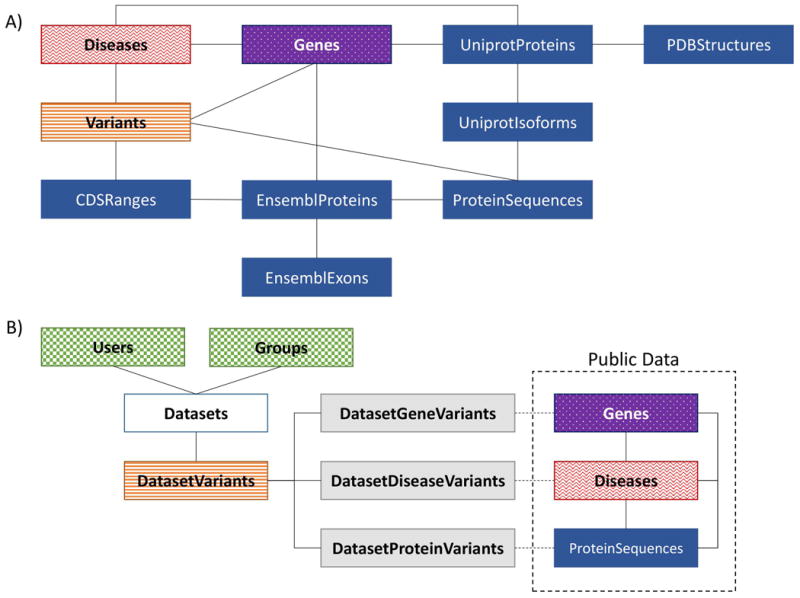
A) Public database design – a simplified design of the public HUMA database. The database is divided into four sections: proteins (blue/dark solid), variants (orange/horizontal stripes), diseases (red/waves), and genes (purple/dotted). B) Private database design – private data is stored in a separate database. Public proteins, genes, and disease are linked to private variants (orange/horizontal stripes) during the mapping process when the variants are first uploaded. These links are stored in the “connector” tables (grey/light solid). Dataset (white) ownership and sharing is managed via the account tables (green/checkered).
Figure 2
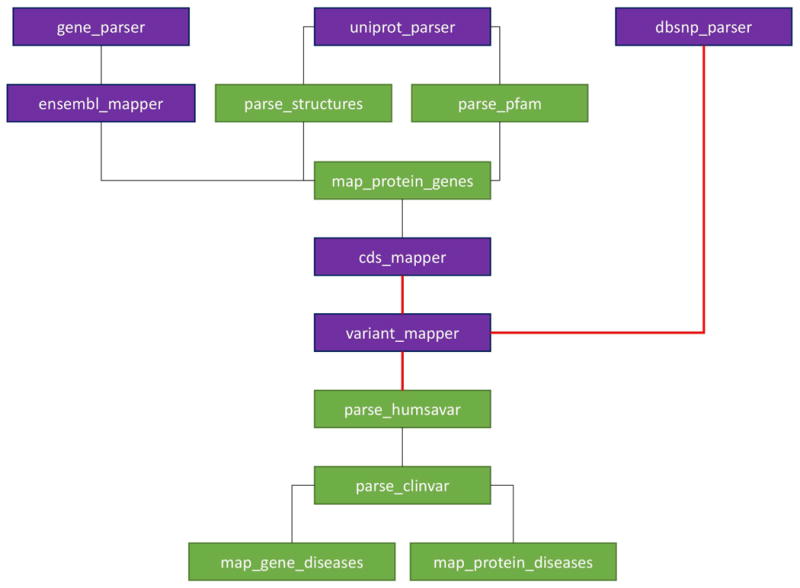
Figure 2. Database population workflow
The workflow for populating the database. Blocks represent scripts that parse data files and populate the database with that data. Dark (purple) blocks represent parsers written in C++ while light (green) blocks represent Python scripts. Red/bold lines represent a part of the workflow that cannot be automated i.e. manual intervention is required.
Figure 3
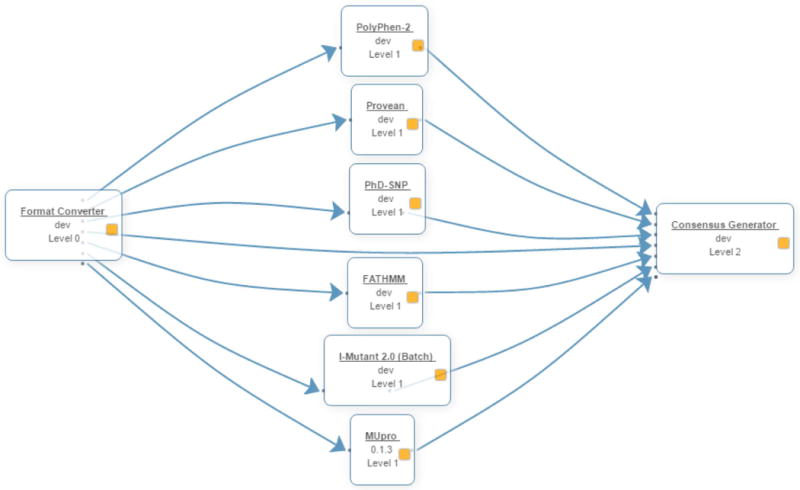
Figure 3. VAPOR workflow
The VAPOR workflow consists of three stages. Firstly, user input is converted into the various formats required by the prediction tools. The predictions are then executed and the results are merged at the last stage.
Figure 4
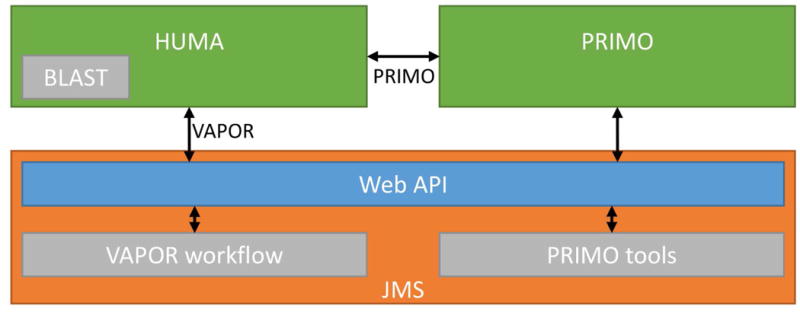
Figure 4. Tool integration via JMS
Tools are integrated via the JMS workflow management system, which provides a RESTful web API that allows external servers, such as HUMA, to access it. In the case of PRIMO, HUMA accesses the PRIMO API, which accesses the JMS API.
Figure 5
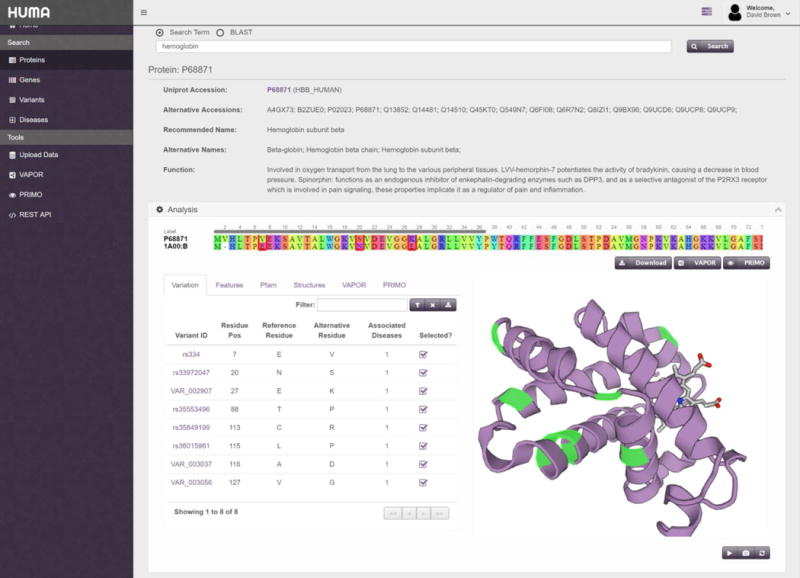
Figure 5. Protein detail page
Detailed result page for P68871. Selected variants are highlighted in the protein structure and outlined in the alignment. Only the “Analysis” block is visible in this screenshot.
Figure 6
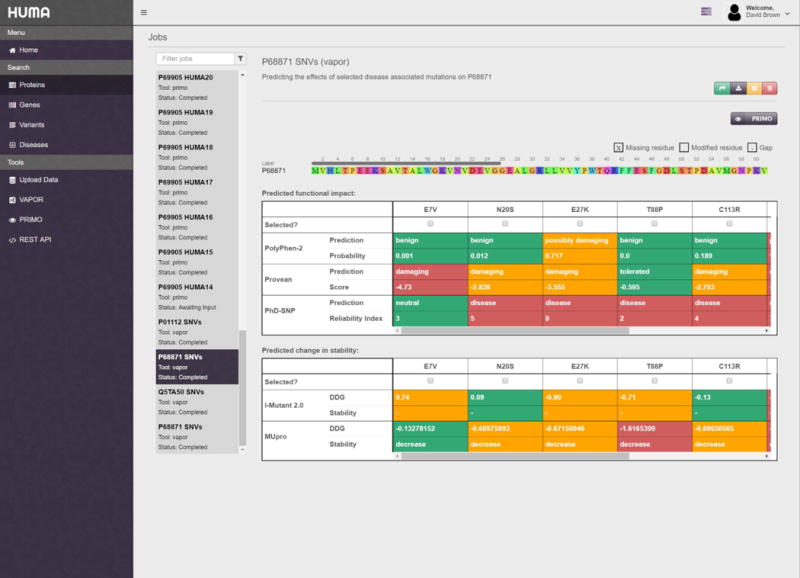
Figure 6. VAPOR results page
Results are split into two tables, the first of which contains functional predictions and the second of which contains stability predictions. From here, specific mutations can be selected and modeled into the protein structure using PRIMO.

References

    1. Adzhubei IA, Schmidt S, Peshkin L, Ramensky VE, Gerasimova A, Bork P, Kondrashov AS, Sunyaev SR. A method and server for predicting damaging missense mutations. Nat Methods. 2010;7:248–249. - PMC - PubMed
    1. Apweiler R. UniProt: the Universal Protein knowledgebase. Nucleic Acids Res. 2004;32:115D–119. - PMC - PubMed
    1. Berman HM, Westbrook J, Feng Z, Gilliland G, Bhat TN, Weissig H, Shindyalov IN, Bourne PE. The Protein Data Bank. Nucleic Acids Res. 2000;28:235–242. - PMC - PubMed
    1. Béroud C, Letovsky SI, Braastad CD, Caputo SM, Beaudoux O, Bignon YJ, Bressac-De Paillerets B, Bronner M, Buell CM, Collod-Béroud G, Coulet F, Derive N, et al. BRCA Share: A Collection of Clinical BRCA Gene Variants. Hum Mutat. 2016;37:1318–1328. - PubMed
    1. Bouaoun L, Sonkin D, Ardin M, Hollstein M, Byrnes G, Zavadil J, Olivier M. TP53 Variations in Human Cancers: New Lessons from the IARC TP53 Database and Genomics Data. Hum Mutat. 2016;37:865–876. - PubMed

Publication types

LinkOut - more resources